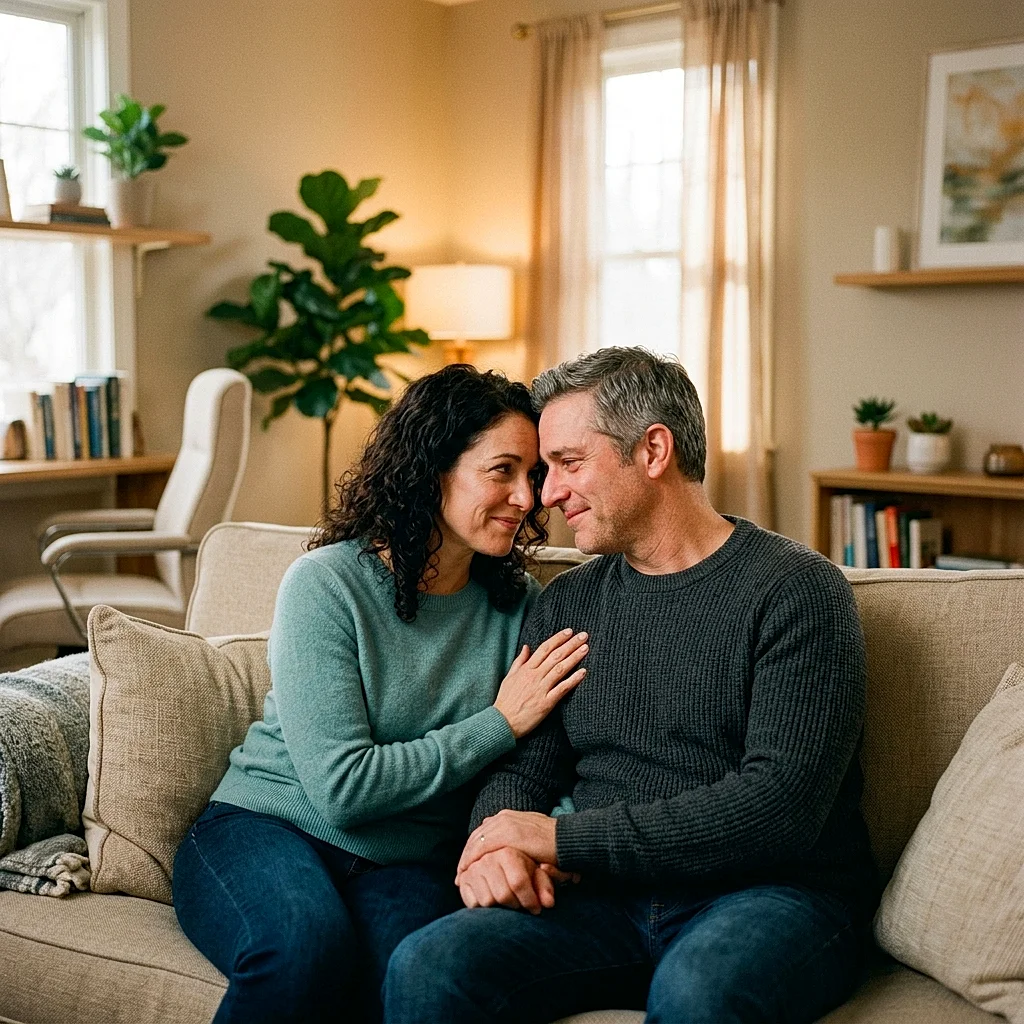
Emotionally Focused Couples Therapy: How EFT Helps Partners Reconnect When Nothing Else Has Worked
We'd tried everything. Date nights. Communication books. A weekend marriage retreat where we made vision boards and held hands during group prayer. We'd even tried the "just talk more" advice that every well-meaning friend seemed to offer, as if the problem was volume rather than the fact that every conversation we had ended the same way.
I'd bring up something that bothered me. She'd get defensive. I'd get louder. She'd shut down. I'd interpret her silence as not caring. She'd interpret my intensity as attacking. We'd retreat to separate corners of the apartment, both convinced that the other person simply didn't understand.
That cycle — pursue, defend, withdraw, repeat — had been running our marriage for three years. We could describe it perfectly. We just couldn't stop it.
Then our therapist said something that changed everything: "The problem isn't that you're fighting. The problem is that underneath the fighting, you're both terrified of the same thing — losing each other. You're just expressing that fear in opposite ways."
That was my introduction to emotionally focused couples therapy. And within four months, a marriage I was mentally preparing to leave had become something I couldn't imagine living without.
This guide explains what EFT is, how it works, why it has the highest success rate of any couples therapy approach, and how to know if it's right for you.
What Is Emotionally Focused Couples Therapy?
Emotionally focused therapy (EFT) — sometimes written as emotionally focussed couples therapy — is a structured, short-term approach to couples therapy developed by Dr. Sue Johnson and Dr. Les Greenberg in the 1980s. It's built on a single, powerful premise: the quality of your emotional bond with your partner is the most important factor in whether your relationship thrives or fails.
That might sound obvious, but most couples therapy approaches focus on different things — communication skills, conflict resolution techniques, compromise strategies. Those are useful tools. But EFT argues that they don't work sustainably unless the underlying emotional connection is secure. Teaching a disconnected couple to "communicate better" is like teaching someone to swim while the pool is on fire. The technique isn't the issue. The environment is.
EFT works by helping couples:
- Identify the negative cycles that are driving their conflicts (pursue-withdraw, attack-attack, withdraw-withdraw)
- Access the deeper emotions underneath those cycles (fear, loneliness, shame, the terror of being abandoned)
- Express those emotions to each other in a way that creates connection instead of escalation
- Restructure the emotional bond so that both partners feel safe, seen, and securely attached
The result? Couples stop fighting about dishes and start talking about what's actually going on — the fear that they don't matter to each other, the grief over lost closeness, the desperate need to know "are you there for me?"
The Science Behind EFT: Why It Works Better Than Other Approaches
EFT isn't based on theories about what should work in relationships. It's based on attachment science — one of the most researched areas in all of psychology.
Attachment Theory in 60 Seconds
In the 1960s, psychologist John Bowlby discovered something fundamental about human beings: we are wired — neurologically, biologically, evolutionarily — to form deep emotional bonds with a small number of people. As infants, we bond with our caregivers. As adults, our primary attachment figure becomes our romantic partner.
When that bond feels secure — when we trust that our partner is accessible, responsive, and emotionally engaged — we function at our best. We're calmer, more confident, more resilient, more creative. We can handle stress, navigate conflict, and take risks because we know someone has our back.
When that bond feels threatened — when our partner seems distant, dismissive, unavailable, or unpredictable — our attachment system goes into alarm mode. We become anxious, angry, clingy, or withdrawn. Not because we're "crazy" or "needy," but because our brain is doing exactly what it evolved to do: fight to maintain the bond that keeps us safe.
This is the key insight of EFT: most relationship conflicts aren't actually about the topic being argued about. They're about the security of the bond.
When she says "you never help around the house," what she's often really saying is "do I matter to you?" When he goes silent during an argument, he's often not being dismissive — he's overwhelmed by the fear that nothing he does is good enough. Both partners are reacting to the same underlying threat: the possibility that the connection is breaking.
The Research on EFT Effectiveness
EFT is the most empirically validated couples therapy approach in existence. The numbers are striking:
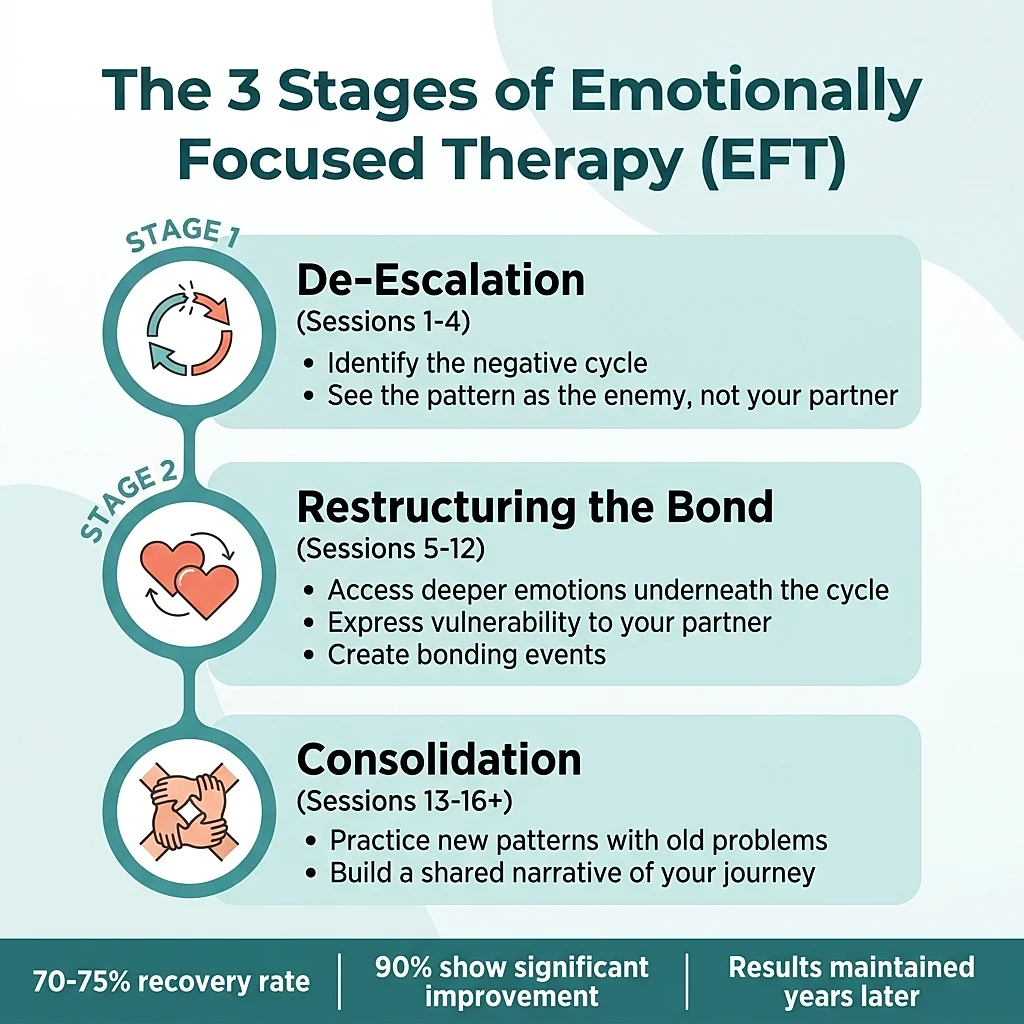
- 70-75% of couples move from distress to recovery after a full course of EFT
- 90% of couples show significant improvement
- Results hold up over time — follow-up studies show that improvements are maintained years after therapy ends
- EFT has been validated across diverse populations — different cultures, ethnicities, income levels, and relationship structures
- It's effective for couples dealing with depression, PTSD, chronic illness, infidelity, and attachment injuries
No other couples therapy approach has this depth of empirical support. The Gottman Method comes close, and it's excellent — but EFT's recovery rates are consistently the highest in the field.
The Three Stages of Emotionally Focused Couples Therapy
EFT follows a clear, structured process with three stages and nine steps. Here's what each stage looks like from the inside — not as a textbook description, but as what you'll actually experience sitting on that couch.
Stage 1: De-Escalation (Sessions 1-4)
This is where you map the enemy. And the enemy isn't your partner — it's the cycle.
In the first few sessions, your therapist will help you identify the specific negative pattern that's been running your relationship. There are a few common ones:
Pursue-Withdraw. One partner pushes for connection (criticizing, demanding, escalating) while the other pulls away (shutting down, going silent, leaving the room). The pursuer gets louder because the withdrawer seems to not care. The withdrawer gets quieter because the pursuer seems angry and unsafe. Both are trying to cope with the same fear — disconnection — in opposite ways.
Attack-Attack. Both partners escalate simultaneously. Every conversation becomes a battle where both people are fighting to be heard, and neither one is listening.
Withdraw-Withdraw. Both partners have given up trying. The relationship is polite, distant, and emotionally dead. No fighting, but no connection either.
Your therapist will help you see the cycle as the problem — not your partner. This is a critical shift. When you stop seeing your spouse as the enemy and start seeing the pattern as the enemy, everything changes. You're no longer fighting each other. You're fighting the cycle together.
By the end of Stage 1, you should be able to say: "There it is. There's our cycle happening again." That awareness alone starts to break its power.
Stage 2: Restructuring the Bond (Sessions 5-12)
This is the heart of EFT — and the hardest part.
In Stage 2, your therapist will help you access the emotions underneath the cycle. Not the surface emotions (anger, frustration, irritation) but the deeper ones that are driving them (fear, sadness, loneliness, shame, the terror of not being enough).
This is where the magic happens, but it doesn't feel like magic at the time. It feels terrifying. Because the therapist will guide you to say things like:
"When you go quiet, I feel like I'm screaming into a void. Like I could disappear and you wouldn't notice. And that scares me more than anything."
"When you come at me with that tone, I freeze because I feel like no matter what I say, it won't be right. I'm so afraid of failing you that I just... stop trying."
These aren't criticisms. They're vulnerabilities. And when one partner expresses genuine vulnerability and the other partner responds to it with empathy and care — that's when the bond starts to restructure. That moment of reaching out and being met is what Dr. Johnson calls a "bonding event." It's the turning point of therapy.
Stage 2 involves two major moves:
The withdrawer re-engages. The partner who typically shuts down finds the courage to express what's happening underneath the silence. Usually it's not apathy — it's overwhelming fear of making things worse. When they can say that out loud, and their partner hears it, the pursuer's entire understanding shifts.
The pursuer softens. The partner who typically escalates drops the criticism and expresses the raw need underneath. Not "you never listen to me" but "I need to know I matter to you. I need to know you're there." When this happens, the withdrawer often opens up in ways they never have before — because the fear that drove their withdrawal has been replaced by an invitation to connect.
Stage 3: Consolidation (Sessions 13-16+)
In the final stage, you practice what you've learned. You revisit old problems through the new emotional lens. Issues that used to trigger the destructive cycle are now navigated differently — not because you've learned a technique, but because the emotional landscape has changed.
You also develop a shared narrative of what happened in therapy. "We used to get stuck in pursue-withdraw, and we both thought the other person was the problem. Now we know we were both just scared of losing each other."
This narrative becomes a tool in itself. When the old cycle starts to creep back — and it will occasionally, because you're human — you can recognize it and name it before it takes over. "I think we're doing the thing. I'm withdrawing because I'm overwhelmed, not because I don't care. Can we try this differently?"
What an EFT Session Actually Looks Like
If you've never been to couples therapy, the idea of sitting in a room talking about your feelings with a stranger is... not appealing. So here's a realistic picture of what happens.
The Room
Usually a comfortable office with a couch (or two chairs) for the couple and a chair for the therapist. Some therapists have tissues prominently placed, which tells you everything you need to know about how these sessions tend to go.
The Format
Sessions are typically 50-75 minutes, weekly or biweekly. The therapist guides the conversation — this isn't a free-form venting session. They'll slow things down, redirect when cycles start to emerge, and ask questions designed to access deeper emotions.
A typical session might flow like this:
- Check-in (5-10 minutes) — How has the week been? What came up between sessions?
- Exploration (30-40 minutes) — The therapist identifies a moment or pattern from the week and helps the couple explore the emotions underneath it. They might focus on one partner at a time, asking questions like: "When that happened, what was going on for you inside?" "What did you need from her in that moment?" "What stopped you from saying that?"
- Enactment (10-15 minutes) — The therapist guides one partner to turn to the other and express what they've just uncovered. "Can you tell him what you just told me? Can you look at him and say 'I needed you to see that I was hurting'?"
- Debrief (5 minutes) — How did that feel? What's different now?
What It Feels Like
Honest answer? Uncomfortable. Especially in the beginning. You're being asked to be vulnerable in a way that most of us have spent our entire lives avoiding. You might cry. Your partner might cry. You might feel exposed, embarrassed, or scared.
But here's what I noticed after the first few sessions: the discomfort was productive. Unlike the discomfort of arguing at home — which led nowhere — the discomfort in therapy led somewhere specific. It led to understanding. To moments of connection that hadn't happened in years. To my wife looking at me and saying "I didn't know that's what was going on for you," and meaning it.
Those moments are worth every second of awkwardness.
Who Is EFT Best For?
EFT isn't for every situation. Here's where it shines — and where other approaches might be better suited.
EFT Is Ideal For:
- Couples caught in repetitive negative cycles — pursue-withdraw, attack-defend, mutual shutdown
- Emotional disconnection — feeling like roommates rather than partners
- Recovering from infidelity — EFT has a specific protocol (Attachment Injury Resolution Model) for processing betrayal
- Couples where one or both partners struggle to be vulnerable — EFT creates the safety needed for emotional risk-taking
- Depression or anxiety affecting the relationship — EFT addresses the relational context of individual mental health issues
- Couples who've tried other therapy and it didn't work — often because the other approaches focused on behavior without addressing the emotional bond underneath
EFT May Not Be the Best Fit For:
- Active domestic violence — safety must be established before emotional vulnerability work can happen. Individual therapy and safety planning come first
- Active untreated addiction — the addiction needs to be addressed alongside or before couples work
- Couples where one partner has already decided to leave — EFT requires both partners to be open to reconnection. Discernment counseling may be more appropriate if one partner has one foot out the door
EFT vs. Other Couples Therapy Approaches
There are several excellent approaches to couples therapy. Here's how EFT compares:
EFT vs. The Gottman Method
Both are evidence-based and effective. The Gottman Method focuses on building friendship, managing conflict through specific skills (soft startups, repair attempts, compromise), and creating shared meaning. EFT focuses on the emotional bond and attachment security. Think of Gottman as more "skills-based" and EFT as more "emotion-based." Many therapists integrate elements of both.
EFT vs. Cognitive Behavioral Couples Therapy (CBCT)
CBCT targets distorted thinking patterns — the assumptions and interpretations that fuel conflict. It's practical and structured. EFT goes deeper into the emotional layer underneath those thoughts. CBCT might help you change the thought "she doesn't care about me." EFT helps you express the fear underneath that thought and have your partner respond to it.
EFT vs. Traditional Marriage Counseling
Traditional counseling often focuses on problem-solving — negotiating compromises, improving communication skills, managing specific issues. EFT addresses the emotional foundation that makes all of those things possible. You can learn every communication technique in the world, but if you don't feel emotionally safe with your partner, you won't use them.
How Long Does EFT Take? (And How Much Does It Cost?)
Duration
A typical course of EFT runs 8-20 sessions, with most couples completing therapy in about 12-16 sessions. Sessions are usually weekly, so you're looking at roughly 3-5 months.
Some couples need fewer sessions (especially if they catch the cycle early). Some need more (particularly if there's been a major attachment injury like infidelity or if one partner has significant individual trauma). Your therapist will discuss expectations during the initial assessment.
Cost
- Private practice EFT therapist: $150-$300 per session (EFT certification requires extensive post-graduate training, which is reflected in fees)
- Online EFT therapy: $100-$200 per session
- Community counseling centers: $50-$100 per session (sliding scale available)
- EFT intensives: $2,000-$6,000 for a concentrated multi-day format
For a full course of 12-16 sessions at average private-practice rates, expect to invest roughly $2,000-$4,500. That's significant. It's also a fraction of what emotional disconnection, divorce, or years of continued suffering would cost — financially and otherwise.
How to Find a Qualified EFT Therapist
Not every therapist who says they "use EFT" is actually trained in it. The difference matters.
Certification Levels
The International Centre for Excellence in Emotionally Focused Therapy (ICEEFT) — founded by Dr. Sue Johnson — maintains a certification system:
- Externship-trained: Completed the foundational 4-day EFT training. This is the minimum — they understand the model but may not have deep experience applying it
- Certified EFT Therapist (CEEFT): Completed the externship PLUS extensive supervised practice, case reviews, and demonstrated mastery. This is the gold standard
- Certified EFT Supervisor/Trainer: Advanced practitioners who train and supervise other EFT therapists
When searching for a therapist, ask specifically: "What is your level of EFT training?" A certified EFT therapist will produce measurably better outcomes than someone who's read about EFT or attended a weekend workshop.
Where to Search
- ICEEFT Therapist Directory — the official directory of trained EFT therapists worldwide
- Psychology Today — filter by "Emotionally Focused" under therapeutic approach
- LoveConnet — our platform connects couples with verified relationship counselors, including EFT-trained therapists. Browse our counselor directory
- Your insurance provider's directory — search for therapists who list EFT as a specialty
Questions to Ask
- "What is your level of EFT training — externship, certified, or supervisor?"
- "How many couples have you treated with EFT specifically?"
- "Do you use the full EFT model, or do you integrate EFT with other approaches?"
- "What does a typical course of treatment look like with you?"
For EFT Therapists: Growing Your Practice
If you're a trained EFT therapist, here's what the market looks like:
- 23,900+ people search for emotionally focused couples therapy every month
- That number is growing by 87% year over year — demand is exploding
- Online therapy has removed geographic limitations, meaning you can serve couples anywhere
- EFT's evidence base makes it increasingly sought after by informed consumers who research before booking
Couples are actively looking for trained EFT therapists. LoveConnet connects certified relationship counselors with couples seeking evidence-based support. If you want to reach couples who specifically want EFT — apply to join our therapist network.
Frequently Asked Questions About Emotionally Focused Couples Therapy
What does "emotionally focused" mean?
It means the therapy focuses on emotions as the primary driver of relationship patterns. Rather than focusing on thoughts (like CBT) or behaviors (like behavioral therapy), EFT targets the emotional responses that create the cycles couples get stuck in. The premise is that when partners can access and share their core emotions — particularly attachment-related fears and needs — the relationship naturally shifts toward greater security and connection.
Is EFT the same as "tapping" (Emotional Freedom Techniques)?
No. Despite the similar acronym, Emotionally Focused Therapy and Emotional Freedom Techniques are completely different approaches. EFT for couples is a research-backed form of psychotherapy focused on attachment bonds. "Tapping" is an alternative healing practice that involves tapping on acupressure points. They share nothing except three letters.
Can EFT help after infidelity?
Yes. EFT has a specific protocol — the Attachment Injury Resolution Model (AIRM) — designed specifically for processing betrayals of trust. It helps the injured partner express the full depth of their pain and the offending partner take genuine responsibility and provide the reassurance needed for healing. Research shows EFT is highly effective for couples recovering from affairs, with many achieving full recovery of trust and intimacy.
What if my partner won't show emotion?
That's actually one of the situations where EFT excels. Many people — particularly those with avoidant attachment styles — have learned to suppress emotion as a survival strategy. EFT doesn't force emotion. It creates the safety conditions where emotion can emerge naturally. Your therapist will work patiently with the less expressive partner, helping them access what's going on beneath the surface at their own pace.
How is EFT different from regular couples counseling?
"Regular" couples counseling often focuses on practical skills — communication techniques, compromise strategies, conflict management. EFT goes to the emotional layer underneath. It asks: why do you fight the way you fight? What are you really feeling when you shut down or escalate? What do you actually need from your partner that you've been afraid to ask for? The practical skills become much easier once the emotional foundation is secure.
Does EFT work for unmarried couples?
Absolutely. EFT works for any committed couple — married, engaged, cohabiting, dating seriously. The attachment dynamics are the same regardless of legal status. If you're in a committed relationship and struggling with emotional disconnection or destructive conflict patterns, EFT applies to you.
What's the success rate of EFT?
EFT has the strongest evidence base of any couples therapy approach. Research consistently shows 70-75% of couples move from distress to recovery, and approximately 90% show significant improvement. Uniquely, follow-up studies demonstrate that these gains are maintained — and often continue to improve — after therapy ends.
The Moment That Changes Everything
There's a moment in almost every EFT process that both partners remember for the rest of their lives. Dr. Johnson calls it a "softening" — the moment when the pursuing partner drops the armor of criticism and says, with complete vulnerability, what they actually need.
In my case, it was my wife looking at me with tears in her eyes and saying: "I don't need you to be perfect. I just need to know you're not going to leave. That when things get hard, you'll stay. Because every time you shut down, a part of me thinks this is the time you're done with me."
I'd had no idea she felt that way. I thought my silence was protecting her from my frustration. She experienced it as abandonment. We'd been hurting each other for years using the exact strategies we thought were keeping the peace.
That moment — the vulnerability, the being met, the sudden understanding — is what EFT builds toward. It doesn't happen in session one. It can't be forced or faked. But when it happens, it rewires something fundamental between two people.
The cycle doesn't have the last word. Your fear doesn't get to run the show. The bond — the one that's been there all along, buried under layers of self-protection and misunderstanding — finally gets to breathe.
That's what emotionally focused couples therapy offers. Not a perfect relationship. Not the absence of conflict. But a relationship where both people feel safe enough to be fully human — and fully loved anyway.
If that sounds like what you've been looking for, find a trained EFT therapist and take the first step. The cycle you've been stuck in isn't permanent. It just needs someone to help you see it, name it, and choose something different.
Related Reading
- Relationship Counseling: Everything You Need to Know Before Your First Session
- Christian Marriage Counseling: A Faith-Based Guide to Healing Your Relationship
- The Seven Principles for Making Marriage Work: What 40 Years of Research Tells Us
- From Doormat to Dreamgirl: How to Stop Settling and Start Getting the Love You Deserve



💬 Discussion (0)
No comments yet. Be the first to share your thoughts!