
The Seven Principles for Making Marriage Work: What 40 Years of Research Actually Tells Us
My parents celebrated their 35th wedding anniversary last year. When I asked my dad what kept them together, he shrugged and said, "We just figured it out as we went." My mom rolled her eyes. "No," she said. "I figured it out. He eventually caught on."
That exchange — the humor, the gentle ribbing, the unspoken affection underneath — is exactly what Dr. John Gottman would point to as a sign of a healthy marriage. Not perfection. Not constant agreement. Just two people who've learned how to be imperfect together without destroying each other in the process.
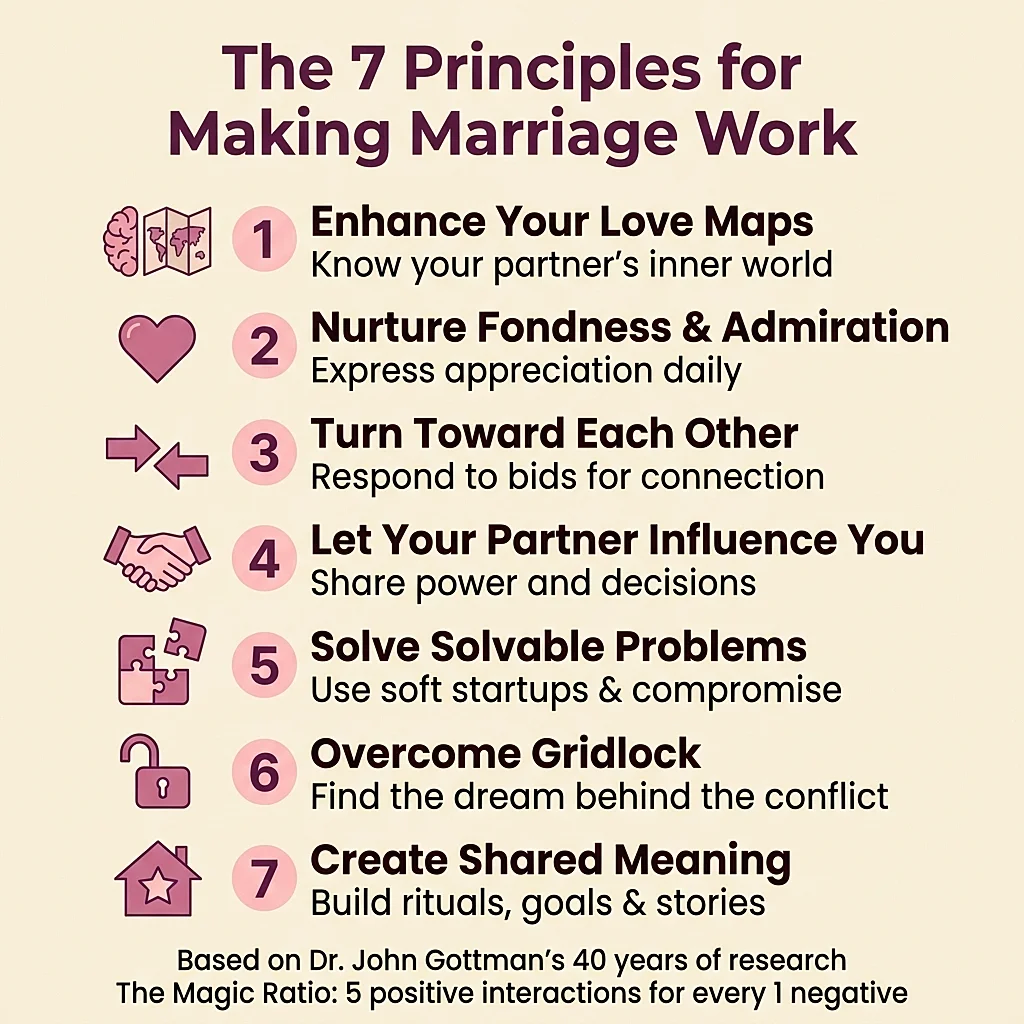
Gottman spent over 40 years studying couples at the University of Washington. He didn't work from theories or hunches. He wired couples up to heart rate monitors, recorded their conversations frame by frame, tracked their facial micro-expressions, and then followed them for decades to see who stayed together and who didn't. The result was the seven principles for making marriage work — a framework backed by the most rigorous relationship research ever conducted.
What makes his findings different from the usual "communicate better" advice? He can predict divorce with 94% accuracy. Not from personality tests or compatibility quizzes, but from watching how a couple handles a 15-minute conversation about a disagreement.
That's what this guide covers. Each of the seven principles, broken down with exercises you can use tonight, the science behind why they work, and the mistakes I see couples making when they try to apply them.
The Foundation: Why Happy Couples Still Fight
Before we get into the seven principles, there's something important to understand. Happy marriages are not conflict-free. Gottman's research showed something that surprised even him: the amount of fighting in a marriage has almost no correlation with whether the marriage survives.
Some of the happiest couples in his studies fought constantly. Some of the most miserable ones never raised their voices. The difference wasn't frequency — it was pattern.
Gottman identified four toxic communication patterns he calls the Four Horsemen of the Apocalypse:
- Criticism — going after who your partner is rather than what they did. "You never think about anyone but yourself" versus "I felt overlooked when you made plans without checking with me."
- Contempt — the single strongest predictor of divorce. Sarcasm, eye-rolling, mockery, name-calling. Anything that communicates "I'm superior to you."
- Defensiveness — responding to a complaint with a counter-complaint. "Well, you do the same thing." It shuts down any possibility of resolution.
- Stonewalling — completely withdrawing. Leaving the room mentally or physically. Going silent. Refusing to engage.
The seven principles are essentially the opposite of these patterns. They build an emotional climate where the horsemen can't survive — not by preventing conflict, but by making the relationship strong enough to handle it.
Principle 1: Enhance Your Love Maps
A "love map" is Gottman's term for the mental model you carry of your partner's inner world. Their current stresses. Their childhood memories. The colleague who drives them crazy. The dream they mentioned once at 2 AM that they've never brought up again.
When I got married, I thought I knew everything about my wife. We'd dated for three years. I could order her coffee without asking and predict which Netflix shows she'd want to watch. I figured that counted.
It doesn't. Knowing someone's coffee order is surface-level familiarity. Knowing what's keeping them up at night — that's a love map.
Gottman found that couples with detailed, current love maps weathered major life transitions dramatically better than those without them. A new baby, a job loss, a health scare — these events break couples who've stopped paying attention to each other's inner lives. The couples who kept updating their knowledge of each other? They came through stronger.
Try This Tonight
Ask your partner one of these questions over dinner. Not as a test. Just because you're curious.
- What's weighing on you the most right now?
- Is there something you've been wanting to do but haven't told me about?
- Who's the person at work you enjoy talking to the most?
- What's one thing about your day that actually went well?
The goal isn't to memorize facts. It's to stay curious about someone you see every day. Because the person you married isn't the same person sitting across from you now. People change. If you're not tracking those changes, you're slowly becoming strangers who share a mortgage.
Principle 2: Nurture Fondness and Admiration
This one sounds simple, and it is. But simple isn't the same as easy.
Fondness and admiration are the antidote to contempt. They're the undercurrent of respect that keeps a marriage alive even when everything else is hard. And Gottman discovered that as long as the fundamental sense of fondness was intact, almost everything else could be repaired. Once it was gone? The marriage was functionally over, even if both people were still living under the same roof.
Here's what's fascinating about the research: when Gottman asked couples to tell the story of how they met, happy couples told it warmly. Even couples going through a rough patch would light up when they remembered their early days. "She was wearing this ridiculous hat, and I couldn't stop staring at her."
Unhappy couples? They rewrote history. "I should have known it wouldn't work. Even back then, there were signs." Same memories. Completely different framing.
The Appreciation Habit
Gottman recommends something dead simple: once a day, tell your partner something you genuinely appreciate about them. Not something they did for you — something about who they are.
Not: "Thanks for doing the dishes."
Instead: "I noticed how patient you were with your mom on the phone earlier. I know she's a lot sometimes, and the way you handle that says a lot about who you are."
That kind of comment lands differently. It doesn't just acknowledge an action — it sees the person. And feeling seen is the foundation that fondness is built on.
If this feels awkward, that's normal. Especially if you've been in a critical pattern for a while. Start small. A text during the day: "I was thinking about you and I'm glad you're mine." You don't need a Hallmark moment. You need consistency.
Principle 3: Turn Toward Each Other Instead of Away
This is arguably the most important principle in the entire framework, and it's the one that gets overlooked the most — probably because it sounds so boring.
Gottman talks about "bids for connection." A bid is any attempt by one partner to get the other's attention, affection, support, or humor. It can be as small as:
- "Wow, look at that bird."
- A sigh while reading something on their phone.
- "You won't believe what happened at work."
- Reaching for your hand during a movie.
Each bid gets one of three responses. You either turn toward it ("Oh, which bird? Where?"), turn away from it (keep scrolling, don't look up), or turn against it ("I'm busy, can you not interrupt me?").
Gottman tracked thousands of these micro-moments. His finding was staggering: couples who stayed married turned toward each other's bids 86% of the time. Couples who divorced? 33%.
Not 50%. Not 60%. Eighty-six percent.
The difference between a lasting marriage and a failed one isn't how you handle the once-a-year blowout argument. It's whether you look up from your phone when your partner says "look at that sunset."
Why This Matters More Than Date Night
I used to think that quality time meant big planned events. A nice dinner out. A weekend trip. An anniversary surprise. Those things are great. But they're also maybe 10 occasions a year.
Bid moments happen 20, 30, 50 times a day. Over a year, that's tens of thousands of opportunities to either connect or disconnect. One fancy dinner can't offset a year of being ignored during the small moments.
The easiest, most immediate thing you can do for your marriage: put your phone face-down when your partner talks to you. That single habit communicates more than a dozen roses ever will.
Principle 4: Let Your Partner Influence You
This was one of Gottman's most surprising findings. In his studies, he discovered that marriages where one partner consistently rejected the other's influence had an 81% chance of divorce.
This isn't about being a pushover. Nobody's asking you to agree with everything your partner says or abandon your own perspective. "Letting your partner influence you" means something more specific: approaching disagreements with the genuine willingness to consider that they might have a point.
It sounds like: "I hadn't thought of it from that angle. Help me understand."
It does NOT sound like: "Fine, whatever you want." (That's capitulation, not influence, and it breeds resentment.)
And it definitely doesn't sound like: "That makes no sense. We're doing it my way."
The Practical Test
Next time you disagree about something — dinner plans, a parenting decision, how to spend the weekend — pause before you make your case. Ask your partner: "What's your thinking on this?" Then actually listen without formulating your rebuttal while they talk.
You might still disagree. That's fine. But the dynamic shifts from "me versus you" to "us figuring this out together." That shift is everything.
Gottman calls it "yielding to win." You gain more by making your partner feel heard than you ever gain by winning an argument. Because in a marriage, when one person wins an argument, both people usually lose something.
Principle 5: Solve Your Solvable Problems
Here's a number that should change how you think about conflict: 69% of the problems in your marriage will never be resolved.
That's not pessimism. That's Gottman's data. Nearly seven out of ten conflicts in a relationship are perpetual — rooted in fundamental personality differences that aren't going anywhere. One of you is a saver, the other's a spender. One needs constant social stimulation, the other recharges alone. One is chronically late, the other shows up fifteen minutes early to everything.
These aren't problems to solve. They're differences to manage. (More on that in Principle 6.)
The remaining 31%? Those are solvable. And the way you approach them matters enormously.
Gottman's Five Steps for Solvable Conflicts
1. Soften your startup. How a conversation begins predicts how it'll end about 96% of the time. If you start with "You always..." or "Why can't you just..." you've already lost. Instead: "I feel [emotion] when [specific situation], and I need [specific request]." Example: "I feel overwhelmed handling bedtime alone every night. Can we alternate?"
2. Make repair attempts. These are any moves to de-escalate tension during an argument. Humor works. ("Okay, I just sounded exactly like my father, and I'm horrified.") So does directness. ("I'm getting defensive. Let me start over.") Gottman found that the ability to make and receive repair attempts was one of the strongest predictors of a lasting marriage — even more than the severity of the conflicts themselves.
3. Self-soothe. When your heart rate exceeds 100 BPM during a fight, your brain goes into survival mode. Logic shuts down. Empathy disappears. You physically cannot have a productive conversation. Call a 20-minute timeout. Go for a walk. Breathe. Come back when your nervous system has settled.
4. Compromise — for real. Actual compromise means both people give something up. If only one person bends, that's not compromise. That's one person swallowing resentment. The solution should be one where both of you can say: "It's not exactly what I wanted, but I'm okay with it."
5. Accept imperfection. Your partner has flaws. So do you. Solving solvable problems doesn't require either of you to become a different person. It requires flexibility, patience, and the willingness to be a team.
Principle 6: Overcome Gridlock
So what about that 69%? The perpetual problems that never go away?
They become gridlocked when they harden into resentment. You've had the same fight so many times that both of you can recite each other's lines. Nobody moves. Nobody budges. The topic becomes a minefield — you avoid it until someone accidentally steps on it, and then it explodes all over again.
Gottman's insight here was profound: behind every gridlocked conflict is a hidden dream. The argument isn't really about the surface issue. It's about what that issue represents.
Finding the Dream Behind the Fight
The couple fighting about money? She grew up in a household where they lost their home. Saving isn't a preference — it's survival instinct. He grew up watching his parents work themselves to death and never enjoy anything. Spending isn't recklessness — it's a refusal to postpone living.
The couple fighting about how much time to spend with extended family? She sees family connection as the anchor of a meaningful life. He experienced his family as suffocating and controlling, and distance is how he protects his peace.
Neither person is wrong. Both dreams are legitimate. The problem isn't the difference — it's the inability to see the dream behind the other person's position.
The Conversation That Changes Everything
Gottman designed a structured dialogue for gridlocked issues. It works like this:
One person speaks. They don't just state their position — they explain why it matters. What does it connect to? What memories, values, or fears are driving it? They get vulnerable.
The other person listens. They don't argue, defend, or problem-solve. They ask questions. "Tell me more about that." "Where does that come from?" "What would it mean to you if we could figure this out?"
The goal isn't agreement. It's understanding. And Gottman found something remarkable: when both partners feel genuinely understood, the emotional charge around the gridlocked issue decreases dramatically — even if nothing changes practically.
The gridlock doesn't disappear. But it softens. The minefield becomes a garden with some weeds in it. You can walk through it without getting hurt.
Living With the Difference
After the understanding happens, couples can create what Gottman calls "temporary compromises." You identify what's non-negotiable for each person, find the areas where there's flexibility, and design arrangements you can try for a while before reassessing.
A couple gridlocked over socializing might agree: "One social event per week, and every other Saturday is just for us. We'll try it for two months and see how it feels."
It's not perfect for either person. That's the point. Perpetual problems don't have perfect solutions. They have workable ones — if both people feel respected in the process.
Principle 7: Create Shared Meaning
The seventh principle is about something bigger than solving problems or managing conflict. It's about building a marriage that means something.
Gottman found that the happiest long-term couples had created what he calls a "shared meaning system" — a micro-culture within their relationship with its own traditions, inside jokes, values, goals, and stories. Their marriage wasn't just a practical arrangement. It was a life with a narrative.
Four Ways to Build Shared Meaning
Rituals of connection. Every couple has routines. But routines aren't the same as rituals. A routine is brushing your teeth before bed. A ritual is the ten-minute conversation you have while lying in the dark before sleep, talking about anything and nothing.
Happy couples protect their rituals. The Sunday morning market trip. The Friday movie night. The way they always kiss properly — not a peck — when one of them leaves for work. These moments create a sense of "us" that no one else shares.
What rituals do you have? Which ones have you let slide? What new ones could you create?
Supporting each other's roles. Your partner isn't just your partner. They're also a parent, a professional, a friend, a son or daughter, a community member. Marriages thrive when both people actively support each other across all these roles — not just the ones that directly benefit the relationship.
Shared goals. Where are you headed — together? Not just next weekend, but in a year? Five years? What are you building? Couples who share a vision for the future navigate the present with more patience and purpose.
Shared symbols and stories. The inside jokes. The nicknames that make no sense to anyone else. The origin story you tell at dinner parties. The song that's "ours." These aren't frivolous. They're the DNA of your relationship's identity. They remind you that out of everyone in the world, you chose each other. And that choice created something that exists nowhere else.
What a Day Looks Like When You Practice All Seven
The principles aren't a checklist you go through once and forget. They're woven into daily life. Here's what that actually looks like:
Morning. You ask what's on their plate today (Love Maps). You tell them something specific you admire about them (Fondness). You kiss them goodbye like you mean it (Turning Toward).
Midday. You text them something that shows you remembered what they said this morning (Love Maps). When a joint decision comes up, you ask their opinion before acting (Influence).
Evening. You put your phone down when they walk in (Turning Toward). If a problem comes up, you lead with "I feel" instead of "You always" (Solvable Problems). If the old argument surfaces, you focus on understanding instead of winning (Gridlock). You protect your bedtime ritual — the ten minutes of talking in the dark (Shared Meaning).
None of these actions are heroic. None of them take more than a few minutes. But stacked together, day after day, they build a marriage that can handle anything.
The 5:1 Ratio: The Number That Predicts Everything
If you remember one thing from Gottman's research, make it this: happy, stable marriages maintain a ratio of at least five positive interactions for every one negative interaction.
Five to one. That's the magic ratio.
It doesn't mean you can never fight or be annoyed or have a bad day. It means the overall emotional balance of your marriage needs to be overwhelmingly positive. Five laughs for every eye-roll. Five "I love yous" for every sharp comment. Five moments of connection for every moment of tension.
When the ratio drops below 5:1, couples start reporting unhappiness. When it drops below 1:1 — when negative interactions outweigh positive ones — the marriage is typically in crisis.
This is why the small stuff matters so much. A compliment over breakfast, an encouraging text, a genuine laugh at their joke, a touch on the shoulder as you walk past — these aren't extras. They're the structural foundation of a marriage that lasts.
Common Mistakes That Sabotage Progress
Trying to overhaul everything at once. Pick one principle. Practice it for three weeks. Let it become natural. Then add another. Trying to change seven things simultaneously leads to burnout and gives up.
Waiting for your partner to start first. "I'll be more appreciative when they start being more appreciative" is a death spiral. Someone has to go first. Let it be you. The research shows that when one partner changes their behavior, the other typically follows within weeks — not because they were told to, but because the emotional climate shifted.
Turning the principles into weapons. "You just stonewalled me!" "You're not turning toward my bid!" Using Gottman's language to critique your partner defeats the entire purpose. Practice the spirit, not the vocabulary.
Expecting perfection. You will forget to soften your startup. You will sometimes turn away from a bid because you're exhausted. You'll have days when appreciation is the last thing on your mind. That's human. The goal isn't perfection — it's a pattern. Get it right more often than you get it wrong, and the compound effect will transform your marriage.
When to Seek Professional Help
The seven principles are powerful, but they're not a substitute for therapy in certain situations. Consider working with a licensed couples therapist — ideally one trained in the Gottman Method — if:
- Contempt has become the default tone of your interactions
- One or both of you have emotionally disconnected and can't find your way back
- There's been infidelity (or the temptation of it)
- Any form of emotional, verbal, or physical abuse is present
- You've been stuck on the same gridlocked issues for years with zero movement
Gottman's own data shows that couples wait an average of six years after problems start before seeking help. That's six years of damage that could have been addressed when it was still manageable. If you're considering therapy, the best time to start was probably years ago. The second-best time is now.
Frequently Asked Questions About the Seven Principles
Do the seven principles for making marriage work apply to all relationship types?
Gottman's original research focused on heterosexual married couples, but subsequent studies have validated the principles across same-sex couples, cohabiting partners, and culturally diverse relationships. The core dynamics — turning toward bids, expressing admiration, managing conflict — are universal to committed partnerships regardless of gender or legal status.
What if only one partner is willing to try?
That's actually the most common scenario. One person reads the book or article, gets motivated, and the other person isn't interested. The good news: you can apply most of the principles unilaterally. Start softening your startups, turning toward bids, and expressing appreciation. Many couples report that the uninterested partner begins reciprocating within a few weeks once they feel the shift.
How long before you see results?
Some changes work immediately. Softening your startup tonight will produce a better conversation tonight. Building your love map takes a few intentional conversations. The deeper shifts — rebuilding fondness after years of criticism, moving a gridlocked issue toward dialogue — typically take three to six months of consistent effort.
What's the single most important principle?
Gottman himself has said that if he could recommend only one thing, it would be Principle 3: turning toward each other. It requires no special conversation, no buy-in from your partner, and no formal exercises. You simply start paying attention to their bids and responding. It's the fastest way to change the emotional temperature of any relationship.
Can a marriage recover from contempt?
Yes, but it's difficult and usually requires professional support. Contempt is the most corrosive of the Four Horsemen because it communicates fundamental disrespect. Rebuilding from contempt means rebuilding the foundation of fondness and admiration from near-zero, which is possible but requires significant commitment from both partners.
What's the difference between a perpetual problem and a solvable one?
Solvable problems are situational — who does the dishes, how to manage this month's budget, bedtime routines for the kids. Perpetual problems are rooted in personality — one person needs more social contact, different approaches to risk, different levels of tidiness. If you've been fighting about the same thing for years and neither person has moved, it's almost certainly perpetual.
The Bottom Line
A friend of mine who's been married for 22 years once told me: "Marriage isn't about finding someone you never disagree with. It's about finding someone worth disagreeing with."
I think Gottman would approve of that. His four decades of research show that the marriages which last aren't the ones without conflict. They're the ones where both people decided — every day, in dozens of tiny ways — to stay curious about each other, to show up for the small moments, and to treat each other with the kind of respect that makes it safe to be imperfect together.
The seven principles for making marriage work aren't complicated. They're just consistent. And consistency, it turns out, is the secret ingredient that no amount of grand gestures can replace.
Start with one principle. Tonight. Not because your marriage is failing, but because the person you chose deserves your attention — and so does the life you're building together.



💬 Discussion (0)
No comments yet. Be the first to share your thoughts!