Relationship Counseling: Everything You Need to Know Before Your First Session
My wife and I almost didn't make it to our first counseling appointment. Not because we changed our minds — but because we sat in the car for twenty minutes arguing about whose idea it was to go.
The irony wasn't lost on either of us.
We'd been circling the same three arguments for over a year. Money. Her mother. The fact that I apparently load the dishwasher "aggressively." We weren't screaming at each other or throwing things. It was worse than that. We'd just... stopped trying. Conversations had become transactions. Eye contact had become rare. The apartment felt like a shared workspace where two very polite strangers occasionally exchanged logistics about groceries.
A friend who'd been through something similar finally said the thing nobody wants to hear: "You two need relationship counseling."
I immediately got defensive. "We're not that bad." She raised an eyebrow. "Nobody who's doing great says 'we're not that bad.'"
She was right. And that first appointment — the one we almost missed because we were too busy proving we didn't need it — changed the trajectory of our marriage.
If you're reading this, you're probably in a similar place. Maybe you've been thinking about relationship counseling for weeks or months. Maybe your partner suggested it and you're not sure what to expect. Maybe you're a counselor yourself, looking for the right platform to connect with couples who need your help.
Whatever brought you here, this guide covers everything: what relationship counseling actually is, how it works, what it costs, how to find the right therapist, and what to expect during and after the process.
What Is Relationship Counseling?
Relationship counseling — also called couples therapy or couples counseling — is a form of psychotherapy designed to help two people in a relationship identify and resolve conflicts, improve communication, and strengthen their connection.
That's the textbook definition. Here's the real one: it's a structured space where you can say the things you've been afraid to say, with someone in the room whose job is to make sure it doesn't go sideways.
A trained relationship counselor acts as a neutral third party. They're not there to take sides, assign blame, or tell you whether to stay together. They're there to help you understand patterns — the ways you communicate (and miscommunicate), the triggers that escalate conflict, and the unspoken needs that are driving the tension beneath the surface.
Most people think counseling is for relationships that are falling apart. That's a misconception. Relationship counseling works across the entire spectrum:
- Preventive counseling — for couples who are doing well but want to build stronger foundations before problems develop
- Maintenance counseling — for couples navigating normal transitions (new baby, career change, relocation) who want support staying connected
- Crisis counseling — for couples dealing with infidelity, trust breakdowns, or persistent conflict that's become unmanageable
- Pre-marital counseling — for engaged couples who want to address potential issues before they walk down the aisle
- Separation counseling — for couples who've decided to part ways but want to do it with minimal damage, especially when children are involved
The common thread? None of these situations require your relationship to be "broken." They just require two people who want something better than what they currently have.
Signs You Might Need Relationship Counseling
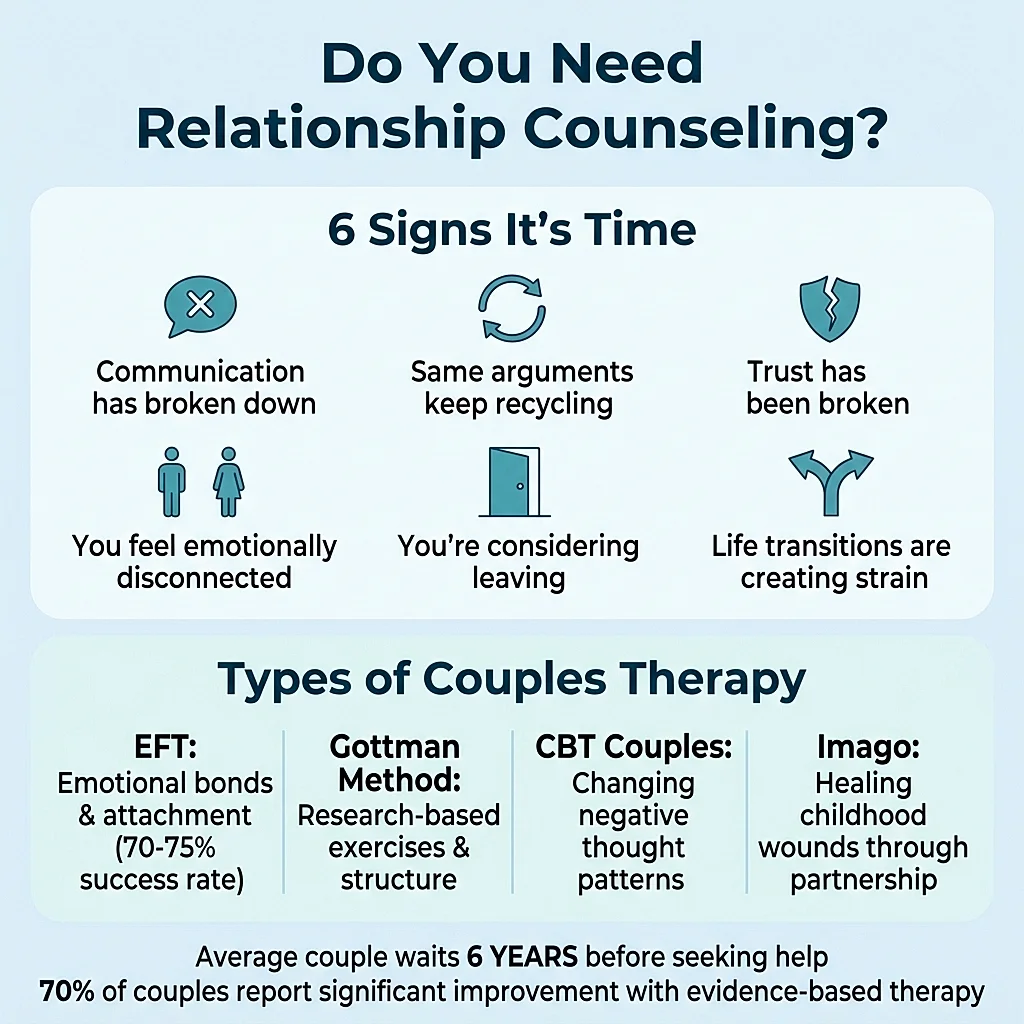
One of the biggest mistakes couples make is waiting too long. Research from the Gottman Institute shows that the average couple waits six years after problems begin before seeking professional help. Six years of compounding resentment, eroded trust, and hardened patterns. By the time many couples walk into a therapist's office, they've been doing damage for half a decade.
You don't need to be in crisis to benefit from counseling. But if any of these sound familiar, it's time:
Communication Has Broken Down
You've stopped talking about anything meaningful. Conversations are limited to logistics — who's picking up the kids, what's for dinner, when the plumber is coming. When you do talk about something real, it escalates within minutes. Or worse, one of you shuts down completely.
The Same Arguments Keep Recycling
You've had the same fight about the same issue dozens of times, and nothing ever changes. You both know each other's lines by heart. The argument has become a script that you perform on repeat, and it always ends the same way — someone storms off, someone goes quiet, and the issue simmers until next time.
There's Been a Betrayal of Trust
Infidelity is the most obvious example, but trust can be broken in many ways: financial dishonesty, emotional affairs, broken promises, hidden addictions. Any situation where one partner feels fundamentally deceived by the other requires professional support to navigate — not because it's impossible to heal, but because the path is too complex to walk alone.
You're Emotionally Disconnected
You live together but you feel alone. Physical intimacy has declined or disappeared. You don't look forward to seeing each other. You've started confiding in friends, family, or colleagues instead of your partner. The emotional bond that once connected you has thinned to the point where you're essentially roommates.
You're Considering Leaving
If separation or divorce has crossed your mind — even as a fleeting thought — counseling is worth trying before making that decision. Not because leaving is always wrong, but because you deserve to make that choice from a place of clarity, not reactivity. Counseling can either help you rebuild or help you separate with intention. Both outcomes are valuable.
Life Transitions Are Creating Strain
A new baby. A job loss. A cross-country move. A health diagnosis. Retirement. These transitions don't cause relationship problems, but they amplify whatever was already there. If the foundation is shaky, a major transition will expose every crack. Counseling during transitions is proactive, not reactive — and significantly more effective than waiting for the cracks to become canyons.
Types of Relationship Counseling
Not all counseling is the same. Different approaches work for different situations, and understanding the major types helps you choose what's right for you.
Emotionally Focused Therapy (EFT)
Developed by Dr. Sue Johnson, EFT focuses on the emotional bonds between partners. It's based on attachment theory — the idea that our need for secure connection is as fundamental as our need for food and shelter.
EFT helps couples identify the negative cycles they're stuck in (pursue-withdraw, attack-defend) and rebuild the emotional safety that allows genuine vulnerability. It's one of the most researched approaches, with studies showing that 70-75% of couples move from distress to recovery after EFT.
Best for: Couples who feel emotionally disconnected, struggling with intimacy, or caught in repetitive conflict cycles.
The Gottman Method
Based on Dr. John Gottman's decades of research (the same research behind "The Seven Principles for Making Marriage Work"), this approach uses structured interventions to strengthen friendship, manage conflict, and create shared meaning.
Gottman Method therapists assess the relationship using specific frameworks — the Sound Relationship House, the Four Horsemen, the repair attempt analysis — and create targeted interventions based on where the relationship is struggling.
Best for: Couples who want a structured, research-based approach with concrete exercises and measurable progress.
Cognitive Behavioral Couples Therapy (CBCT)
CBCT focuses on the thought patterns that drive relationship distress. It helps partners identify distorted thinking ("She doesn't love me because she forgot our anniversary"), challenge those distortions, and develop healthier interpretations and responses.
Best for: Couples where one or both partners tend toward negative assumptions, catastrophizing, or mind-reading.
Imago Relationship Therapy
Created by Dr. Harville Hendrix, Imago therapy operates on the premise that we unconsciously choose partners who mirror the people who wounded us in childhood — and that the conflicts in our relationship are actually opportunities to heal those original wounds.
The centerpiece technique is the "Imago Dialogue," a structured conversation format where one partner speaks and the other mirrors, validates, and empathizes — without rebutting.
Best for: Couples who recognize that their issues connect to childhood experiences or family-of-origin patterns.
Narrative Therapy
Narrative therapy helps couples examine the "stories" they tell about their relationship and each other. Often, couples get locked into problem-saturated narratives ("We're always fighting," "He never listens") that become self-fulfilling. Narrative therapy helps rewrite those stories by identifying exceptions, strengths, and alternative interpretations.
Best for: Couples who feel stuck in a negative narrative about their relationship and need help seeing the bigger picture.
Online Relationship Counseling
The rise of telehealth has made relationship counseling more accessible than ever. Online sessions happen via video call, and many therapists now offer hybrid models — some sessions in person, others online. Research shows that online couples therapy is equally effective as in-person therapy for most issues, with the added benefits of convenience, reduced commute time, and greater flexibility in scheduling.
Best for: Couples with busy schedules, those in rural areas, or partners who are temporarily long-distance.
What to Expect During Relationship Counseling
Walking into your first session is intimidating. For most people, it's the first time they've ever discussed their relationship with a stranger. Here's what actually happens:
The First Session: Assessment
Your first appointment is usually about information-gathering. The therapist will ask both partners about the relationship's history, current concerns, and goals for therapy. They'll want to understand how you met, what drew you together, when things started feeling difficult, and what you've already tried.
Some therapists will also meet with each partner individually for a separate assessment session. This gives each person the chance to share things they might not feel comfortable saying in front of their partner — yet.
Don't worry about being "good" at therapy. There's no right answer. The therapist isn't grading you. They're trying to understand your relationship's unique patterns and figure out how to help.
The Work Phase: Sessions 2-12+
After the initial assessment, regular sessions begin. These typically happen weekly or biweekly and last 50-90 minutes. During these sessions, you'll:
- Explore specific conflicts and the patterns driving them
- Practice new communication skills in real-time with the therapist's guidance
- Identify and express unmet needs that have been going unspoken
- Learn to de-escalate during arguments
- Work through past hurts that are still affecting the present
- Develop shared goals and strategies for the relationship going forward
Some sessions will feel like breakthroughs. Others will feel frustrating — like you're going in circles. Both are normal. Change isn't linear, and the sessions that feel hardest are often the ones that produce the most growth.
Between Sessions: The Real Work
What happens between sessions matters as much as what happens during them. Most therapists assign "homework" — exercises to practice at home, conversations to have, behaviors to try. The couples who take this seriously progress faster than those who treat therapy as a once-a-week fix and go back to old patterns the rest of the time.
Duration: How Long Does Relationship Counseling Take?
There's no universal answer, but here are general timelines:
- Short-term (6-12 sessions): Focused on specific issues like communication improvement, navigating a specific transition, or pre-marital preparation
- Medium-term (12-24 sessions): For more entrenched patterns, rebuilding after infidelity, or addressing multiple issues simultaneously
- Long-term (24+ sessions): For deeply rooted issues, complex trauma histories, or couples who find ongoing support valuable for maintenance
Most couples see meaningful improvement within 8-12 sessions if they're actively engaged in the process.
How Much Does Relationship Counseling Cost?
This is the question everyone asks and nobody wants to answer because "it depends" is genuinely the truth. But here are real numbers:
- Private practice therapist: $100-$250 per session (varies dramatically by location — NYC and LA are on the high end, smaller cities on the lower end)
- Community mental health centers: $20-$80 per session (sliding scale based on income)
- Online platforms: $60-$150 per session (often lower overhead means lower cost)
- Graduate training clinics: $10-$50 per session (supervised graduate students provide therapy at reduced rates — quality is often excellent)
Does Insurance Cover Relationship Counseling?
It depends on your plan, but here's the reality: many insurance plans don't cover couples therapy specifically. Some therapists work around this by billing under one partner's individual diagnosis (anxiety or depression, for example) if it's clinically appropriate. Always ask your therapist about insurance options upfront.
Is It Worth the Cost?
Consider what a divorce costs — financially, emotionally, and for children involved. The average cost of divorce in the United States is between $15,000 and $20,000. A full course of relationship counseling might run $1,500 to $5,000. Even if counseling doesn't save the relationship, it typically makes any outcome — staying together or separating — healthier and less destructive.
How to Find the Right Relationship Counselor
The therapist matters. A lot. Research consistently shows that the therapeutic relationship — how well you connect with your specific therapist — is the single strongest predictor of positive outcomes. More than the therapist's degree, their approach, or their years of experience.
Here's how to find the right fit:
Where to Search
- Your insurance provider's directory — if cost is a concern, start here
- Psychology Today's therapist finder — the largest directory, filterable by specialty, location, and approach
- The Gottman Referral Network — for Gottman Method-trained therapists specifically
- ICEEFT directory — for Emotionally Focused Therapy specialists
- Platforms like LoveConnet — where verified relationship counselors can connect directly with couples seeking support
- Personal referrals — ask friends, your primary care doctor, or your own individual therapist if you have one
Questions to Ask Before Booking
- What's your training and approach to couples therapy?
- How many couples have you worked with?
- Do you take sides, or how do you stay neutral?
- What's your availability and cancellation policy?
- What does a typical session look like?
- How do you handle situations where one partner wants to leave and the other doesn't?
Red Flags in a Therapist
- They consistently take one partner's side
- They tell you what to do rather than helping you figure it out
- They share their own relationship problems or opinions excessively
- They don't have specific training in couples therapy (individual therapy skills don't automatically transfer)
- You consistently feel worse after sessions with no sense of progress
Relationship Counseling vs. Individual Therapy: What's the Difference?
This comes up a lot, and the answer is: they serve different purposes, and sometimes you need both.
Individual therapy focuses on one person's mental health, personal patterns, and individual growth. It's the right choice when the primary issues are internal — depression, anxiety, trauma, attachment wounds — even if those issues affect the relationship.
Relationship counseling focuses on the dynamic between two people. The "patient" is the relationship itself. It's the right choice when the primary issues are interactional — communication breakdowns, conflict patterns, disconnection, unresolved grievances between partners.
Many therapists recommend a combination: individual therapy for each partner to work on their own stuff, plus couples therapy to work on the relationship. This dual approach is particularly effective when both partners are bringing unresolved personal issues into the relationship.
Does Relationship Counseling Actually Work?
The evidence says yes — with caveats.
Research shows that approximately 70% of couples who engage in evidence-based couples therapy report significant improvement in relationship satisfaction. The most studied approaches — EFT and the Gottman Method — both have strong empirical support.
But here's the caveat: therapy works when both partners are engaged. If one person is going through the motions while secretly planning their exit, outcomes are predictably poor. If both partners are genuinely committed to the process — even if they're skeptical — the odds are strongly in their favor.
Factors that predict positive outcomes:
- Both partners attend consistently
- Both partners complete homework between sessions
- The therapist is specifically trained in couples therapy (not just individual therapy)
- Couples seek help earlier rather than later
- The approach is evidence-based (EFT, Gottman, CBCT) rather than generic "talk therapy"
For Counselors: Why Your Expertise Has Never Been More Needed
If you're a licensed relationship counselor or therapist reading this, here's what the data says about the current landscape:
- 206,000+ people search for "relationship counseling" every month — and that number is growing 7% year over year
- The average couple waits six years before seeking help, meaning the demand far exceeds current accessibility
- Online counseling has exploded in adoption, opening the door for therapists to reach clients beyond their geographic area
- Younger couples (millennials and Gen Z) are significantly more likely to seek counseling than previous generations — the stigma is fading fast
The bottleneck isn't demand. It's access. Couples who are ready for help often struggle to find qualified counselors who are accepting new clients, offer flexible scheduling, or provide the specific modality they need.
Platforms like LoveConnet are bridging that gap by connecting licensed relationship counselors directly with couples actively seeking support. If you're a therapist looking to expand your practice, reach new clients, and make a genuine difference in people's relationships — apply to join the platform and get in front of the people who need you most.
How to Get the Most Out of Relationship Counseling
Going to therapy doesn't guarantee results. Going to therapy engaged dramatically increases your odds. Here's how to make every session count:
Come Prepared
Before each session, spend five minutes thinking about what you want to discuss. What happened during the week that felt significant? What did you notice about your own patterns? What are you struggling with? Walking in with clarity helps you use the time more effectively than winging it.
Be Honest — Even When It's Uncomfortable
Therapy only works with the truth. If you're performing the "good partner" role in sessions while harboring resentment, fantasies about leaving, or secrets that affect the relationship — you're paying for theater, not therapy. The therapist can only help with what they know.
Focus on Yourself, Not Your Partner
The instinct is to use sessions to catalog everything your partner is doing wrong. Resist this. Focus on your own feelings, your own patterns, and your own contributions to the dynamic. "I feel unheard when..." is more productive than "You never listen."
Do the Homework
When your therapist assigns exercises between sessions, do them. These aren't optional busywork — they're the bridge between insight and behavioral change. The couples who progress fastest are the ones who practice between sessions, not just during them.
Be Patient
Patterns that took years to develop won't dissolve in three sessions. There will be setbacks. There will be weeks where you feel like nothing is changing. That's normal. Change is happening beneath the surface before it becomes visible on top. Trust the process.
Frequently Asked Questions About Relationship Counseling
Can relationship counseling help if only one partner is willing to go?
Yes. While couples therapy is most effective with both partners present, individual therapy focused on your relationship patterns can be transformative. You can't change your partner, but you can change how you respond to them — and that often shifts the entire dynamic. Some therapists also offer "discernment counseling" specifically for mixed-agenda couples where one wants therapy and the other doesn't.
Is relationship counseling the same as marriage counseling?
Functionally, yes. "Marriage counseling" specifically refers to counseling for married couples, while "relationship counseling" is broader — it includes dating couples, engaged couples, cohabiting partners, and married couples. The therapeutic approaches are the same regardless of legal status.
What's the difference between a counselor, therapist, and psychologist?
The terms overlap but have technical distinctions. Counselors (LPC, LMHC) and therapists (LMFT, LCSW) both provide talk therapy and are licensed by the state. Psychologists hold doctoral degrees (PhD or PsyD) and may offer more specialized assessments. For couples therapy, any of these professionals can be excellent — what matters most is specific training in couples work, regardless of the title.
How do I convince my partner to try counseling?
Frame it as an investment, not an intervention. Instead of "we need counseling because things are bad," try "I want us to have the best relationship possible, and I think talking to someone could help us get there." Normalize it. Most resistance comes from fear or stigma, not actual opposition to improving the relationship.
What if counseling reveals that we should separate?
That happens sometimes, and it's not a failure. If counseling helps you reach clarity about an incompatibility that can't be bridged, that's a successful outcome — even though it's painful. A counselor-guided separation is typically far healthier for everyone involved (especially children) than a reactive, conflict-driven breakup.
Can we do relationship counseling online?
Absolutely. Multiple studies have confirmed that online couples therapy is as effective as in-person therapy for most situations. The only exceptions where in-person may be preferable are cases involving domestic violence, severe substance abuse, or acute mental health crises where safety assessment requires physical presence.
Taking the First Step
The hardest part of relationship counseling isn't the sessions. It isn't the homework. It isn't even the vulnerability of saying out loud the things you've been holding inside.
The hardest part is making the appointment.
There's always a reason to wait. "Things aren't that bad yet." "We can't afford it right now." "We'll try harder on our own first." These are all valid-sounding reasons, and they're also the same reasons the average couple waits six years — six years of damage — before getting help.
Your relationship doesn't need to be in crisis for counseling to help. In fact, the earlier you go, the less work there is to do and the better the outcomes.
If you've been thinking about it, that's your signal. The thinking itself means something needs attention. Whether it's a conversation that's been avoided, a pattern that's been repeating, or a distance that's been growing — there's someone trained to help you navigate it.
All you have to do is start.



💬 Discussion (0)
No comments yet. Be the first to share your thoughts!