
Christian Relationship Counseling: How Faith-Based Guidance Helps You Build Healthier Relationships at Every Stage
I walked into my first counseling appointment single, 26 years old, and convinced there was something fundamentally wrong with me.
Every relationship I'd been in followed the same pattern. I'd meet a great guy at church or through mutual friends. We'd connect over shared faith, shared values, shared vision for the future. Everything would feel right — for about three months. Then the same issues would surface. I'd get anxious. He'd pull away. I'd try harder. He'd pull further. I'd eventually blow up or shut down, and the relationship would end with both of us confused about what went wrong.
Three relationships. Same pattern. Different guys.
My small group leader — a woman I deeply respected — finally said what I needed to hear: "Maybe the common factor in all three relationships isn't the men. Maybe it's the patterns you're bringing into the room. And maybe talking to a Christian counselor about your relationship patterns would help you more than another Bible study on Proverbs 31."
She was right. Christian relationship counseling didn't just help me understand why my relationships kept failing. It helped me understand myself — my attachment patterns, my fears, my unconscious beliefs about love that I'd been carrying since childhood — all through the lens of a faith I trusted and a God I believed was invested in my healing.
This guide is for anyone navigating relationships through the lens of faith. Whether you're single and working on yourself, dating and trying to do it God's way, engaged and preparing for marriage, or struggling with family dynamics — Christian relationship counseling offers something that purely secular therapy doesn't: a framework where your faith isn't just tolerated. It's central.
What Is Christian Relationship Counseling?
Christian relationship counseling is professional therapeutic support for any relational issue — not just marriage — delivered within a faith-based framework. While Christian marriage counseling focuses specifically on married couples, Christian relationship counseling covers a much broader scope:
- Individual relationship patterns — understanding why you keep choosing the same type of partner, attracting unhealthy dynamics, or struggling with intimacy
- Dating relationships — navigating physical boundaries, emotional pacing, communication, and discerning whether someone is right for you
- Pre-marital counseling — preparing for marriage by addressing expectations, conflict styles, finances, family dynamics, and spiritual compatibility
- Interfaith relationships — when you and your partner don't share the same faith or practice at different levels of commitment
- Family relationships — healing dynamics with parents, siblings, or extended family that affect your romantic life
- Breakup and divorce recovery — processing grief, rebuilding identity, and learning from past relationships without losing faith
- Friendships — navigating conflict, boundaries, and expectations within Christian community
A Christian relationship counselor integrates evidence-based therapeutic techniques — emotionally focused therapy, cognitive behavioral therapy, attachment-based approaches — with biblical wisdom, prayer, and spiritual discernment. They understand that for a believer, relationships don't exist in a spiritual vacuum. Your faith shapes how you love, what you value, and what you need from the people closest to you.
Christian Relationship Counseling Is Not Just for Couples in Crisis
There's a misconception in many church communities that counseling is the last resort — something you try when things are falling apart. In reality, the most effective Christian couples counseling happens before crisis. And individual relationship counseling can transform your relational health at any stage of life.
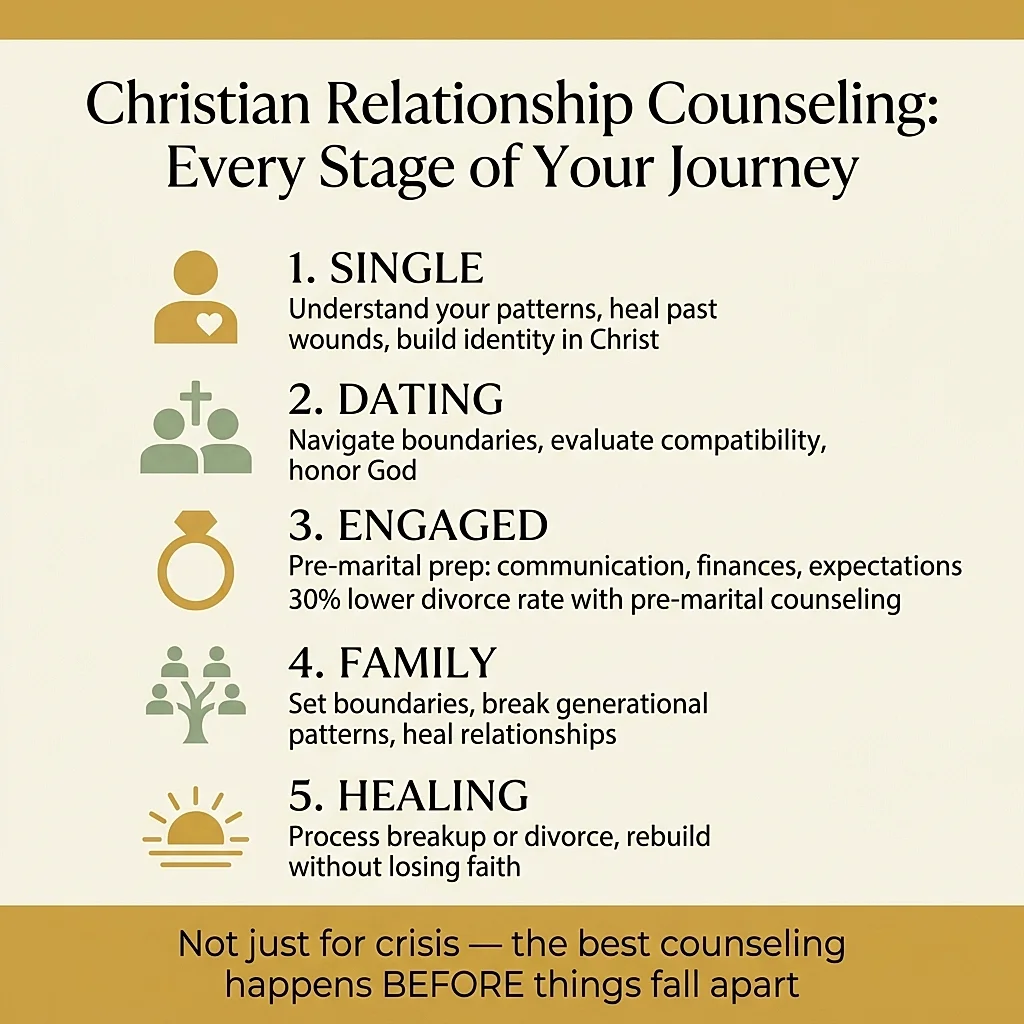
If You're Single
This might sound counterintuitive — why would you need relationship counseling if you're not in a relationship? Because the patterns that will show up in your next relationship already exist inside you. They were shaped by your family of origin, your past experiences, your attachment style, and the beliefs about love and worthiness that you've absorbed — consciously or not.
A counselor can help you:
- Identify your relational patterns — do you people-please? Avoid conflict? Choose emotionally unavailable partners?
- Understand your attachment style and how it affects your behavior in relationships
- Process past relationship wounds so you don't carry them into the next one
- Distinguish between biblical standards and unrealistic expectations shaped by church culture
- Build a healthy identity rooted in Christ rather than in someone else's validation
I've watched friends pray for a godly spouse for years while unconsciously sabotaging every connection that came their way — because the internal work hadn't been done. Prayer is essential. But sometimes God answers the prayer for a better relationship by first inviting you to become a healthier person.
If You're Dating
Christian dating comes with a unique set of tensions that secular dating doesn't face. You're trying to honor God with your body, guard your heart, discern His will for your future, and figure out whether this person is "the one" — all while navigating the normal human experience of attraction, anxiety, and uncertainty.
A Christian relationship counselor can help you:
- Navigate physical boundaries without shame or legalism
- Communicate your needs and values clearly without fear of losing the relationship
- Recognize the difference between godly conviction and anxiety-driven overthinking
- Evaluate compatibility beyond surface-level spiritual metrics ("he goes to church" is not the same as "he pursues Christ")
- Process the pressure — from yourself, your family, your church — to get married quickly
If You're Engaged
Pre-marital counseling is the single most impactful thing you can do for your future marriage. Research consistently shows that couples who complete structured pre-marital counseling have a 30% lower divorce rate than those who don't.
Many churches require it, but even if yours doesn't, choosing to do it proactively is an investment that pays dividends for decades. Pre-marital counseling with a Christian counselor typically covers:
- Communication styles — learning how you each handle conflict, express love, and process emotion before those differences become sources of ongoing friction
- Financial expectations — merging finances is one of the top sources of marital conflict. Addressing spending habits, debt, generosity, and financial goals before the wedding prevents years of hidden resentment
- Family of origin — understanding how each partner's upbringing shaped their expectations for marriage, family roles, holiday traditions, and parenting philosophies
- Sexual expectations — often the most avoided topic in Christian pre-marital prep, and therefore the source of the most surprise and frustration after the wedding
- Spiritual leadership — what does shared faith look like in daily life? Who leads? How do you handle different denominational backgrounds or levels of commitment?
- Conflict resolution — every couple will disagree. The question is whether you've developed healthy patterns for disagreeing before the stakes get high
If You're Navigating Family Dynamics
Sometimes the relationship that needs the most attention isn't romantic. Many Christians carry deep wounds from family relationships — controlling parents, absent fathers, emotionally manipulative siblings, enmeshed family systems — that directly impact their ability to have healthy romantic relationships.
A Christian relationship counselor can help you:
- Set boundaries with family members without feeling like you're dishonoring them
- Process childhood wounds through the lens of forgiveness AND healthy self-protection
- Navigate the tension between "honor your father and mother" and "leave and cleave"
- Break generational patterns of dysfunction, addiction, or emotional abuse
- Reconcile painful family experiences with a loving God
How Christian Relationship Counseling Works
If you've never been to counseling, here's what to expect — specifically in a faith-integrated setting.
The First Session: Intake and Assessment
Your counselor will spend the first session getting to know you. They'll ask about:
- Your current relational concerns — what brought you in
- Your relationship history — patterns, past experiences, what's worked and what hasn't
- Your family background — how relationships were modeled in your home growing up
- Your faith journey — not to evaluate your spirituality, but to understand how your faith intersects with your relational life
- Your goals — what does "better" look like for you?
Many Christian counselors will also ask how you'd like faith integrated into your sessions. Some clients want prayer, Scripture, and spiritual direction woven throughout. Others want the counselor to share their faith but rely primarily on clinical tools. A good counselor follows your lead.
The Work Phase
Regular sessions — typically weekly or biweekly, 50-60 minutes each — focus on the specific issues you've identified. Depending on your situation, this might include:
- Attachment work — understanding your attachment style (anxious, avoidant, disorganized, secure) and how it drives your relationship behavior. This often connects to your earliest experiences of love and safety — including your early experience of God
- Cognitive restructuring — identifying distorted beliefs about relationships ("I'm too much," "I don't deserve love," "all men leave") and replacing them with truth rooted in Scripture and evidence
- Boundary development — learning to set limits that protect your wellbeing without feeling guilty. This is especially important in church contexts where "sacrificial love" can be distorted into codependency
- Grief processing — if you're recovering from a breakup, divorce, or relational loss. Christian counseling offers a unique space to grieve honestly while holding onto hope
- Spiritual integration — exploring how your relationship with God connects to your relationships with people. Often, the way we relate to God mirrors the way we relate to partners — and vice versa
Between Sessions
Most counselors assign exercises to practice between sessions — journaling prompts, communication exercises, Scripture meditations, or behavioral experiments. The couples and individuals who progress fastest are the ones who engage with this material consistently, not just the ones who show up to appointments.
Finding the Right Christian Relationship Counselor
The quality of your counselor matters more than the approach they use. Research consistently shows that the therapeutic relationship — how safe and understood you feel with your specific therapist — is the strongest predictor of positive outcomes.
What to Look For
- Licensure. A license (LMFT, LPC, LCSW, PsyD) ensures clinical competence. Faith alone doesn't qualify someone to handle complex relational trauma, attachment disorders, or co-occurring mental health issues. Look for both credentials and faith.
- Faith integration training. The best Christian counselors don't just add a prayer at the beginning of a secular session. They've trained specifically in integrating faith with evidence-based practice. Ask about their approach.
- Relational specialty. Not all counselors specialize in relationships. A therapist who primarily treats anxiety or depression may not have the couples or relational training needed for your specific concerns.
- Personal fit. You should feel safe, not judged. A good Christian counselor will challenge you with grace, not shame. If you leave sessions feeling condemned rather than convicted, it's the wrong fit.
Where to Search
- Your pastor or church staff — most maintain referral lists of trusted Christian counselors in the area
- American Association of Christian Counselors (AACC) — the largest organization of Christian counselors with a searchable directory
- Psychology Today — filter by "Christian" in the religion section of their therapist finder
- LoveConnet — our platform connects individuals and couples with verified Christian relationship counselors. Find a faith-based counselor who understands your values
- Christian university counseling centers — schools like Liberty, Regent, and Denver Seminary operate training clinics with reduced-rate sessions
Questions to Ask Before Booking
- "How do you integrate faith into your counseling? Can you give me an example?"
- "Are you licensed? What are your credentials?"
- "Do you have experience with my specific issue (dating patterns, pre-marital prep, family dynamics, etc.)?"
- "What does a typical session look like?"
- "How do you handle situations where someone's faith and mental health seem to be in tension?"
The Cost of Christian Relationship Counseling
Real numbers, because transparency matters:
- Licensed Christian counselors (private practice): $100-$250 per session
- Pastoral counseling through your church: Often free or donation-based
- Online Christian counseling: $60-$150 per session
- Church-affiliated counseling centers: $25-$80 per session (sliding scale)
- Graduate training clinics at Christian universities: $10-$50 per session
Making It Affordable
- Ask your church. Many churches have benevolence funds or counseling budgets specifically for members. Some partner with local Christian counseling practices to offer discounted sessions.
- Check insurance. Some plans cover counseling when billed under an individual diagnosis. Ask the counselor about insurance options and superbills.
- Sliding scale. Many Christian counselors offer reduced rates based on financial need. It's always worth asking.
- Group formats. Some Christian counseling centers offer relationship skills groups or workshops at lower per-person costs than individual sessions.
Common Issues Addressed in Christian Relationship Counseling
Purity Culture Wounds
This is one of the most common — and most sensitive — issues Christian relationship counselors address. Many believers grew up in purity culture environments where messages about sexuality were rooted in fear, shame, and rigid rules rather than the beauty and holiness of God's design.
The result? Adults who struggle with sexual shame in marriage, who can't "flip the switch" from "sex is dangerous" to "sex is a gift," or who carry deep guilt over past sexual experiences that prevents them from being fully present with their spouse.
A skilled Christian counselor addresses this not by dismissing biblical sexual ethics, but by separating God's actual design from the distorted cultural messaging that was layered on top of it.
Codependency in Christian Relationships
The church's emphasis on sacrificial love, servant leadership, and "dying to self" can sometimes be weaponized — unintentionally or intentionally — to enable codependent dynamics. When "love is patient, love is kind" becomes "love means tolerating anything without complaint," something has gone wrong.
Christian relationship counseling helps distinguish between genuine, healthy self-sacrifice and the loss of self that comes from believing your needs don't matter. Jesus set boundaries. He withdrew from crowds. He said no. Biblical love doesn't require erasing yourself.
Singleness and the Pressure to Marry
In many church communities, singleness past a certain age carries an unspoken stigma. The well-meaning questions — "Are you seeing anyone?" "Have you tried this dating app?" "I know someone perfect for you" — communicate a subtle message: you're incomplete without a spouse.
A Christian relationship counselor can help you:
- Process the grief of unfulfilled desire without losing faith
- Distinguish between healthy desire for partnership and unhealthy dependence on it for identity
- Build a meaningful life that honors your current season rather than treating it as a waiting room
- Navigate the loneliness honestly, without the spiritual bypassing of "God is enough" dismissing legitimate human need
Interfaith Relationships
When one partner is a committed Christian and the other isn't — or when both are Christians but from very different traditions — unique tensions emerge. A Christian relationship counselor can help navigate questions like:
- Is this relationship wise? How do I discern without being judgmental?
- How do we handle differences in church attendance, prayer, holidays, and moral convictions?
- What do we teach our children?
- How do I honor my partner's beliefs while staying true to my own?
Rebuilding After Breakup or Divorce
In some church communities, divorce carries a stigma that makes recovery even harder. You're grieving the loss of the relationship AND navigating the feeling that you've failed spiritually. A Christian relationship counselor provides a space where both the emotional and spiritual dimensions of loss are honored — without judgment.
The Biblical Foundation for Seeking Help
Scripture doesn't just permit seeking counsel — it actively encourages it:
- Proverbs 12:15 — "The way of a fool is right in his own eyes, but a wise man listens to advice."
- Proverbs 15:22 — "Without counsel plans fail, but with many advisers they succeed."
- Galatians 6:2 — "Bear one another's burdens, and so fulfill the law of Christ."
- James 5:16 — "Therefore, confess your sins to one another and pray for one another, that you may be healed."
The pattern throughout Scripture is clear: isolation leads to stagnation. Community — including the community of a skilled counselor — leads to growth. Seeking Christian relationship counseling isn't a departure from faith. It's one of the most faithful things you can do.
For Christian Counselors: Expanding Your Practice
If you're a licensed counselor with a heart for faith-integrated relational work, the demand is significant and growing:
- Thousands of Christians search for faith-based relationship counseling every month
- The stigma around counseling in church communities is declining rapidly, especially among younger believers
- Online counseling has removed geographic barriers, allowing you to serve clients anywhere
- There's a significant shortage of counselors who are both clinically trained AND genuinely faith-integrated
LoveConnet connects licensed Christian counselors with individuals and couples seeking faith-based support. If you want to reach people who are actively searching for a counselor who shares their values — apply to join our counselor network.
Frequently Asked Questions
What's the difference between Christian relationship counseling and Christian marriage counseling?
Christian marriage counseling focuses specifically on married couples — healing trust, restoring intimacy, resolving conflict within the marriage covenant. Christian relationship counseling is broader — it covers all relationships including dating, pre-marital, family dynamics, friendships, and individual relational patterns. Both are faith-integrated, but they serve different needs.
Do I need to be in a relationship to benefit from relationship counseling?
Absolutely not. Some of the most transformative relational work happens when you're single. Understanding your attachment style, processing past wounds, and building a healthy identity before entering a relationship means you'll bring your best self — not your most anxious or wounded self — into your next connection.
Is online Christian relationship counseling effective?
Yes. Research confirms that online therapy is equally effective as in-person therapy for most relational issues. Many Christian counselors now offer video sessions, making faith-integrated support accessible regardless of your location.
What if I'm not sure I want a faith-based approach?
That's okay. A good Christian counselor will meet you where you are. They won't force prayer, Scripture, or spiritual direction on you. They'll ask how you'd like faith integrated — and respect your answer. If you're curious but cautious, communicate that upfront.
How long does relationship counseling typically take?
It depends on the complexity of the issues. General patterns: 6-12 sessions for focused work (pre-marital prep, processing a specific breakup), 12-24 sessions for deeper pattern work (attachment issues, family-of-origin healing), and ongoing as needed for complex situations. Most people notice meaningful shifts within 8-12 sessions.
Can my counselor also be my pastor?
They can, but there are limitations. Pastoral counseling is valuable for spiritual guidance and mild relational issues. For more complex concerns — clinical depression, trauma, addiction, deeply entrenched relational patterns — a licensed professional with specific therapeutic training is the better choice. Many people benefit from both: a pastor for spiritual mentoring and a licensed counselor for clinical work.
Your Relationships Reflect Your Growth
Here's what nobody told me before I started counseling: the work you do on yourself doesn't just improve your romantic relationships. It improves everything. Your friendships become more authentic. Your family dynamics become more manageable. Your relationship with God deepens — because the walls you built to protect yourself from people were often the same walls keeping you at arm's length from Him.
Christian relationship counseling isn't about fixing what's broken. It's about becoming who God designed you to be — fully known, fully loved, and fully capable of offering that same depth to someone else.
Whether you're single and working on patterns, dating and navigating boundaries, engaged and preparing for a lifetime, or healing from a loss you didn't see coming — a Christian relationship counselor can walk that road with you. Not as a replacement for God's guidance, but as one of the ways He provides it.
Start today. Your future relationships will thank you.
Related Reading
- Christian Marriage Counseling: A Faith-Based Guide to Healing Your Marriage
- Relationship Counseling: Everything You Need to Know Before Your First Session
- Emotionally Focused Couples Therapy: How EFT Helps Partners Reconnect
- From Doormat to Dreamgirl: How to Stop Settling and Start Getting the Love You Deserve
- The Seven Principles for Making Marriage Work



💬 Discussion (0)
No comments yet. Be the first to share your thoughts!