
Premarital Counseling: The Complete Guide to Building a Marriage That Actually Lasts
My fiancé and I almost didn't make it to the wedding — and I don't mean we almost broke up. I mean we almost made it to the altar without ever having a single honest conversation about money.
He was a saver. I was a spender. He grew up in a household where talking about money was normal — budget spreadsheets on the kitchen table, retirement accounts discussed over dinner. I grew up in a household where money was a source of shame, secrecy, and screaming matches. We'd been together for three years, engaged for six months, and we had never once talked about how we'd manage our finances as a married couple.
It wasn't until a friend — married for twelve years — sat us down and said, "Have you done premarital counseling?" that we even considered it. My first reaction was defensive: We don't need counseling. We're fine. Counseling is for couples with problems.
That assumption — that counseling is for broken relationships — is exactly why so many marriages fail. Premarital counseling isn't about fixing something that's broken. It's about stress-testing the foundation before you build a life on it.
Six sessions later, my fiancé and I had discovered three major areas where our assumptions were completely misaligned — money, in-laws, and whether we'd raise kids in a religious tradition. None of these had come up naturally in three years of dating. All of them would have become landmines in our marriage.
We got married. That was eight years ago. We still use the communication framework our counselor taught us. And when I look at friends who skipped this step and are now fighting about the exact things we resolved before the wedding, I think: premarital counseling was the single best investment we made in our marriage.
What Is Premarital Counseling?
Premarital counseling is a structured series of sessions — typically with a licensed therapist, counselor, or trained facilitator — designed to help engaged or soon-to-be-married couples explore the topics that will define their marriage before the wedding day.
Think of it as a comprehensive compatibility audit. Not to determine whether you should get married, but to ensure you're entering the marriage with shared expectations, honest communication, and practical strategies for the challenges that every marriage eventually faces.
Premarital counseling typically covers:
- Communication patterns — how you fight, how you repair, how you express needs
- Financial planning and values — spending habits, debt, savings goals, who manages what
- Family of origin — how your upbringing shapes your expectations of marriage
- Intimacy and sexual expectations — desire differences, boundaries, evolving needs
- Conflict resolution — identifying your default patterns and building healthier ones
- Roles and responsibilities — household labor, career priorities, decision-making
- Children — whether to have them, when, how many, parenting philosophy
- In-law relationships — boundaries, holidays, loyalty conflicts
- Spiritual or value alignment — shared beliefs, religious practice, moral frameworks
- Life goals — where you want to live, career ambitions, retirement vision
The goal isn't to eliminate all disagreements — that's impossible and unhealthy. The goal is to surface the disagreements now, when you have time, emotional bandwidth, and professional support to work through them — rather than discovering them during your first year of marriage when the stakes are higher and the exits are harder.
Why Do Couples Need Premarital Counseling?
The data is striking. Research from the American Psychological Association consistently shows that premarital education programs reduce the risk of divorce by up to 30%. A landmark study published in the Journal of Family Psychology found that couples who participated in premarital counseling reported higher marital satisfaction, better communication, and lower conflict levels over a five-year period compared to couples who didn't.
But you don't need research to understand why it works. Consider what marriage actually requires:
You're Merging Two Entirely Different Operating Systems
Every person enters a marriage running the software they were programmed with in childhood. Your family of origin taught you what "normal" looks like — how conflict should be handled, how money should be managed, how affection should be expressed, how roles should be divided.
The problem is that your partner was programmed with entirely different software. Their "normal" may be your "dysfunctional." Their idea of a healthy argument might be your idea of emotional abuse. Their financial philosophy might be your worst nightmare.
Premarital counseling makes both operating systems visible so you can consciously choose which elements to keep, which to discard, and which to merge into something new.
Dating Doesn't Prepare You for Marriage
Dating is a highlight reel. Even long-term dating. You're showing your best self, navigating relatively low-stakes decisions, and operating with an implicit exit option that changes the entire dynamic. Marriage removes the exit option (or at least makes it enormously costly), introduces a web of legal, financial, and social obligations, and requires sustained partnership through illness, job loss, family crises, and the relentless grind of daily logistics.
Premarital counseling bridges the gap between the relationship you've been practicing and the one you're about to commit to.
The Topics That Destroy Marriages Are the Ones Nobody Talks About
The Gottman Institute's research identifies four communication patterns that predict divorce with over 90% accuracy: criticism, contempt, defensiveness, and stonewalling. Most couples have no idea they're engaging in these patterns until they're deeply entrenched.
Premarital counseling teaches you to recognize these patterns early and replace them with healthier alternatives — before they calcify into habits that are exponentially harder to break.
What Happens in Premarital Counseling Sessions
If you've never been to any form of counseling, the idea of sitting in a room with your partner and a stranger can feel intimidating. Here's a realistic walkthrough of what to expect.
Session 1: Getting the Lay of the Land
The first session is typically an intake — your counselor will ask about your relationship history, how you met, what attracted you to each other, and what prompted you to seek premarital counseling. Many counselors also administer a relationship assessment questionnaire (common tools include PREPARE/ENRICH, FOCCUS, or the Gottman Relationship Checkup) to identify your strengths and growth areas as a couple.
This session is about building trust with your counselor. A good premarital counselor will make both partners feel safe and heard — not favoring one over the other.
Sessions 2-5: Deep Dives into Core Topics
Each session typically focuses on one or two core topics. The counselor facilitates structured conversations where both partners express their expectations, fears, and non-negotiables on each subject.
These conversations often surface surprises. You might discover that your partner assumes you'll handle all the cooking because that's how their family worked — even though you both work full-time. You might learn that your partner has $40,000 in student debt they've never mentioned. You might realize that one of you firmly wants children and the other is genuinely unsure.
The counselor's role isn't to take sides or give you "the answer." It's to help you hear each other, understand the underlying values driving each position, and negotiate agreements that both partners can genuinely commit to.
Session 6+: Skills Building and Integration
Later sessions focus on practical skills — communication techniques, conflict resolution strategies, and rituals of connection that research shows keep marriages healthy long-term. Your counselor might have you practice active listening exercises, teach you the "softened startup" technique for raising complaints without triggering defensiveness, or help you design a shared financial system.
Many couples end premarital counseling with a written "relationship contract" — not a legal document, but a set of shared agreements on the key topics they discussed. This document becomes a reference point you can return to when conflicts arise.
The 8 Critical Topics Covered in Premarital Counseling
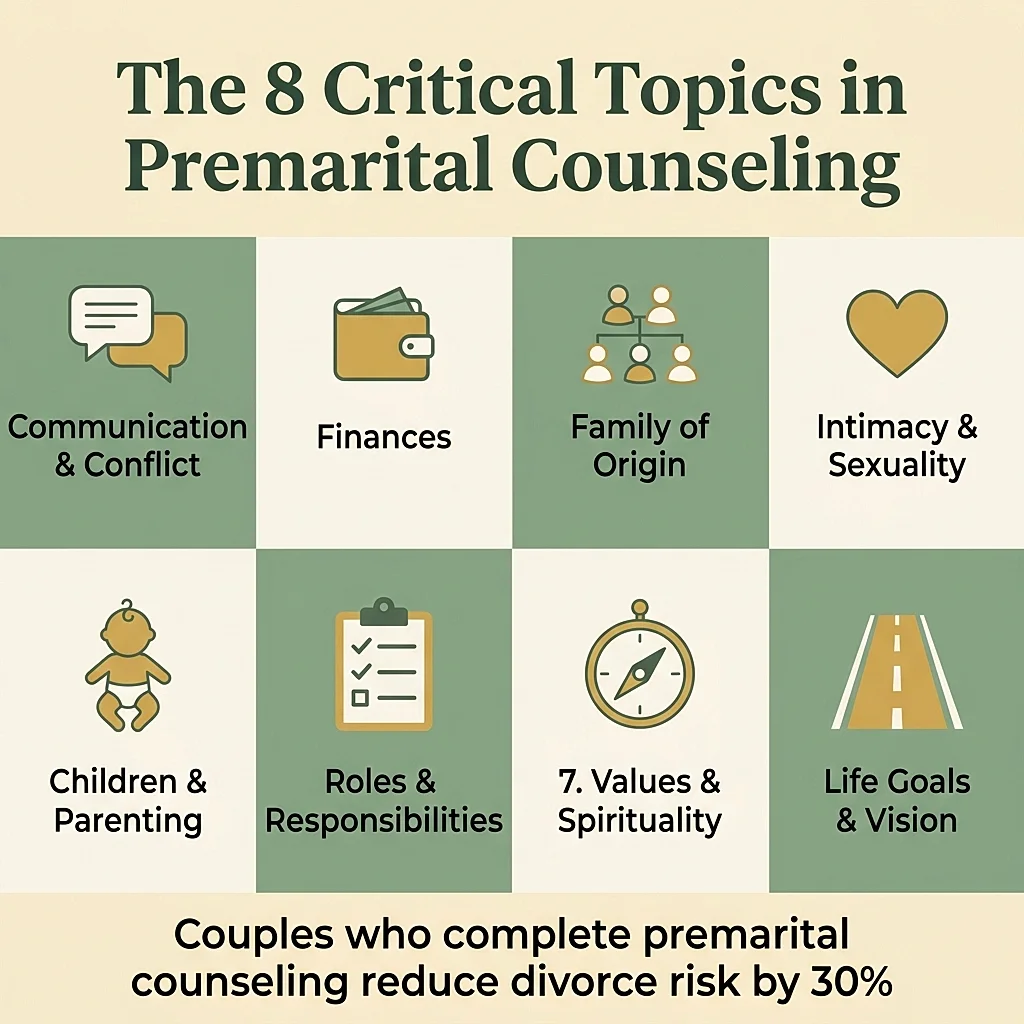
1. Communication and Conflict
This is the foundation. Every other topic depends on your ability to communicate effectively and navigate disagreements without causing lasting damage.
Your counselor will help you identify:
- Your communication style under stress (do you pursue or withdraw?)
- Your conflict patterns (who escalates? who shuts down? who brings up issues and who avoids them?)
- The difference between a complaint ("I feel hurt when you don't call") and criticism ("You never think about anyone but yourself")
- How to repair after an argument — the Gottman research shows that how couples repair matters more than how they fight
If communication is already a challenge in your relationship, relationship counseling can provide a deeper dive into these patterns before or alongside premarital work.
2. Finances
Money is the number one source of conflict in marriages. Not because of the money itself, but because money represents security, freedom, power, and values — and partners often have fundamentally different relationships with all four.
Premarital counseling will address:
- Full financial disclosure — income, debts, credit scores, savings, investments
- Joint vs. separate accounts — or a hybrid system
- Spending philosophies — how much is "too much" for a purchase without consulting your partner?
- Financial roles — who pays the bills, who manages investments, who tracks the budget?
- Financial goals — homeownership timeline, retirement age, emergency fund targets
- Financial fears — what's each partner's worst-case financial scenario, and how can you protect against it?
3. Family of Origin
You don't just marry a person — you marry a family system. Your partner's family shaped their expectations for marriage, their definition of love, their tolerance for conflict, and their assumptions about gender roles.
Premarital counseling explores:
- What marriage looked like in each partner's family
- What each partner wants to replicate and what they want to change
- In-law relationships — boundaries, expectations, holiday logistics
- How family of origin trauma might affect the marriage (an area where therapy for trust issues can be particularly valuable)
4. Intimacy and Sexuality
Sexual expectations are one of the most under-discussed topics before marriage — partly because of discomfort, partly because the dating phase often masks long-term incompatibilities. When the relationship is new, desire is effortless. When it's five years old, it requires intentionality.
Premarital counseling provides a safe space to discuss:
- Sexual expectations — frequency, preferences, boundaries
- How desire differences will be navigated
- The difference between physical intimacy and emotional intimacy
- How life transitions (children, stress, aging) will affect your intimate life
- Past sexual trauma that may affect the relationship
5. Children and Parenting
This is a non-negotiable topic. If one partner wants children and the other doesn't, no amount of love or compromise will bridge that gap. Premarital counseling ensures this conversation happens explicitly rather than assumed.
Key questions explored:
- Do both partners want children? How many? When?
- What parenting styles do you each envision? (Authoritative? Permissive? Structured?)
- How will childcare be divided? Will one parent stay home?
- What if fertility is an issue — are you open to IVF, adoption, surrogacy?
- How will parenting disagreements be resolved?
- What role will extended family play in raising children?
6. Roles and Responsibilities
Who takes out the trash? Who manages the social calendar? Who handles car maintenance? Who cooks? Who cleans? These seem like small questions, but research shows that inequitable division of household labor is one of the top predictors of marital dissatisfaction — particularly for women.
Premarital counseling helps couples create an explicit, mutually agreed-upon division of responsibilities rather than drifting into patterns based on gender assumptions or whoever has lower tolerance for mess.
7. Values and Spirituality
Shared values are the bedrock of long-term compatibility. Premarital counseling explores whether your values are genuinely aligned or merely assumed to be.
Topics include:
- Religious or spiritual practice — how important is it to each partner?
- If you have different faiths (or one partner has none), how will you navigate holidays, rituals, and community?
- How will children be raised spiritually?
- Ethical values — charitable giving, social responsibility, lifestyle choices
For couples where faith is central to the relationship, Christian marriage counseling provides a premarital framework that integrates biblical principles with evidence-based relationship science. Many churches now require or strongly recommend premarital counseling before performing a wedding ceremony.
8. Life Goals and Vision
Where do you want to live in five years? Ten? Are you open to relocating for a career opportunity? When do you want to retire? How important is career advancement versus work-life balance? What does your ideal daily life look like?
These questions seem abstract until one partner gets a job offer in another state and the other refuses to move. Premarital counseling ensures these conversations happen before the decisions become urgent.
Types of Premarital Counseling
Secular (Evidence-Based) Premarital Counseling
Conducted by licensed therapists (LMFTs, LPCs, psychologists), secular premarital counseling uses research-backed frameworks and validated assessment tools. It's clinically structured, non-religious, and focuses on communication science, attachment theory, and behavioral patterns.
Common programs:
- PREPARE/ENRICH — the most widely used and researched premarital assessment tool, covering 12 relationship areas with a validated questionnaire and facilitator-led discussion
- Gottman Method — based on Dr. John Gottman's 40+ years of marriage research, focuses on building friendship, managing conflict, and creating shared meaning
- Emotionally Focused Therapy (EFT) — especially effective for couples where one or both partners have attachment insecurities that could affect the marriage
Best for: Couples who want a clinical, evidence-based approach without a religious framework.
Faith-Based Premarital Counseling
Offered by pastors, priests, rabbis, or faith-oriented licensed counselors, faith-based premarital counseling integrates spiritual principles with relationship education. Many religious traditions now require premarital counseling before performing a wedding ceremony.
Best for: Couples where shared faith is central to the relationship. Christian relationship counseling combines scriptural wisdom with modern relationship science for couples who want both dimensions.
Online Premarital Counseling
Virtual premarital counseling has grown substantially — offering the same structured sessions via video call. Many couples prefer this for scheduling flexibility, especially when both partners have demanding work schedules or live in different locations during the engagement.
Best for: Couples with scheduling constraints, long-distance engaged couples, or those in areas with limited access to specialized premarital counselors.
Group Premarital Workshops
Some counselors and organizations offer premarital education in a group format — multiple couples working through a structured curriculum together. This can be more affordable than individual sessions and offers the added benefit of hearing other couples navigate similar challenges.
Best for: Budget-conscious couples who are comfortable in a group setting.
How Long Does Premarital Counseling Take?
- Standard premarital counseling: 6-8 sessions over 2-3 months
- Intensive premarital retreats: 1-2 full days (compressed format)
- Faith-based programs: 4-12 sessions depending on the tradition
- Online programs: Self-paced over 4-8 weeks, or structured weekly sessions
Most counselors recommend starting premarital counseling 4-6 months before the wedding. This gives you enough time to work through the material without the stress of last-minute wedding logistics competing for your emotional energy.
How Much Does Premarital Counseling Cost?
- Licensed therapist (private practice): $125-$250 per session × 6-8 sessions = $750-$2,000
- Online therapy platforms: $80-$150 per session
- PREPARE/ENRICH program: $35 assessment fee + facilitator fees ($150-$800 total)
- Church-based programs: Often free or $50-$200 for the entire program
- Group workshops: $100-$400 per couple
- Weekend intensives: $500-$3,000 (all-inclusive retreat format)
To put this in perspective: the average U.S. wedding costs over $33,000. Premarital counseling — the one investment that actually predicts whether the marriage succeeds — costs less than the wedding cake. It's the most cost-effective investment you'll make in your entire wedding budget.
Does Premarital Counseling Work? What the Research Says
The evidence is robust:
- 30% reduction in divorce risk for couples who complete premarital education (Stanley et al., Journal of Family Psychology)
- Higher relationship quality reported at 1-year, 3-year, and 5-year follow-ups
- Better communication skills — couples who completed premarital counseling used more constructive conflict behaviors and fewer destructive ones
- Improved sexual satisfaction — couples who discussed intimacy expectations before marriage reported higher sexual satisfaction in the first five years
- Lower rates of domestic violence — premarital education programs that include conflict management training showed reduced rates of partner aggression
The research is particularly clear on one point: the quality of the program matters more than the format. A well-facilitated 6-session program with a skilled counselor outperforms a 12-session program with a poorly trained one. This is why finding the right counselor is crucial.
How to Find the Right Premarital Counselor
What to Look For
- Licensure — LMFT (Licensed Marriage and Family Therapist), LPC, or psychologist with couples specialization
- Specific premarital training — certified in PREPARE/ENRICH, Gottman Method, or EFT
- Comfort with both partners — a good premarital counselor creates safety for both people, not just the more talkative one
- Structured approach — look for a counselor who uses a curriculum or assessment tool, not just "let's talk about whatever comes up"
Where to Search
- Psychology Today — filter by "Premarital Counseling" in the specialties section
- PREPARE/ENRICH Facilitator Locator — find a certified facilitator near you
- Gottman Therapist Directory — for Gottman Method-trained counselors
- LoveConnet — we connect couples with verified, specialized premarital counselors who use evidence-based approaches. Find a premarital counselor
Questions to Ask a Potential Counselor
- What assessment tool do you use? (PREPARE/ENRICH, Gottman Checkup, etc.)
- How many sessions do you recommend, and what topics does each cover?
- What's your approach when partners have a fundamental disagreement on a major topic?
- Do you provide any take-home materials or exercises between sessions?
- What's your experience with interfaith, intercultural, or blended-family couples?
When Premarital Counseling Reveals a Problem
Here's the part nobody warns you about: sometimes premarital counseling reveals that you're not ready to get married, or that there are issues that need significant work before the wedding should proceed.
This can feel devastating — especially with deposits paid and invitations sent. But discovering a fundamental incompatibility during a $1,000 counseling program is infinitely better than discovering it during a $15,000 divorce.
Common red flags that emerge in premarital counseling:
- One partner refuses to engage or dismisses the process
- A fundamental disagreement on children (want vs. don't want)
- Undisclosed debt, addiction, or infidelity
- Controlling or abusive behavior that becomes visible under the counselor's observation
- One partner's family has an unhealthy level of control over the relationship
- Deep attachment wounds that need individual therapy before couples work can be effective
A skilled premarital counselor will not tell you whether to get married. They will help you see clearly — and then trust you to make an informed decision with open eyes rather than hopeful ones.
For Counselors: The Demand for Premarital Specialists Is Surging
If you're a licensed therapist with couples training:
- 21,600+ people search for "premarital counseling" every month — growing 32% year over year
- Modern couples are more educated and proactive about relationship health than any previous generation
- Many couples specifically seek premarital counseling outside their religious community, creating demand for secular, evidence-based providers
- Online platforms have expanded your reach beyond your geographic area
LoveConnet connects qualified counselors with couples actively seeking premarital preparation. If you specialize in couples work — apply to join our counselor network.
Frequently Asked Questions
Is premarital counseling only for couples with problems?
No — and this is the biggest misconception. Premarital counseling is preventive, not corrective. It's the relationship equivalent of a pre-purchase home inspection. You're not inspecting the house because you think it's broken. You're inspecting it because you want to know what you're investing in and address potential issues before they become expensive repairs.
Can we do premarital counseling if we're not engaged yet?
Absolutely. Many couples do pre-engagement counseling to help them decide whether to get engaged. Some counselors actually recommend this — working through the material without the pressure of a wedding date and deposits on the line allows for more honest, exploratory conversations.
What if my partner doesn't want to go?
This is common, and it's usually rooted in fear — fear of being judged, fear of what might surface, or simply discomfort with the idea of counseling. Framing it as "I want us to start our marriage with the best possible foundation" is usually more effective than "I think we need help." If your partner remains resistant, that resistance itself is worth exploring — it may signal avoidance patterns that will show up in the marriage.
How is premarital counseling different from couples therapy?
Premarital counseling is proactive and educational — you're building skills and exploring compatibility before problems arise. Couples therapy is typically reactive and therapeutic — addressing existing problems, often after significant damage. Think of it as the difference between regular exercise (prevention) and physical therapy after an injury (treatment).
Do we need premarital counseling if we've been together a long time?
Yes — arguably even more so. Long-term couples often assume they know everything about each other, but length of relationship doesn't equal depth of conversation. Many couples who've been together for years have never explicitly discussed financial management, parenting philosophies, or end-of-life care preferences because "it never came up." Premarital counseling ensures nothing is left to assumption.
What if we disagree on something major during counseling?
That's exactly what counseling is for. A major disagreement discovered in counseling is not a failure — it's a success. You now have a professional helping you navigate it, time to work through it before the wedding, and the clarity to make an informed decision about how to proceed.
The Best Wedding Gift You Can Give Yourselves
Every couple planning a wedding obsesses over flowers, venues, photographers, and seating charts. These details matter for one day. The relationship you're building matters for every day after.
Premarital counseling is the one wedding investment that pays dividends for decades. It's where you learn that your partner assumes you'll spend every Christmas with their family. It's where you discover that you have completely different definitions of "clean house." It's where you find out that your partner's idea of financial security requires three times what yours does — and that this difference will become a nightly argument if you don't address it now.
It's also where you discover what's extraordinary about your relationship. A good premarital counselor will highlight your strengths as much as your growth areas. You'll leave sessions not just more prepared, but more connected — with a deeper understanding of why you chose each other and a shared language for protecting that choice when life gets hard.
Because it will get hard. Marriage isn't a fairy tale — it's a partnership that requires skill, intention, and ongoing maintenance. Premarital counseling gives you the skills before you need them, the conversations before they become arguments, and the foundation before you build your life on it.
Start the conversation. Find a counselor. Give your marriage the preparation it deserves.
Related Reading
- Relationship Counseling: Everything You Need to Know Before Your First Session
- Christian Marriage Counseling: A Faith-Based Guide to Healing Your Marriage
- Emotionally Focused Couples Therapy: How EFT Helps Partners Reconnect
- Therapy for Trust Issues: How to Heal When You Can't Stop Waiting for the Other Shoe to Drop
- Christian Relationship Counseling: Faith-Based Guidance at Every Stage



💬 Discussion (0)
No comments yet. Be the first to share your thoughts!