
From Doormat to Dreamgirl: How to Stop Settling and Start Getting the Love You Actually Deserve
I used to be the girl who texted back within 30 seconds, every time. Didn't matter if he took three days to reply. Didn't matter if his message was a one-word "hey." My phone would buzz, I'd drop everything, and I'd craft a carefully worded response designed to seem casual while being anything but.
I made excuses for terrible behavior. "He's just stressed." "He's not great at communicating." "He's different when we're alone." I'd rearrange my schedule, cancel plans with friends, and twist myself into someone I barely recognized — all because I was terrified that if I stopped being convenient, he'd leave.
He left anyway.
And honestly? That was the best thing that could've happened. Because it forced me to look at a pattern I'd been ignoring for years: I wasn't dating as myself. I was dating as the version of me that I thought men wanted. Agreeable. Low-maintenance. Available. Never upset. Never demanding. Never too much.
That's what being a doormat looks like. And if you're reading this, some part of that story probably sounds familiar.
Going from doormat to dreamgirl isn't about playing games, acting cold, or becoming someone you're not. It's about the opposite. It's about finally becoming who you actually are — and being unapologetic about it. It's about learning that your needs aren't negotiable, your boundaries aren't optional, and the right person will never ask you to shrink yourself to make them comfortable.
This guide is the roadmap I wish I'd had five years ago.
What Does "Doormat" Actually Look Like in Dating?
Nobody wakes up one morning and decides to become a doormat. It happens gradually. Slowly. One compromised boundary at a time until you look up and realize you've lost yourself entirely.
Here's what it typically looks like — and be honest with yourself about how many of these hit close to home:
- You tolerate behavior you'd tell your best friend to walk away from. He cancels last minute, and instead of being upset, you say "no worries!" He's clearly talking to other women, and you pretend not to notice because you don't want to seem "crazy."
- You're always the one making effort. You plan the dates. You initiate the conversations. You drive to his side of town. You adjust your schedule. And when he does the bare minimum, you're so grateful it almost makes you cry.
- You abandon your own opinions. "What do you want to eat?" becomes "Whatever you want!" every single time. Not because you genuinely don't care, but because you've learned that having preferences creates friction, and friction might make him leave.
- You apologize for things that aren't your fault. He's in a bad mood? You apologize for "making" him upset. He forgot your plans? You apologize for not reminding him enough. His behavior is the problem, but somehow you're the one saying sorry.
- You're terrified of being "too much." Too emotional. Too needy. Too demanding. Too sensitive. You've internalized the idea that having needs makes you difficult, so you stuff them down until you can barely feel them anymore.
- Your self-worth is entirely dependent on his attention. A good morning text? Best day ever. Radio silence? You spiral. Your emotional state is essentially controlled by someone who probably doesn't even realize they have that power over you.
If you read that list and felt called out — that's not a bad thing. That's awareness. And awareness is where every transformation starts.
Why Women Become Doormats (It's Not What You Think)
The easy explanation is "low self-esteem," and sure, that's part of it. But it's more nuanced than that. Plenty of women who are absolute powerhouses in their careers, friendships, and personal lives turn into completely different people the moment a romantic relationship enters the picture.
That disconnect isn't random. It has roots.
The Good Girl Programming
From childhood, many women are taught — explicitly or implicitly — that being "good" means being agreeable, accommodating, and easy to be around. Boys who assert themselves are "leaders." Girls who assert themselves are "bossy" or "difficult."
That conditioning doesn't disappear when you turn 18. It follows you into your dating life, where it morphs into this belief: if I'm easy enough, pleasant enough, understanding enough — he'll love me. The problem is that being easy to be around and being valued are not the same thing. The first one makes you convenient. The second one makes you irreplaceable.
Attachment Anxiety
If you grew up in a household where love felt conditional — where you had to earn affection by being good, helpful, or invisible — you probably developed an anxious attachment style. This means you crave closeness and reassurance, and any sign of withdrawal from your partner sends you into a tailspin of people-pleasing behaviors designed to pull them back.
You're not crazy. You're not "clingy." Your nervous system learned at a young age that love disappears when you're inconvenient, and it's been running that program ever since.
The Scarcity Mindset
There's a belief — reinforced by dating apps, social media, and well-meaning relatives — that "good men are rare" and if you find one, you better hold on tight. This scarcity thinking makes you tolerate things you shouldn't, because you're operating from the fear that this is the best you'll get.
That fear is a lie. But it's a convincing one.
What a Dreamgirl Actually Is (And Isn't)
Let me clear something up: a "dreamgirl" isn't some unattainable, Instagram-perfect woman who never has a bad day. She's not playing hard to get. She's not manipulating men with psychological tactics. She's not cold, unavailable, or "above" relationships.
A dreamgirl is a woman who knows her worth and acts accordingly. That's it. That's the whole thing.
In practical terms, she:
- Has standards — and enforces them. Not a checklist of superficial requirements, but genuine non-negotiables about how she deserves to be treated.
- Communicates directly. She doesn't hint, hope, or drop passive-aggressive clues. She says what she means and means what she says.
- Has a full life outside of dating. Her identity isn't "someone's girlfriend." She has friendships, passions, goals, and interests that exist independently of any man.
- Walks away from what doesn't serve her. Not with drama or ultimatums. Quietly, with dignity, because she knows her time and energy are finite resources.
- Isn't afraid to be alone. She wants partnership, but she doesn't need it to feel complete. This changes everything about how she shows up in relationships.
The difference between a doormat and a dreamgirl isn't looks, age, or luck. It's the relationship she has with herself.
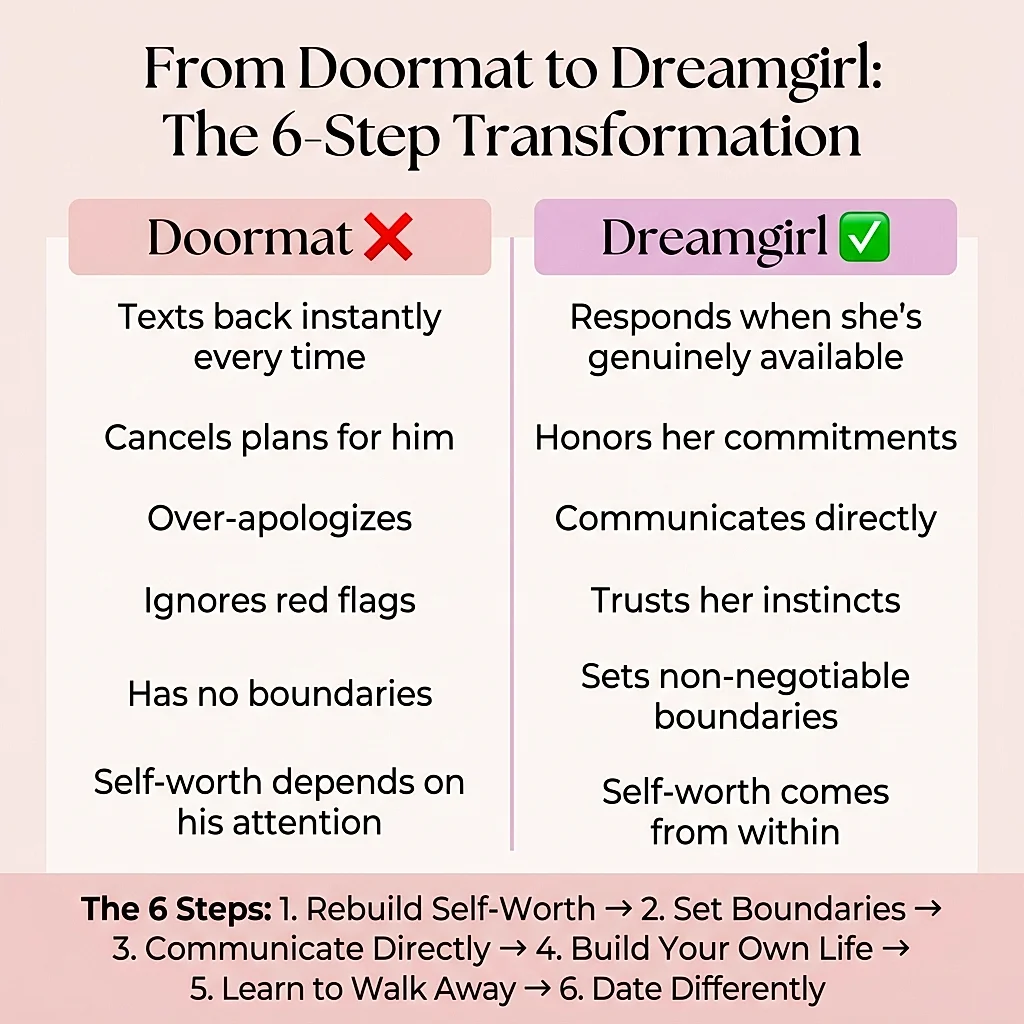
Step 1: Rebuild Your Relationship With Yourself
Everything else in this guide depends on this step. You cannot set boundaries you don't believe you deserve. You cannot communicate needs you don't believe are valid. You cannot walk away from bad treatment if some part of you thinks it's the best you'll get.
Self-worth isn't a switch you flip. It's more like a muscle — one that's probably atrophied from years of neglect. You rebuild it the same way you'd rebuild any muscle: repetition, consistency, and patience.
The Mirror Exercise
This sounds cheesy. Do it anyway. Every morning, before you check your phone, look at yourself in the mirror and say — out loud — one thing you like about yourself. Not your appearance (though that counts too). Something about who you are.
"I'm a loyal friend." "I work hard and I'm good at what I do." "I handled that situation yesterday with grace." "I'm brave for even trying to change this pattern."
The first week, it'll feel absurd. The second week, it'll feel awkward. By the third week, something shifts. You start to believe it. Not because you brainwashed yourself, but because you're finally paying attention to evidence that was always there — evidence you were too busy looking for validation from someone else to notice.
The Friend Test
When you're unsure whether you're being a doormat, ask yourself this: if my best friend told me her boyfriend was doing this, what would I say?
You'd probably say "leave him." Or at least "that's not okay." So why is it okay when it's happening to you?
We're often much better at protecting the people we love than protecting ourselves. The friend test forces you to apply the same standard to your own life that you'd apply to someone you care about.
Stop the Over-Giving
Doormat behavior often looks like generosity. You do everything for him — cook, clean, plan, organize, remember, accommodate — and tell yourself it's because you're a caring person. And maybe you are. But there's a difference between genuine generosity and giving to avoid abandonment.
Ask yourself honestly: would you still do all of this if you knew he'd stay regardless? If the answer is no — if the over-giving is fueled by fear — it's not generosity. It's a transaction. And transactions don't build real love.
Step 2: Identify and Set Non-Negotiable Boundaries
Boundaries are the single most important thing separating doormats from dreamgirls. A doormat has boundaries she doesn't enforce. A dreamgirl has boundaries she doesn't negotiate.
But here's where most women get stuck: they don't actually know what their boundaries are. They've spent so long adapting to other people's needs that they've never sat down and identified their own.
The Non-Negotiable Exercise
Get a piece of paper. Write down your answers to these:
- What behavior am I no longer willing to tolerate? (Examples: being yelled at, being lied to, being consistently deprioritized, having my feelings dismissed)
- What do I need in a relationship to feel safe and valued? (Examples: consistent communication, physical affection, emotional honesty, quality time)
- What am I willing to walk away over, even if it hurts? (This is the hard one. If nothing on your list qualifies, you don't have boundaries — you have preferences.)
Your boundaries aren't ultimatums. You don't announce them with a speech. You enforce them with action. When someone crosses a boundary, the consequence isn't a lecture — it's distance. You step back. You disengage. You protect your peace.
The First Time Is the Hardest
The first time you enforce a boundary, you'll feel like you're doing something wrong. Your heart will race. You'll want to take it back. You'll worry that he'll think you're being dramatic or unreasonable.
That discomfort? It's the sensation of breaking a pattern. It feels wrong because it's unfamiliar, not because it's actually wrong. Push through it. The second time is easier. By the fifth time, it starts to feel natural.
Step 3: Master the Art of Communication (Without Over-Explaining)
Doormats over-explain. They justify, defend, and elaborate on every feeling, every boundary, every decision — because deep down, they don't believe their reasons are good enough on their own.
"I can't hang out tonight because I already made plans with my friends and we've had this planned for three weeks and I know you wanted to see me but I just feel like I should honor my commitment and I hope you understand and I promise we can reschedule—"
A dreamgirl? "I can't tonight — I have plans. How about Thursday?"
That's it. No essay. No apology. No justification. Clear, direct, warm. She's not being rude. She's being honest. And the right man will respect that far more than a paragraph of over-explaining.
Say What You Mean. Mean What You Say.
If something bothers you, say it — the first time. Not the fifth time, after you've been silently resenting it for weeks. Not as a passive-aggressive comment disguised as a joke. Directly, calmly, without drama.
"When you cancel plans last minute, it makes me feel like I'm not a priority. I need more consistency."
That's vulnerable. It's direct. And it gives him the opportunity to either step up or show you who he is. Both outcomes are valuable information.
Stop Chasing Reassurance
Doormats ask: "Are you mad at me?" "Is everything okay?" "Do you still like me?" Constantly seeking reassurance that the relationship is safe.
This does two things, both of them bad. First, it communicates insecurity, which is exhausting for the other person. Second — and more importantly — it trains you to look outside yourself for proof of your own value. Every time you seek reassurance and get it, the relief is temporary. The anxiety comes back. And the cycle repeats.
The alternative: sit with the discomfort. Let him come to you sometimes. If silence between texts makes you spiral, that's information about your attachment patterns, not about the relationship. Work on that. Journal about it. Talk to a therapist. But don't make it his problem to solve.
Step 4: Stop Being Available 24/7
This isn't about playing games. It's about having a life.
A doormat is always available because she's organized her entire existence around the possibility that he might want to see her. She keeps her schedule open "just in case." She doesn't commit to plans with friends because what if he texts?
A dreamgirl has a calendar that's full — not because she's trying to seem busy, but because she genuinely is busy. She has hobbies, friendships, career goals, workouts, creative projects, and social commitments that existed before him and will continue to exist regardless of him.
When you have a full life, two things happen:
- You stop needing his attention to fill the void, which makes you more relaxed, confident, and attractive.
- Your time becomes genuinely valuable — to you and to him. He can't just assume you're available. He has to plan. He has to earn a spot on your calendar. Not through tests or games, but through the natural consequence of you being a person with priorities.
Practical Steps
- Commit to at least two activities per week that have nothing to do with dating. A fitness class, a book club, a creative project, volunteering. Something that's yours.
- Stop canceling plans for him. If you already committed to something, honor it. A man who's worth your time will respect that — and probably find it attractive.
- Don't reply instantly every time. Not as a manipulation tactic. As a natural consequence of being engaged in your actual life. If you're in the middle of something, finish it. He can wait.
Step 5: Learn to Walk Away
This is the hardest part. And it's the part that separates women who talk about change from women who actually change.
Walking away doesn't mean storming out of a restaurant. It means calmly, clearly, firmly removing yourself from situations that don't meet your standards. It means being willing to lose someone rather than lose yourself.
Here's the paradox: the willingness to walk away is often what makes people treat you better. Not because you're threatening them, but because it communicates something profound — that you value yourself more than you fear being alone.
That energy shifts everything. People can feel it. It's the difference between someone who stays because they want to and someone who stays because they're afraid to leave. The first one inspires respect. The second one invites mistreatment.
When to Walk Away
- When your boundaries are repeatedly crossed despite clear communication
- When you're putting in 90% of the effort and getting 10% in return
- When you feel worse about yourself than you did before the relationship
- When you're making excuses for behavior that you'd never tolerate from a friend
- When you've told him what you need and he's shown you — through actions, not words — that he's unwilling or unable to provide it
Walking away isn't failure. It's the ultimate act of self-respect. And the space it creates? That's where the right person can finally enter.
Step 6: Date Differently This Time
Once you've done the inner work — rebuilt your self-worth, identified your boundaries, learned to communicate directly — it's time to apply it in the real world. And this means dating completely differently than you did before.
Let Him Lead (at First)
I know this sounds old-fashioned. Hear me out.
When you're recovering from doormat patterns, you need to break the habit of over-functioning. That means stepping back from planning, initiating, and managing the early stages of dating. Not because you're incapable, but because you need to see what he does when you're not doing everything.
Does he plan dates? Does he follow up? Does he make effort? Or does he wait for you to do the work and then show up?
This isn't a test. It's information-gathering. A man who's genuinely interested will step forward. A man who's only interested in convenience will fade. Both outcomes save you time.
Watch Actions, Ignore Words
"I really like you." "You're different." "I've never felt this way before." Words are free. Anyone can say them. What matters is what follows.
Does he call when he says he will? Does he show up when he commits to plans? Does his behavior match his promises? Words create feelings. Actions create trust. Don't confuse the two.
Pace Yourself
Doormats go all-in immediately. First great date? She's already imagining the wedding. Second date? She's emotionally invested. Third date? She's rearranging her life around him.
Slow down. Let things unfold. You don't need to decide in the first week whether this person is your future. Give yourself permission to observe, evaluate, and decide — without the pressure of commitment hanging over every interaction.
The right person won't be scared off by you taking your time. The wrong person will — and that's exactly the point.
The Transformation Timeline: What to Actually Expect
I'd love to tell you that reading this article will fix everything by tomorrow. It won't. Transformation is messy, non-linear, and slower than you want it to be.
Here's a realistic timeline:
Week 1-2: Awareness. You start noticing your doormat patterns in real-time. You catch yourself over-apologizing, over-explaining, seeking reassurance. You don't necessarily stop, but you see it happening. That's huge.
Month 1: Discomfort. You start setting boundaries and it feels terrible. You say no for the first time and spend the next three hours convinced you ruined everything. You let a text sit for an hour without responding and your anxiety skyrockets. This is normal. This is the old programming fighting back.
Month 2-3: Adjustment. The discomfort starts to fade. Setting boundaries gets easier. You start to feel a quiet confidence that wasn't there before. Friends notice. Your posture changes. Your tolerance for nonsense drops dramatically.
Month 4-6: Integration. The new behaviors start feeling natural. You're no longer performing confidence — you have it. You find yourself walking away from situations that the old you would've clung to. You start attracting different people. Better people. People who meet your standards because you actually have standards.
Month 6+: Identity shift. You're not "trying to be a dreamgirl." You just are one. The transformation isn't a role you're playing — it's who you've become. And dating? It's not the anxiety-riddled emotional rollercoaster it used to be. It's actually enjoyable.
What the Right Relationship Looks Like After the Transformation
Once you've done this work, relationships feel fundamentally different. Not perfect. Not without challenges. But different in a way that matters.
- You feel safe without seeking constant reassurance. His silence doesn't send you spiraling. Your nervous system is calm.
- Effort is mutual. You're not doing everything. Neither is he. It's balanced — naturally, not because you're keeping score.
- You can disagree without panic. Conflict doesn't feel like the end of the world. You can express disappointment without fearing abandonment.
- You're yourself. Not a curated version. Not the cool girl. Not the low-maintenance girl. Yourself — opinions, quirks, emotions, and all. And he loves that person. Not the performance.
- You chose him. He didn't rescue you. You're not in the relationship out of fear, loneliness, or desperation. You're there because you genuinely want to be. And that changes everything about the power dynamic.
That's what's waiting on the other side of this work. Not a fairy tale. Something better: a real relationship with a real person who loves the real you.
Frequently Asked Questions
How do I go from doormat to dreamgirl without seeming cold or distant?
You don't become cold. You become clear. There's a huge difference. Cold is withdrawing affection to punish someone. Clear is expressing your needs directly and enforcing boundaries when they're crossed. The right person won't perceive healthy boundaries as coldness — they'll perceive them as self-respect, and they'll respect you more for it.
What if I set boundaries and he leaves?
Then he just gave you the most valuable information possible: he was only interested in the version of you that didn't have needs. That's not a loss. That's a bullet dodged. The right person will not only respect your boundaries — they'll appreciate them, because boundaries create the safety and clarity that healthy relationships need.
Is "from doormat to dreamgirl" about manipulating men?
Absolutely not. Manipulation is about controlling someone else's behavior for your benefit. This transformation is about changing YOUR behavior — your patterns, your self-worth, your communication. You're not tricking anyone. You're becoming a healthier, more authentic version of yourself. The changes in how men respond to you are a natural byproduct, not a manipulation tactic.
Can I transform if I'm already in a relationship?
Yes, and many women do. It's harder because you're changing the dynamic of an existing relationship rather than starting fresh, and your partner may resist the changes at first. Clear communication is essential: "I've realized I haven't been honoring my own needs, and I'm working on changing that." Some relationships improve dramatically. Others reveal themselves to be built entirely on the doormat dynamic — and when the doormat stands up, there's nothing left. Both outcomes are valuable.
How long does the transformation take?
Most women report significant internal shifts within 2-3 months of consistent effort. The full identity shift — where the new behaviors feel natural rather than forced — typically takes 6-12 months. It depends on the depth of the patterns, whether you're working with a therapist, and how consistently you practice. There's no shortcut, but every day of practice compounds.
What books should I read alongside this?
Start with "Attached" by Amir Levine (understanding your attachment style), "Boundaries" by Henry Cloud (learning to set and enforce limits), and "Women Who Love Too Much" by Robin Norwood (understanding the over-giving pattern). Each one addresses a different dimension of the doormat-to-dreamgirl transformation.
The Truth Nobody Tells You
Going from doormat to dreamgirl isn't about becoming a different person. It's about removing the layers of people-pleasing, fear, and conditioning that have been hiding who you actually are.
Underneath the over-apologizing, the excessive accommodation, the fear of being "too much" — there's a woman with opinions, desires, standards, and a spine. She's been there the whole time. She's just been too afraid to show up because somewhere along the way, she learned that being herself wasn't safe.
It is safe. And the right people will prove that to you — once you give them the chance to meet the real you.
Start today. Not tomorrow. Not when you feel "ready." Not when the current situationship ends. Today. Pick one thing from this guide and do it. Set one boundary. Say one honest thing. Stop over-explaining one decision.
That's how it starts. One small act of self-respect, followed by another, and another, until you look up and realize you're not the same person you were six months ago.
You're the dreamgirl. And you always were.



💬 Discussion (0)
No comments yet. Be the first to share your thoughts!