
Christian Marriage Counseling: A Faith-Based Guide to Healing and Strengthening Your Relationship
My pastor once told me something I'll never forget. I was sitting in his office, embarrassed to be there, explaining that my wife and I were "going through a rough patch." He listened quietly for about ten minutes, then said: "You know, David and Bathsheba had problems. Abraham and Sarah had problems. Jacob and Rachel had problems. You're in good company."
Then he leaned forward. "But those marriages survived because God was in the middle of them. The question isn't whether your marriage has problems. The question is whether you're willing to invite someone in to help you work through them."
That conversation led me to Christian marriage counseling — and I'll be honest, it wasn't what I expected. I'd imagined someone reading Bible verses at us while we sat on a couch feeling judged. What I actually got was a licensed therapist who happened to share our faith, who used both clinical tools and biblical wisdom, and who helped us see patterns we'd been blind to for years.
If you're a Christian couple struggling in your marriage — or even just feeling the distance grow — this guide covers everything you need to know about faith-based counseling. What it is, how it differs from secular therapy, what it costs, how to find the right counselor, and why getting help isn't a sign of weak faith. It's a sign of strong obedience.
What Is Christian Marriage Counseling?
Christian marriage counseling is a form of couples therapy that integrates biblical principles and spiritual practices alongside evidence-based therapeutic techniques. It's not prayer instead of therapy. It's prayer plus therapy.
A Christian marriage counselor is typically a licensed mental health professional — an LMFT, LPC, LCSW, or psychologist — who also has training in pastoral care or biblical counseling. They bring the same clinical tools as any secular therapist (cognitive behavioral techniques, emotionally focused therapy, Gottman Method exercises) but they also incorporate:
- Scripture — using biblical teachings to frame relationship dynamics, forgiveness, and covenant commitment
- Prayer — opening or closing sessions with prayer, or praying together about specific issues
- Spiritual disciplines — incorporating practices like devotional study, gratitude journaling, and serving together
- Covenant theology — understanding marriage as a sacred covenant before God, not just a legal contract
- Forgiveness frameworks — drawing on Christ's model of grace and redemption to address betrayal and hurt
The key distinction is this: secular counseling asks "how can we make this relationship work better?" Christian marriage counseling asks that same question — and adds: "how does God want us to grow through this, and what does His design for marriage look like in our specific situation?"
Both questions matter. And in my experience, addressing them together produces something deeper than either one alone.
Why Christian Couples Hesitate to Seek Counseling (And Why They Shouldn't)
Within the church, there's often an unspoken belief that strong faith should be enough to fix a marriage. If you're praying hard enough, serving faithfully enough, and trusting God completely enough — your marriage should just work.
This belief, while well-intentioned, has kept countless Christian couples stuck in pain for years longer than necessary. Here's why it's wrong:
"We Should Be Able to Handle This With Prayer Alone"
Prayer is powerful. Nobody's arguing that. But consider this: when you break your arm, you pray AND you go to the doctor. When your car breaks down, you pray AND you call a mechanic. Why would your marriage be different?
God works through people. He works through skilled counselors who've spent years learning how human relationships function. Seeking professional help isn't a lack of faith — it's using the resources God has placed in your path. Proverbs 11:14 says it plainly: "Where there is no guidance, a people falls, but in an abundance of counselors there is safety."
"Our Church Might Judge Us"
This fear is real, and unfortunately, sometimes justified. Some church communities do carry stigma around counseling. But here's what I've found: the couples who were brave enough to be open about getting help almost always discovered that their transparency gave other struggling couples permission to seek help too.
Your marriage isn't a performance for the congregation. It's a covenant between you, your spouse, and God. Getting help to honor that covenant is an act of spiritual maturity, not weakness.
"What If the Counselor Tells Us to Divorce?"
A Christian marriage counselor operates within a framework that honors the sanctity of marriage. Their default orientation is toward reconciliation and restoration — not because they'll guilt you into staying, but because they believe in the redemptive power of covenant commitment.
That said, reputable Christian counselors also recognize that there are situations — abuse, addiction that endangers family safety, unrepentant infidelity — where separation may be the wisest and most protective course of action. They won't force you to stay in a situation that's destroying you. They'll help you discern the path forward with both wisdom and grace.
"We Can't Afford It"
This is a practical concern, and it's valid. But consider the cost of not going. What does it cost — emotionally, spiritually, financially — to let your marriage deteriorate for another year? Another five years? Divorce, if it comes to that, costs the average American family $15,000-$20,000. A full course of counseling typically runs $1,500-$5,000.
Many churches also offer subsidized counseling, and many Christian counselors offer sliding-scale fees. The resources exist. Sometimes you just need to ask.
Christian Marriage Counseling vs. Secular Counseling: What's Actually Different?
This is probably the most common question I hear, and the answer is more nuanced than most people expect.
What's the Same
At the clinical level, a lot. Licensed Christian counselors use the same evidence-based techniques as their secular counterparts:
- Emotionally Focused Therapy (EFT) — helping couples identify and change negative emotional cycles
- The Gottman Method — building friendship, managing conflict, creating shared meaning (based on 40 years of research)
- Cognitive Behavioral Therapy (CBT) — addressing distorted thought patterns that fuel conflict
- Communication skills training — active listening, "I" statements, conflict de-escalation
These tools work regardless of your faith background, and a good Christian counselor won't abandon them in favor of "just praying about it."
What's Different
The framework. In secular counseling, the goal is typically individual happiness and relationship satisfaction. If the relationship isn't making both people happy, ending it is a neutral option. In Christian counseling, marriage is understood as a covenant — a sacred commitment that exists within God's larger story. This doesn't mean divorce is never an option, but it does mean the default orientation is toward restoration, healing, and keeping the covenant intact.
The source of authority. Secular counseling draws on psychological research and therapeutic theory. Christian counseling draws on those same sources AND on Scripture, pastoral wisdom, and the counsel of the Holy Spirit. This isn't about ignoring science in favor of Bible verses — it's about integrating both.
The role of forgiveness. Forgiveness is a therapeutic concept in both settings, but in Christian counseling it takes on a deeper dimension. It's modeled on Christ's forgiveness of us — unearned, unconditional, and transformative. This framework gives couples a profound template for extending grace to each other, even when it feels impossible.
The spiritual dimension. Christian counseling addresses issues that secular therapy typically doesn't touch: spiritual warfare in the home, the role of individual and shared devotional life, the impact of unconfessed sin on intimacy, the healing power of praying together, and the couple's shared calling and purpose.
Types of Christian Marriage Counseling
Not all faith-based counseling looks the same. Here are the main approaches you'll encounter:
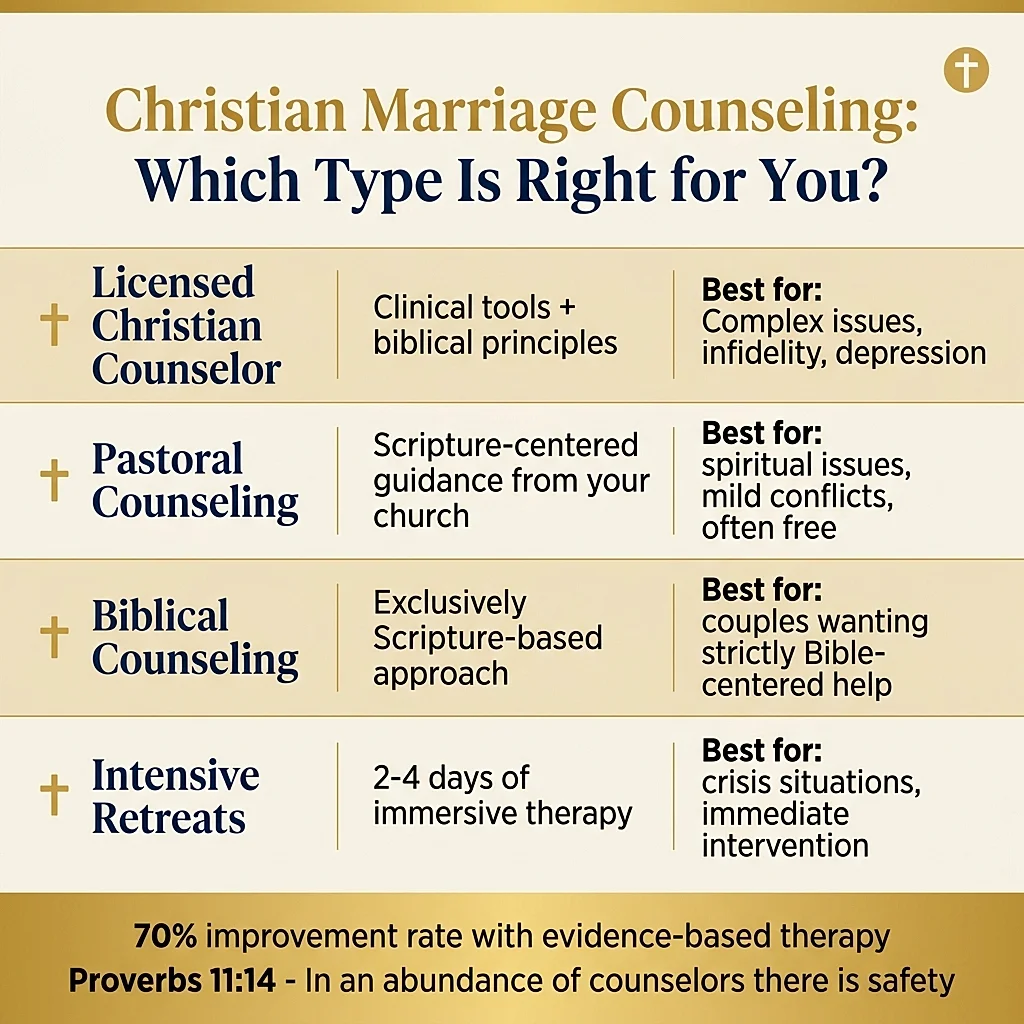
Licensed Professional Christian Counseling
This is the gold standard. The counselor holds a state license (LMFT, LPC, LCSW, PsyD) AND has additional training in integrating faith with clinical practice. They can diagnose mental health conditions, use evidence-based treatments, and bill insurance — all while incorporating biblical principles.
Best for: Couples dealing with serious issues — infidelity, depression, anxiety, communication breakdown, sexual difficulties, or blended family challenges. The clinical training ensures they can handle complex situations that require more than pastoral guidance alone.
Pastoral Counseling
This is counseling provided by a pastor, elder, or church leader — often someone with a degree in divinity or pastoral care. Pastoral counselors are deeply rooted in Scripture and theology, and they understand the specific dynamics of Christian marriages.
Best for: Couples whose issues are primarily spiritual — struggling with shared devotional life, navigating theological disagreements, processing a faith crisis, or needing guidance on biblical roles within the marriage. Pastoral counseling is often free or low-cost, making it a good starting point.
Limitation: Most pastoral counselors aren't licensed mental health professionals. If the issues involve diagnosable conditions (depression, PTSD, addiction), a licensed professional is the better choice.
Biblical Counseling (Nouthetic Counseling)
This approach, developed by Jay Adams, relies exclusively on Scripture as the source of guidance and change. It views the Bible as sufficient for addressing all of life's problems, including marriage difficulties.
Best for: Couples who want a strictly Bible-centered approach and are comfortable with a framework that prioritizes Scripture over psychological theory.
Limitation: The exclusively biblical approach can miss clinical issues that benefit from evidence-based treatment. Many mainstream Christian counseling organizations recommend an integrated approach that values both Scripture and psychological science.
Intensive Marriage Retreats
Several Christian organizations offer intensive counseling retreats — typically 2-4 days of immersive therapy. Programs like Focus on the Family's Hope Restored, Retrouvaille (Catholic), and National Institute of Marriage offer concentrated, faith-based couples work that accomplishes months of weekly sessions in a single weekend.
Best for: Couples in crisis who need immediate, intensive intervention. Also good for couples who can't commit to weekly sessions due to scheduling or geography.
Online Christian Marriage Counseling
The same quality counseling, delivered via video call. Multiple studies confirm that online couples therapy is as effective as in-person sessions for most situations. This format is particularly valuable for:
- Couples in rural areas without access to local Christian counselors
- Military families or couples separated by work travel
- Anyone who wants more scheduling flexibility
- Couples who feel more comfortable in their own home environment
Platforms like LoveConnet connect couples directly with verified Christian relationship counselors who offer both online and in-person sessions. If you're looking for a faith-based therapist who understands your values, browse our counselor directory to find someone who fits.
What to Expect in Christian Marriage Counseling
Walking into your first session is nerve-wracking. Here's what actually happens so you're not going in blind.
Session 1: Getting to Know Your Marriage
The first appointment is mostly assessment. Your counselor will ask about:
- Your relationship history — how you met, when things started feeling difficult
- Current issues — the specific problems that brought you in
- Individual backgrounds — family of origin, past relationships, personal mental health
- Faith life — your individual and shared spiritual practices, church involvement, how faith plays a role in your marriage
- Goals — what would "better" look like for both of you?
Some counselors will also ask to meet with each partner individually for one session. This gives each person the chance to share things they might not say in front of their spouse — at least not yet.
Don't worry about being "ready" or having the right answers. The counselor's job is to create a safe space. Your job is to show up honestly.
The Middle Phase: Doing the Work
Regular sessions (typically weekly or biweekly, 50-90 minutes each) will involve:
- Pattern identification — recognizing the cycles you're stuck in (pursue-withdraw, attack-defend, mutual avoidance)
- Communication exercises — practicing healthier ways to express needs, frustrations, and appreciation
- Conflict resolution — learning to disagree without destruction
- Forgiveness work — processing past hurts and developing a framework for genuine (not performative) forgiveness
- Spiritual practices — may include praying together in session, discussing relevant Scripture, or developing shared devotional habits
- Homework — exercises to practice between sessions (these are where the real change happens)
How Long Does It Take?
- 6-12 sessions: Specific issues like communication improvement or navigating a transition
- 12-24 sessions: More complex patterns, rebuilding after betrayal, or addressing multiple issues
- 24+ sessions: Deep-rooted issues or couples who find ongoing support valuable
Most couples see meaningful progress within 8-12 sessions if both partners are genuinely engaged.
How Much Does Christian Marriage Counseling Cost?
Real numbers, because vague answers don't help:
- Licensed Christian counselors (private practice): $100-$250 per session
- Pastoral counseling (through your church): Often free or donation-based
- Online Christian counseling platforms: $60-$150 per session
- Intensive marriage retreats: $1,500-$5,000 for a full program (2-4 days)
- Community or church-affiliated counseling centers: $25-$80 per session (sliding scale)
Ways to Reduce the Cost
- Ask your church. Many churches have counseling funds specifically for members in need. Some will pay for a set number of sessions. Others have staff counselors who provide services for free.
- Check your insurance. Some plans cover counseling when billed under an individual diagnosis. Ask the counselor if they accept your insurance or offer superbills for out-of-network reimbursement.
- Sliding scale fees. Many Christian counselors offer reduced rates based on financial need. Don't be afraid to ask.
- Graduate training programs. Christian universities with counseling programs (Liberty, Regent, Denver Seminary) often have training clinics where supervised graduate students provide therapy at significantly reduced rates.
How to Find the Right Christian Marriage Counselor
The quality of your counselor matters more than almost anything else. Research consistently shows that the therapeutic relationship — how comfortable and safe you feel with your specific therapist — is the strongest predictor of positive outcomes.
Where to Look
- Your pastor. Most pastors maintain referral lists of trusted Christian counselors in the area
- The American Association of Christian Counselors (AACC) — the largest organization of Christian counselors, with a searchable directory
- Psychology Today — filter by "Christian" under the Religion section in their therapist finder
- Focus on the Family's counseling referral line — they offer a free initial consultation and referrals
- LoveConnet — our platform connects couples with verified Christian relationship counselors. Find a counselor who shares your faith
Questions to Ask Before You Book
- "How do you integrate faith into your counseling approach?" — This tells you whether they genuinely incorporate biblical principles or just have "Christian" in their title
- "Are you licensed?" — Licensure ensures clinical competence. Faith alone doesn't qualify someone to handle complex relational trauma
- "What's your approach to divorce?" — A good Christian counselor will honor the covenant without guilting you into an unsafe situation
- "How do you handle situations where partners have different levels of faith?" — This is common, and a skilled counselor navigates it with sensitivity
- "What does a typical session look like?" — Make sure the format and style match your expectations
Red Flags to Watch For
- They use Scripture as a weapon to guilt or shame either partner
- They consistently take one partner's side (often the husband's in some church contexts)
- They dismiss clinical issues (depression, anxiety, trauma) as purely spiritual problems
- They have no formal training or licensure — just a Bible and good intentions
- They insist you stay in a relationship that involves abuse, without addressing safety
When Your Spouse Won't Go to Counseling
This is one of the most common situations Christian couples face. One partner recognizes the need for help; the other resists. Maybe they see it as a sign of failure. Maybe they're afraid of what might come up. Maybe they genuinely believe prayer should be enough.
What You Can Do
Reframe the conversation. Instead of "we need counseling because our marriage is failing," try: "I want our marriage to be the best it can be. I think talking to someone could help us get there." Frame it as an investment in your future, not an intervention for your problems.
Start with pastoral counseling. Some spouses who resist "therapy" are open to meeting with a pastor or church leader. This can serve as a bridge to professional counseling once they see the value of guided conversations.
Go alone. Individual counseling focused on your marriage can be remarkably effective. You can't change your spouse, but you can change your own patterns — and when one partner changes, the relational dynamic often shifts enough that the other partner notices and becomes curious.
Involve a trusted couple. Sometimes hearing from another married couple — especially one who's been through counseling themselves — carries more weight than anything you can say. Men, in particular, often respond better to hearing another man's experience.
The Biblical Foundation for Marriage Counseling
For those who need the scriptural backing — and there's nothing wrong with wanting it — the Bible is remarkably clear about the value of seeking counsel:
- Proverbs 12:15 — "The way of a fool is right in his own eyes, but a wise man listens to advice."
- Proverbs 15:22 — "Without counsel plans fail, but with many advisers they succeed."
- Proverbs 11:14 — "Where there is no guidance, a people falls, but in an abundance of counselors there is safety."
- Galatians 6:2 — "Bear one another's burdens, and so fulfill the law of Christ."
- Ecclesiastes 4:9-10 — "Two are better than one... For if they fall, one will lift up his fellow."
The pattern is consistent: wisdom comes from seeking guidance. Marriage counseling isn't a modern invention that contradicts biblical principles — it's a practical expression of them.
What Christian Marriage Counseling Can (and Can't) Do
What It Can Do
- Help you communicate needs without attacking each other
- Identify the patterns driving your recurring conflicts
- Rebuild trust after betrayal or broken promises
- Restore emotional and physical intimacy
- Navigate major transitions (new baby, career change, empty nest) with your faith intact
- Deepen your shared spiritual life
- Help you forgive — genuinely, not just performatively
- Give your marriage a framework that honors both psychological health and biblical truth
What It Can't Do
- Force your spouse to change if they're unwilling
- Guarantee that your marriage will survive (though it significantly improves the odds)
- Replace individual therapy if one or both partners have personal mental health issues that need separate attention
- Substitute for personal spiritual growth — your relationship with God is your responsibility, not your counselor's
- Fix abuse. If you're in an abusive relationship, your first step is safety — not counseling. Contact the National Domestic Violence Hotline at 1-800-799-7233
For Christian Counselors: The Demand Has Never Been Higher
If you're a licensed counselor with a heart for faith-based marriage work, here's the landscape:
- 11,000+ people search for "christian marriage counseling" every month — and that number is growing
- Christian couples are increasingly seeking counselors who share their faith AND have clinical credentials
- Online counseling has removed geographic barriers, meaning you can serve couples anywhere
- The stigma around counseling within the church is declining rapidly, especially among younger Christians
The need is massive. The supply is limited. Couples are actively searching for counselors who understand both the clinical and the spiritual dimensions of marriage.
LoveConnet is building a community where licensed Christian counselors connect directly with couples who need faith-based support. If you're passionate about helping marriages thrive through both clinical excellence and biblical wisdom — apply to join our counselor network and start reaching the couples who are looking for exactly what you offer.
Frequently Asked Questions
Is Christian marriage counseling only for Christian couples?
Most Christian counselors welcome couples of any faith background, as long as both partners are comfortable with a faith-integrated approach. If one spouse is Christian and the other isn't, a skilled Christian counselor will navigate that difference with sensitivity — incorporating faith where it's welcome and relying on clinical tools where it's not.
How is Christian marriage counseling different from regular couples therapy?
The clinical techniques are largely the same. The difference is the framework: Christian counseling views marriage as a sacred covenant, incorporates Scripture and prayer, emphasizes forgiveness modeled on Christ's grace, and addresses the spiritual dimensions of the relationship. It's therapy plus faith — not one instead of the other.
What if our pastor offers to counsel us? Should we go to a licensed counselor instead?
It depends on the complexity of your issues. Pastoral counseling is excellent for spiritual guidance, mild communication issues, and general marriage enrichment. For more complex issues — clinical depression, trauma, addiction, infidelity — a licensed professional with specific couples therapy training is the better choice. Many couples benefit from both: pastoral support for the spiritual dimension and professional therapy for the clinical dimension.
Can we do Christian marriage counseling online?
Yes. Research confirms that online couples therapy is equally effective as in-person therapy for most situations. Many Christian counselors now offer video sessions, making it possible to work with a faith-based therapist regardless of your location.
How do I know if our marriage needs professional counseling or just prayer?
If you've been praying about the same issue for months and nothing has changed, that's often God's way of directing you toward additional resources. Prayer and counseling aren't competing options — they're complementary. The most effective approach is usually both: seeking God's guidance through prayer AND seeking human wisdom through a trained counselor.
What if we can't afford it?
Start with your church — many have counseling funds or staff counselors who serve for free. Ask potential therapists about sliding-scale fees. Look into graduate training clinics at Christian universities. And consider that the cost of not going — in emotional damage, spiritual disconnection, and potential divorce — far exceeds the cost of a few months of sessions.
Your Marriage Is Worth Fighting For
If you've been on the fence about seeking help, consider this: the fact that you're reading this article means something in your marriage needs attention. Maybe it's a specific wound that hasn't healed. Maybe it's a slow drift you can't quite name. Maybe it's just the sense that things could be better — that the marriage God designed for you has more to offer than what you're currently experiencing.
Whatever it is, it won't fix itself. Prayer matters. Personal effort matters. But sometimes the most faithful thing you can do is invite a skilled guide into the journey — someone who can see what you can't, challenge what you've normalized, and help you build something stronger than what you started with.
Ecclesiastes 4:12 puts it this way: "A cord of three strands is not quickly broken." In your marriage, those three strands are you, your spouse, and God. A Christian marriage counselor doesn't add a fourth strand — they help you weave the three you already have more tightly together.
Start today. Not when things get worse. Not when you've "tried everything else." Today. Because the marriage God has for you is worth every ounce of effort it takes to find it.



💬 Discussion (0)
No comments yet. Be the first to share your thoughts!