
Therapy for Trust Issues: How to Heal When You Can't Stop Waiting for the Other Shoe to Drop
I knew I had a trust problem when I found myself going through my boyfriend's phone at 2 AM — for the third time that month.
Not because he'd done anything wrong. He hadn't. He was, by every objective measure, a good partner. Present. Faithful. Consistent. And I was repaying that consistency by treating him like a suspect in an investigation he didn't know was happening.
The worst part? I knew it was irrational. I could see myself doing it and think, "This is insane. He's given you no reason to doubt him." But the anxiety didn't care about evidence. It operated on a deeper logic — one that said: everyone leaves eventually, everyone lies eventually, and if you let your guard down, you'll be the last to know.
That logic didn't come from my current relationship. It came from every relationship before it. From a father who promised to show up and didn't. From a first boyfriend who swore he wasn't talking to anyone else while maintaining an entirely separate relationship. From a pattern of betrayal that had taught my nervous system one lesson: trust is a setup for devastation.
I finally went to therapy — not because I wanted to "fix myself," but because I could see the destruction coming. I was going to sabotage the best relationship I'd ever had, and I couldn't stop myself alone.
Therapy for trust issues didn't just help me stop checking his phone. It helped me understand why I needed to. And that understanding changed everything.
What Are Trust Issues, Really?
Trust issues get tossed around casually — "I have trust issues" has become a dating profile disclaimer. But clinical trust issues are more than skepticism or caution. They're a persistent, often unconscious pattern of expecting betrayal, deception, or abandonment from people who are close to you.
Trust issues typically manifest as:
- Hypervigilance — constantly scanning for signs of dishonesty, infidelity, or emotional withdrawal
- Testing behavior — unconsciously creating situations to "prove" your partner can't be trusted (then interpreting neutral results as suspicious)
- Emotional walls — keeping people at arm's length to avoid the vulnerability that trust requires
- Self-sabotage — pushing away good relationships because the intimacy feels unsafe
- Controlling behavior — monitoring a partner's phone, social media, location, or friendships
- Difficulty being vulnerable — struggling to share feelings, needs, or fears because vulnerability has been punished before
- Catastrophic thinking — assuming the worst about ambiguous situations ("she's late = she's with someone else")
- Chronic jealousy — feeling threatened by your partner's relationships with others, even platonic ones
Here's what most people don't understand: trust issues aren't a character flaw. They're an adaptive response. At some point in your life, not trusting people was the smart move. It protected you. The problem is that your nervous system is still running that protective program even when the threat is gone.
Therapy doesn't ask you to just "decide to trust." It helps your nervous system learn that safety is possible again.
Where Do Trust Issues Come From?
Trust issues always have a source. Understanding yours is the first step toward healing — because the treatment depends on the root cause.
Childhood and Family of Origin
This is the most common and deepest source. If the people who were supposed to be your first safe haven were instead unpredictable, absent, or harmful, your brain learned early that close relationships are dangerous.
Specific childhood experiences that create trust issues:
- Inconsistent parenting — a parent who was loving one day and rageful or withdrawn the next. You never knew which version you'd get, so you learned to stay on guard
- Parental abandonment — a parent who left, was incarcerated, or was emotionally absent. The lesson: people who say they'll be there won't be
- Parental infidelity — witnessing one parent betray the other teaches children that love and betrayal coexist
- Emotional neglect — having your feelings dismissed, minimized, or punished. You learned that showing vulnerability leads to pain
- Abuse — physical, emotional, or sexual abuse from a caregiver creates a fundamental breach of trust that shapes every subsequent relationship
These experiences shape your attachment style — the template your brain uses for all close relationships. If your early attachments were insecure, your adult relationships will carry that template until it's consciously restructured. This is exactly what emotionally focused therapy is designed to address.
Romantic Betrayal
Infidelity. Lies. Financial deception. Emotional affairs. Hidden addictions. These are the trust injuries that most people think of first, and they're devastating precisely because they come from the person you chose to be most vulnerable with.
After betrayal, the brain doesn't just lose trust in the person who hurt you. It often generalizes — losing trust in the entire category. One partner's infidelity becomes "all men cheat" or "no one can be faithful." One friend's betrayal becomes "people only care about themselves."
This generalization is a protective mechanism, but it's also a prison. It punishes every future partner for the sins of a past one.
Trauma (Beyond Relationships)
Trauma from any source — assault, accidents, medical trauma, combat, natural disasters — can create trust issues. When your sense of safety has been shattered in one area, it often bleeds into others. If the world feels fundamentally unsafe, how can any individual person within it be trusted?
Post-traumatic stress can manifest as hypervigilance, emotional numbness, difficulty with intimacy, and a persistent sense that danger is always nearby — all of which look like "trust issues" in relationships.
Repeated Relational Patterns
Sometimes trust issues develop not from a single traumatic event but from a pattern of smaller disappointments. Friends who gossip behind your back. Bosses who take credit for your work. Partners who make promises they don't keep. None of these alone constitutes trauma, but together they build a worldview: people aren't reliable. Relying on others is foolish. The only person you can count on is yourself.
Types of Therapy That Work for Trust Issues
Not all therapy is equally effective for trust issues. Here are the approaches with the strongest evidence:
Emotionally Focused Therapy (EFT)
Emotionally focused therapy is arguably the most effective approach for trust issues within a relationship. EFT is built on attachment theory — the science of how human beings form emotional bonds — and directly addresses the fear, vulnerability, and protective behaviors that trust issues create.
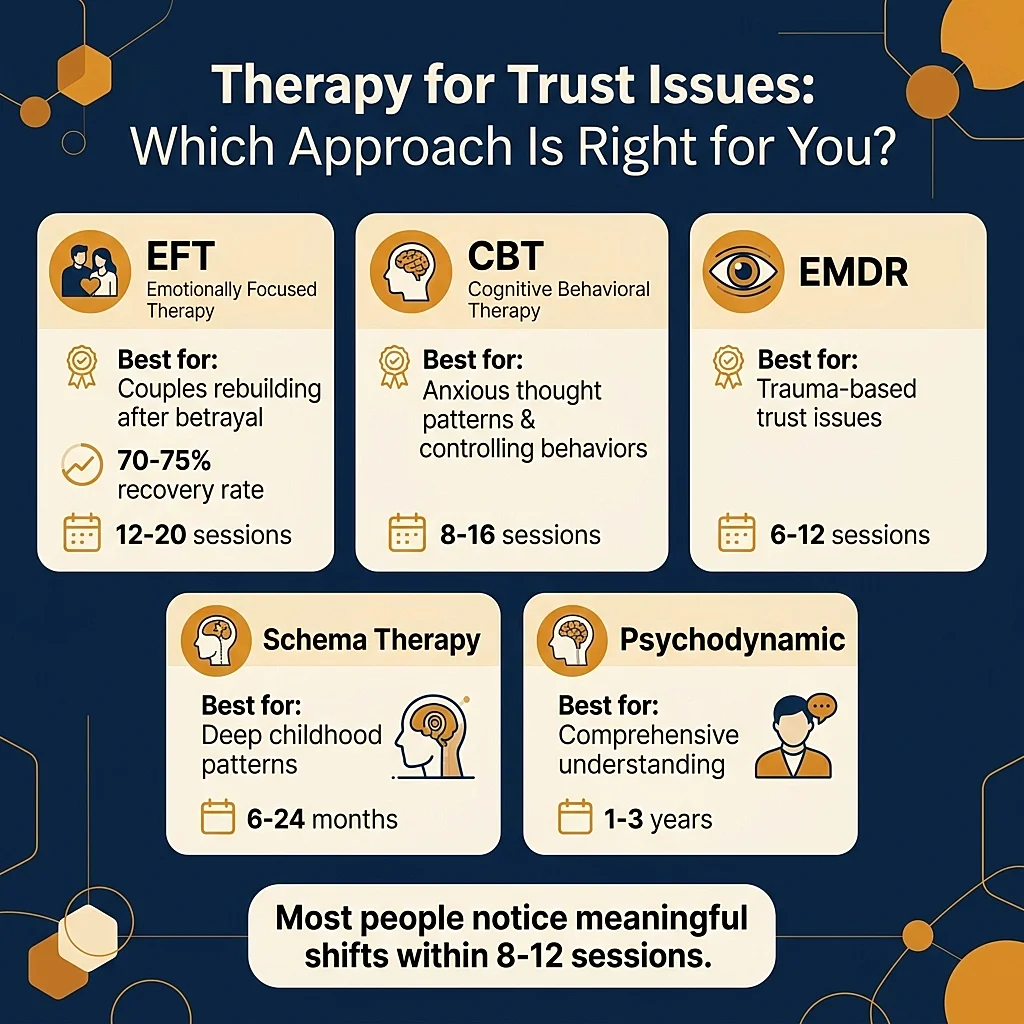
In EFT, you'll learn to:
- Identify the negative cycle your trust issues are driving (pursue-withdraw, monitor-defend)
- Access the deeper emotions underneath the distrust (fear of abandonment, terror of being deceived again)
- Express those emotions to your partner in a way that invites connection rather than defensiveness
- Create "bonding events" — moments where vulnerability is met with genuine care, gradually rewiring your attachment template
Best for: Couples dealing with trust issues together — especially after infidelity or emotional betrayal. EFT has a specific protocol (the Attachment Injury Resolution Model) designed for processing betrayals of trust. Research shows 70-75% of couples move from distress to recovery.
Cognitive Behavioral Therapy (CBT)
CBT targets the thought patterns that fuel trust issues. When you have trust issues, your mind runs a predictable script: assume the worst, filter for confirming evidence, dismiss contradicting evidence, and treat your interpretation as fact.
A CBT therapist will help you:
- Identify cognitive distortions — mind-reading ("she's thinking about leaving"), catastrophizing ("he's 10 minutes late, something is wrong"), black-and-white thinking ("one lie means everything was a lie")
- Challenge those distortions with evidence — what's the actual probability? What are alternative explanations?
- Develop healthier thought patterns through structured exercises
- Reduce anxiety-driven behaviors (phone checking, reassurance-seeking, interrogating)
Best for: Individuals whose trust issues manifest primarily as anxious thinking patterns and controlling behaviors. CBT is structured, practical, and produces relatively quick results (8-16 sessions for focused work).
EMDR (Eye Movement Desensitization and Reprocessing)
EMDR is a trauma-processing therapy originally developed for PTSD. It's highly effective when trust issues stem from specific traumatic events — a parent's abandonment, a partner's infidelity, abuse, or assault.
EMDR works by helping the brain reprocess traumatic memories so they lose their emotional charge. The memory doesn't disappear, but it stops triggering the same flood of panic, hypervigilance, and protective shutdown. When the trauma is resolved, the trust issues that grew from it often resolve naturally.
Best for: Trust issues rooted in identifiable traumatic events. EMDR is often faster than traditional talk therapy for trauma — many people experience significant relief in 6-12 sessions.
Schema Therapy
Schema therapy addresses the deep life patterns (schemas) that develop in childhood and run your relationships on autopilot. If you grew up with abandonment, mistrust, or emotional deprivation, you likely have core schemas — deeply held beliefs like "people will always leave me" or "I can't trust anyone to be honest" — that operate below conscious awareness.
Schema therapy helps you:
- Identify your core schemas and understand where they came from
- Recognize how those schemas drive your behavior in current relationships
- Develop a "healthy adult" mode that can override the schema when it activates
- Gradually revise the schema through corrective experiences — both in therapy and in real relationships
Best for: Deep-rooted trust issues that trace back to childhood, especially when the same patterns have repeated across multiple relationships over many years.
Psychodynamic Therapy
Psychodynamic therapy explores how your unconscious patterns — formed in early relationships — play out in your current life. It's less structured than CBT and slower than EMDR, but it offers something neither can: a deep understanding of why you are the way you are.
For trust issues specifically, psychodynamic therapy examines:
- How your early attachment relationships created your template for trust
- How you unconsciously recreate those early dynamics in adult relationships
- The defense mechanisms you use to protect yourself from vulnerability (intellectualization, projection, avoidance)
- How the therapeutic relationship itself becomes a corrective experience — trusting your therapist is practice for trusting others
Best for: People who want deep, comprehensive understanding of their trust patterns and are willing to invest time in longer-term therapy.
What Therapy for Trust Issues Actually Looks Like
The idea of therapy can itself trigger trust issues — you're being asked to be vulnerable with a stranger. Here's a realistic picture of what to expect.
The First Few Sessions: Building Safety
A good therapist knows that someone with trust issues can't just dive into deep emotional work on day one. The first 2-4 sessions are about building a foundation of safety.
Your therapist will:
- Ask about your history — what happened, who hurt you, how you've coped
- Explain their approach and what therapy will look like
- Set clear boundaries — confidentiality, session structure, what to expect
- Let you set the pace. A therapist pushing too fast with someone who has trust issues will lose them
You might test your therapist without realizing it. Arriving late to see how they respond. Withholding information to see if they push. Watching for inconsistencies. This is normal. It's your trust template running its diagnostic. A skilled therapist will recognize this and respond with consistent, non-judgmental presence — which itself is part of the healing.
The Middle Phase: Doing the Work
Once safety is established, the real work begins. Depending on the approach, this might involve:
- Examining specific memories — when did trust first break for you? What happened, and what did you make it mean?
- Identifying patterns — how do your trust issues show up in current relationships? What are the triggers?
- Challenging beliefs — is "no one can be trusted" actually true, or is it a generalization from specific experiences?
- Building tolerance for vulnerability — gradually practicing openness in a safe setting (therapy) before extending it to relationships
- Processing grief — because underneath trust issues there's almost always unprocessed grief for what you lost or never had
How Long Does It Take?
- CBT for specific trust-related anxiety: 8-16 sessions
- EMDR for trauma-based trust issues: 6-12 sessions
- EFT for couples rebuilding trust: 12-20 sessions
- Schema therapy for deep-rooted patterns: 6-24 months
- Psychodynamic therapy for comprehensive work: 1-3 years
Most people notice meaningful shifts within 8-12 sessions, regardless of the approach. You won't be "cured" in that time, but you'll have enough understanding and tools to start changing the pattern in real time.
Can You Fix Trust Issues Without Therapy?
You can make progress on your own — but therapy accelerates the process dramatically and addresses depths that self-help typically can't reach. That said, these practices genuinely help alongside professional support:
1. Learn Your Attachment Style
Understanding whether you're anxious, avoidant, disorganized, or secure gives you a framework for your behavior. When you can say "I'm doing the anxious-attachment thing right now" instead of "I'm going crazy," you've created a crucial gap between trigger and reaction.
2. Practice Gradual Vulnerability
Trust isn't all-or-nothing. You don't have to go from zero to fully vulnerable overnight. Start small. Share something mildly personal with a friend. See what happens. Share something slightly more personal. Build a track record of positive experiences that your nervous system can reference.
3. Distinguish Past from Present
When you feel the distrust surge, ask yourself: "Is this about what's happening right now, or is this about what happened before?" Often the intensity of the reaction will tell you — if checking his location tracker feels like life or death, the emotion is disproportionate to the situation. That's a signal that the past is speaking.
4. Communicate the Fear, Not the Accusation
"I'm feeling anxious and I don't know why" is a vulnerable statement that invites connection. "Where were you? Who were you with? Let me see your phone" is an accusation that invites defensiveness. Learning to express your needs without attacking is one of the most important relationship skills you can develop.
5. Build Self-Trust First
Sometimes the deepest trust issue isn't about other people — it's about yourself. You don't trust your own judgment because it's failed you before. "I trusted the wrong person" becomes "I can't trust my ability to evaluate people."
Rebuilding self-trust means: keeping promises to yourself, honoring your own boundaries, making decisions and following through, and learning to distinguish intuition from anxiety.
Trust Issues in Relationships: When to Go Alone vs. Together
Individual Therapy Is Better When:
- Your trust issues predate your current relationship (childhood origins)
- You recognize the issue is primarily internal — your partner hasn't done anything to warrant distrust
- You need a space to explore vulnerability without your partner present
- You have unprocessed trauma that needs attention before couples work can be effective
Couples Therapy Is Better When:
- Trust was broken within the relationship (infidelity, deception, broken promises)
- Both partners need to understand the dynamic they're caught in
- The untrusting partner needs to hear the other partner respond to their fear with empathy
- You want to rebuild trust together rather than individually
Many people benefit from both — individual therapy to process the roots and couples therapy to apply the healing within the relationship.
How Much Does Therapy for Trust Issues Cost?
- Private practice therapist: $100-$250 per session
- Online therapy platforms: $60-$150 per session
- Community mental health centers: $20-$80 per session (sliding scale)
- Graduate training clinics: $10-$50 per session (supervised by licensed professionals)
- EMDR specialists: $150-$300 per session (specialized training reflected in fees)
For a full course of focused trust-issue work (12-20 sessions), expect roughly $1,200-$5,000 depending on approach and setting. Check your insurance — many plans cover individual and couples therapy when billed under an appropriate diagnosis.
For couples working through trust issues from a faith-based perspective, Christian marriage counseling offers an additional dimension — forgiveness modeled on grace, covenant commitment, and the healing power of shared spiritual practice.
How to Find the Right Therapist for Trust Issues
Finding a therapist when you have trust issues is uniquely challenging — you're asking someone who struggles to trust to find a stranger and trust them with their deepest wounds. Here's how to make it manageable.
What to Look For
- Specialization in trauma, attachment, or relationship issues — not all therapists are equipped for deep trust work
- Training in evidence-based approaches — EFT, CBT, EMDR, or schema therapy specifically
- A consultation call — most therapists offer a free 15-minute call. Use it to gauge how safe you feel with them
- Consistency and reliability — a therapist who cancels frequently or runs late will reinforce your trust issues rather than heal them
Where to Search
- Psychology Today — filter by "Trust Issues," "Attachment," or "Trauma" in the specialties section
- EMDRIA — if you want EMDR specifically, this is the official directory
- ICEEFT — for certified Emotionally Focused Therapists
- LoveConnet — we connect individuals and couples with verified relationship counselors specializing in trust repair and attachment work. Find a therapist who understands trust issues
Red Flags in a Therapist
- They dismiss your concerns or tell you to "just trust more"
- They push too fast before safety is established
- They break confidentiality boundaries
- They seem distracted, inconsistent, or unreliable
- You feel judged rather than understood
It's okay to try 2-3 therapists before committing. This isn't indecisiveness — it's due diligence. The therapeutic relationship is the most important factor in outcomes, and with trust issues specifically, the fit matters even more.
For Therapists: The Demand for Trust-Issue Specialization Is Surging
If you're a licensed counselor who specializes in attachment, trauma, or relationship work:
- 16,300+ people search for "therapy for trust issues" every month — and growing 23% year over year
- The intersection of attachment theory and clinical practice is increasingly sought by informed consumers
- Trust issues touch every relational domain — dating, marriage, friendship, workplace, family
- Online therapy has expanded your potential client base beyond geographic limits
LoveConnet connects qualified therapists with individuals and couples actively seeking help with trust and relationship issues. If this is your specialty — apply to join our therapist network.
Frequently Asked Questions
Can therapy actually fix trust issues?
Yes — but "fix" might not be the right word. Therapy helps you understand where your trust issues come from, develop awareness when they're activated, build tolerance for vulnerability, and gradually create new experiences that update your nervous system's threat assessment. You won't become blindly trusting. You'll become wisely trusting — able to assess risk accurately rather than assuming the worst.
How long does it take to overcome trust issues?
It depends on the depth and source. Surface-level trust anxiety (from a recent betrayal) can improve significantly in 8-16 sessions. Deep-rooted patterns from childhood typically require 6-24 months of consistent work. Most people notice meaningful shifts within the first 2-3 months.
What if I don't trust the therapist?
That's actually expected — and a skilled therapist will welcome it. Your difficulty trusting them IS the material. How you navigate distrust within the therapeutic relationship becomes practice for navigating it everywhere else. A good therapist will be patient, consistent, and transparent — proving through their behavior that reliability exists.
Should I tell my partner about my trust issues?
Generally, yes — but with nuance. Saying "I have trust issues and I'm working on them" is vulnerable and helpful. Saying "I have trust issues so I need your passwords" is using the label to justify controlling behavior. A therapist can help you find the right way and time to have this conversation.
Are trust issues a mental illness?
Trust issues themselves aren't a diagnosable mental disorder, but they often co-occur with conditions that are — PTSD, attachment disorders, anxiety disorders, and borderline personality disorder all involve significant trust difficulties. A licensed therapist can assess whether an underlying condition is contributing and adjust treatment accordingly.
Can you have trust issues without being cheated on?
Absolutely. Some of the deepest trust issues come from childhood experiences — inconsistent parenting, abandonment, emotional neglect — that have nothing to do with romantic betrayal. You can enter your very first relationship with fully formed trust issues because the template was set long before you started dating.
Trust Is a Practice, Not a Destination
Here's what therapy taught me that no amount of self-help reading ever did: trust isn't a switch you flip. It's a practice you build. You don't wake up one morning and think, "I'm healed — I trust people now." You wake up and notice that when your partner is 20 minutes late, you feel a flicker of anxiety instead of a tidal wave. You notice, and you choose not to check his location. You sit with the discomfort instead of acting on it. And then he walks in the door with takeout, and your nervous system logs another data point: safe. He came back. Safe.
Over time, those data points accumulate. The anxiety doesn't disappear — it just gets quieter. The assumption of betrayal gets replaced by something more nuanced: this person has shown up consistently for months. The evidence suggests they're trustworthy. My fear is real, but it's about the past, not the present.
That's what healing looks like. Not the absence of fear, but the presence of choice. You feel the old pull — to check, to question, to withdraw, to test — and you choose differently. Not because someone told you to "just trust." But because you've done the work to understand where the pull comes from, and you've built enough internal safety to let the pull exist without obeying it.
If you're reading this and recognizing yourself — the hypervigilance, the walls, the push-pull, the exhausting performance of pretending everything is fine while internally scanning for threats — you're not broken. You're adapted to a world that wasn't safe. And the good news is: adaptation goes both ways. The same brain that learned to expect betrayal can learn to recognize safety. It just needs help getting there.
Find a therapist. Take the first step. The trust issues that have been running your relationships don't have to have the last word.
Related Reading
- Relationship Counseling: Everything You Need to Know Before Your First Session
- Emotionally Focused Couples Therapy: How EFT Helps Partners Reconnect
- Christian Marriage Counseling: A Faith-Based Guide to Healing Your Marriage
- Christian Relationship Counseling: Faith-Based Guidance at Every Stage
- From Doormat to Dreamgirl: How to Stop Settling and Start Getting the Love You Deserve



💬 Discussion (0)
No comments yet. Be the first to share your thoughts!