
Let's be completely honest for a second. Have you ever gone out of your way to do something incredibly nice for someone you were dating—maybe you spent hours cooking a fantastic meal, or you bought them a really thoughtful gift—and their reaction was just... flat?
You felt unappreciated. They felt overwhelmed. And neither of you understood why.
This exact scenario plays out in Christian dating all the time. We often assume that because we share the same faith and the same values, we automatically communicate love the exact same way. But human psychology doesn't work like that. The reality is that we all have a specific "currency" we use to give and receive love. If you're spending dollars and he only accepts euros, you are both going to end up emotionally broke.
This is where the concept of the 5 Love Languages comes in. It's an absolute game-changer for navigating relationships, especially when you are Christian dating in your 30s and want to figure out compatibility without wasting months of your life.
DEFINITION:
The 5 Love Languages is a concept developed by Dr. Gary Chapman in 1992. It states that there are five primary ways that human beings experience and express romantic love: Words of Affirmation, Quality Time, Receiving Gifts, Acts of Service, and Physical Touch.
KEY TAKEAWAYS
- You default to your own language: We naturally show love in the way we want to receive it, which often completely misses the mark with our partner.
- Fluency requires effort: A healthy relationship requires you to "learn a second language" to communicate in a way your partner actually understands.
- Physical Touch isn't just sexual: In a Christian dating context, this language is about safety, presence, and non-sexual physical reassurance.
- It eliminates confusion: Knowing his love language helps you decode his behavior, acting as the ultimate cheat code alongside the 7 obvious signs he likes you.
What Actually Is a Love Language?
Dr. Gary Chapman, a relationship counselor and pastor, noticed a strange pattern in his counseling sessions. Couples were sitting on his couch, clearly exhausted, saying things like, "I just don't feel loved by him." Meanwhile, the husband would look bewildered and reply, "But I work 50 hours a week to provide for you and I fixed your car yesterday!"
The husband was speaking Acts of Service. The wife was listening for Quality Time.
A "Love Language" is simply the specific avenue through which your brain registers emotional affection. When someone speaks your primary language, your emotional tank fills up rapidly. When they ignore it, you feel unvalued—even if they are doing a hundred other nice things for you.
Let's break down all five, how to spot them, and how to use them to build a rock-solid relationship.
1. Words of Affirmation
For people whose primary language is Words of Affirmation, actions do not necessarily speak louder than words. Unsolicited compliments, verbal encouragement, and hearing the words "I love you" are the lifeblood of their emotional security.
If you are dating a man with this language, he isn't going to feel secure just because you showed up to his church event. He needs you to actually look at him and say, "I am so proud of how you led that group today. You are so good at what you do."
- How to speak it: Send random encouraging text messages during his workday. Leave a sticky note on his steering wheel. Be highly vocal about what you appreciate about his character.
- What destroys it: Harsh criticism, sarcastic insults, and the "silent treatment." For a words-of-affirmation person, verbal insults are physically painful and incredibly hard to forget.
2. Quality Time
This language is all about undivided attention. It's not just about sitting on the same couch while you both scroll through Instagram on your phones. That is proximity, not quality time. Quality time requires eye contact, active listening, and being fully present.
When you are trying to figure out if a guy likes you, his time investment is massive. A man whose language is Quality Time will cancel plans just to sit in a coffee shop with you for two hours, deeply engaged in conversation without checking his phone once.
- How to speak it: Put your phone on "Do Not Disturb" when you are on a date. Ask open-ended questions. Plan dates where the main activity is just talking and connecting, rather than just staring at a movie screen.
- What destroys it: Constantly checking your phone when he's talking, distracted listening, and repeatedly postponing dates.
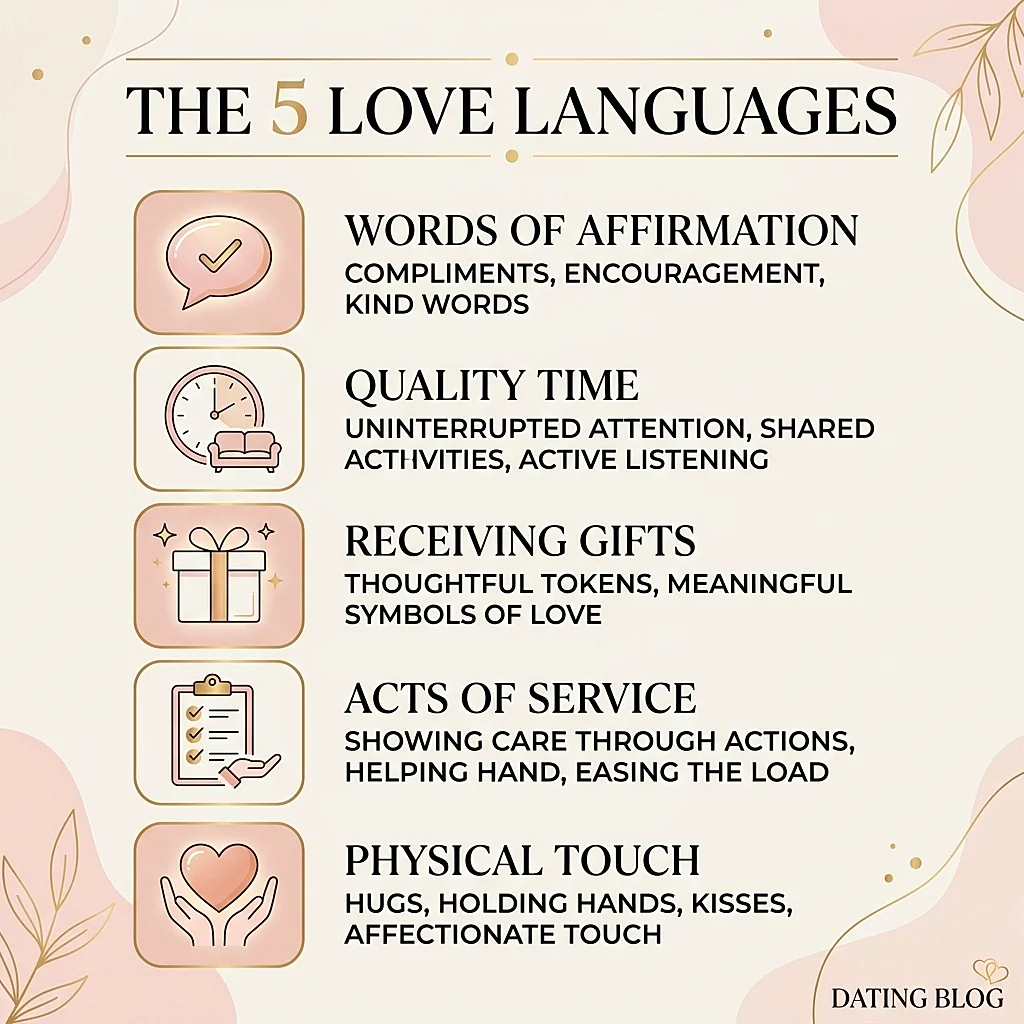
3. Receiving Gifts
People often drastically misunderstand this one. It is not about being materialistic or a gold digger. For someone with the Receiving Gifts language, the physical object is just a tangible symbol of the thought and effort behind it.
It's not about a $5,000 Rolex. It's about him bringing you your exact favorite Starbucks order—the complicated one with oat milk and half a pump of vanilla—on a random Tuesday because he remembered you mentioned you had a rough morning. The gift says, "He was thinking about me when I wasn't around."
- How to speak it: Keep a running note on your phone of things he mentions he likes. Bring him a small pastry from his favorite bakery. Pick up a book you think he'd enjoy.
- What destroys it: Forgetting birthdays, generic gift cards that require zero thought, or making them feel guilty for liking presents.
4. Acts of Service
For these folks, talk is cheap. If you say "I love you" but leave the kitchen a total mess while they are exhausted, they will not feel loved. Their motto is: "Don't tell me you care, show me."
In a dating context, this looks like a man who notices your tire pressure is low and fills it up for you, or a woman who realizes her boyfriend is swamped with finals week and brings him a home-cooked meal so he doesn't have to think about dinner.
- How to speak it: Look for practical ways to lighten his load. Ask, "What can I do to make your week easier?" and then actually do it.
- What destroys it: Breaking promises, laziness, and creating more work for them when they are already stressed.
5. Physical Touch
In the Christian dating sphere, this language can sometimes feel complicated due to boundaries around purity. But it is crucial to understand that Physical Touch is not inherently sexual. It is about the physical reassurance of presence.
A person with this language feels secure through hand-holding, a reassuring hand on the shoulder during a tough conversation, or sitting close together on a bench. The physical connection releases oxytocin, grounding them and making them feel deeply connected.
- How to speak it: High-fives, sitting shoulder-to-shoulder, warm hugs when greeting each other, and gentle, non-sexual physical contact that respects your mutual boundaries.
- What destroys it: Physical neglect, flinching away from contact, or using physical touch purely as a transaction.
How to Find Out His Love Language (Without Being Weird)
You don't need to force him to take a 50-question quiz on your second date. Just watch how he treats other people. We naturally project our own love language onto others. If he is always volunteering to help his friends move (Acts of Service), that's likely how he wants to be loved. If he is always gassing up his friends with compliments (Words of Affirmation), start speaking that language to him.
Understanding these five languages is the ultimate tool for relationship success. When you stop loving him the way you want to be loved, and start loving him the way he needs to be loved, everything changes. The miscommunications drop. The walls come down. And you finally start speaking the same language.
Frequently Asked Questions
Can your love language change over time?
Absolutely. While we usually have a dominant baseline, major life events can shift your needs. For example, if you just started an incredibly stressful new job, you might temporarily crave Acts of Service above all else to help you manage the chaos.
Is it bad if my partner and I have completely different languages?
Not at all! In fact, it is extremely rare for a couple to share the exact same primary language. It just means you both have to be intentional. Relationships take work, and learning to fluently speak a language that isn't native to you is one of the highest forms of romantic maturity.
Can you have more than one love language?
Yes, most people have a primary and a secondary language. You might be 60% Quality Time and 40% Physical Touch. The goal isn't to put yourself in a rigid box; it's to give your partner a roadmap to your heart.



💬 Discussion (0)
No comments yet. Be the first to share your thoughts!