
If you've ever Googled "relationship advice," you already know the problem. The internet is drowning in vague platitudes — "communication is key," "never go to bed angry," "love is a choice." Those phrases aren't wrong, exactly. They're just useless without context. They're bumper stickers posing as wisdom.
Real relationship advice — the kind that actually changes how you show up for another person — is specific, uncomfortable, and sometimes hard to hear. It requires you to look at your own patterns honestly, not just catalog your partner's flaws. And it applies whether you've been together for six months or thirty-six years.
This guide isn't a collection of greeting card quotes. It's a practical, research-informed breakdown of the 15 rules that separate couples who last from couples who don't. Some of these will confirm what you already suspect. Others might sting a little. All of them work.
69%
of relationship conflicts are perpetual — meaning they never fully resolve. According to the Gottman Institute, successful couples learn to manage these recurring disagreements rather than trying to "win" them.
📋 The 15 Rules Inside This Guide
- Listen Like You Mean It
- Learn to Fight Fair
- Turn Toward the Bids
- Build Trust in Small Moments
- Keep Intimacy Alive
- Get Honest About Money
- Protect Your Independence
- Set Digital Boundaries
- Speak Their Love Language
- Red Flags vs. Normal Friction
- Advice for New Couples
- Advice for Long-Term Couples
- Navigating In-Laws & Family
- When to Seek Therapy
- The Daily Habits That Matter
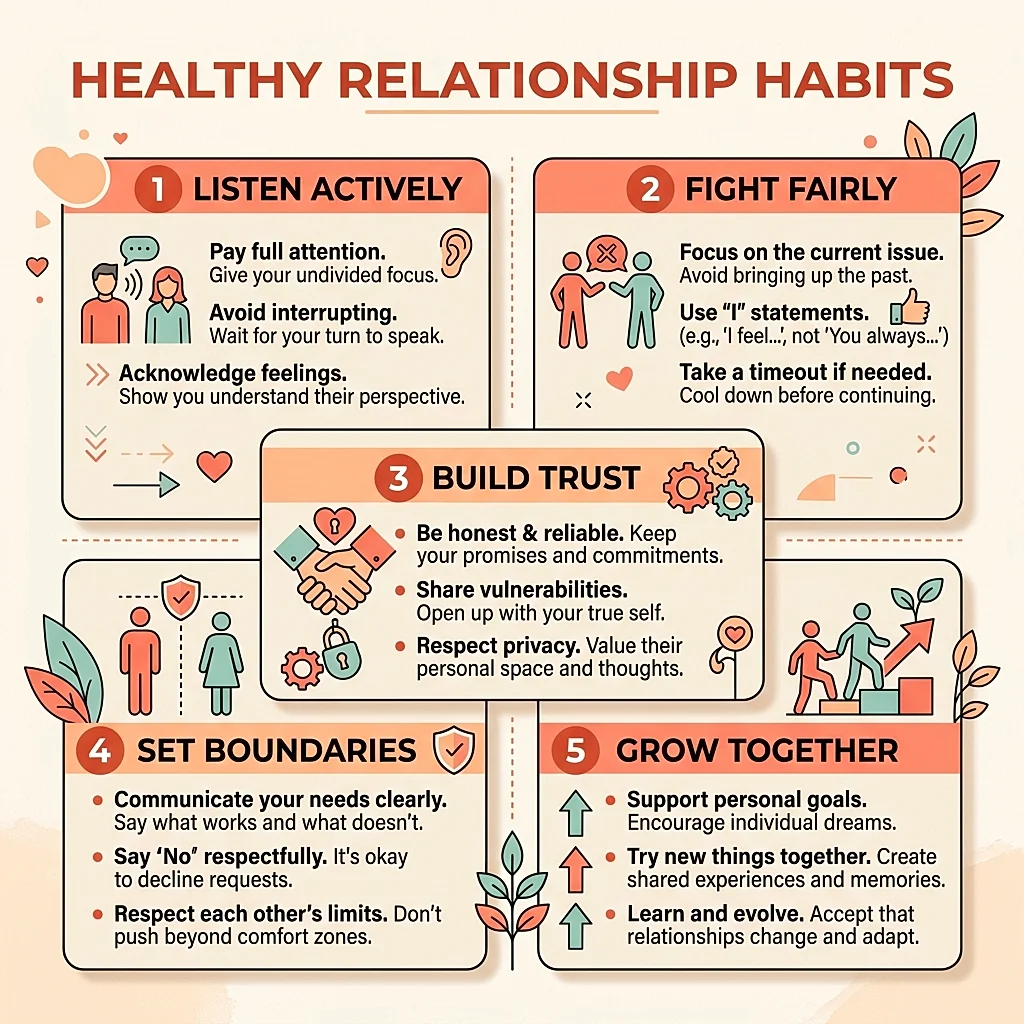
1. Listen Like You Actually Mean It
The most common relationship advice you'll hear is "communicate better." It's not bad advice — it's just incomplete. The real issue isn't that couples don't talk enough. It's that they don't listen enough. There's a massive difference between hearing the words coming out of your partner's mouth and genuinely absorbing what they're trying to tell you.
Most of us listen with one ear while mentally assembling our rebuttal. We're not processing — we're loading ammunition. And our partners can feel it. That's why the same argument keeps happening every three weeks like clockwork. Nobody's actually listening; both people are just taking turns talking at each other.
What active listening looks like in practice: When your partner says something that triggers a reaction in you, pause. Before you respond with your perspective, reflect back what they said: "So what I'm hearing is that you felt dismissed when I made that decision without asking you. Is that right?" It sounds almost painfully simple, but research from the Gottman Institute shows that this single habit — reflecting before responding — defuses more conflicts than any other technique.
"Most couples don't have a communication problem. They have a listening problem disguised as a communication problem."
2. Learn How to Fight Fair
Here's a piece of relationship advice that might surprise you: fighting is not the problem. Every healthy couple fights. The couples who claim they "never argue" are either lying or suppressing things that will eventually detonate.
The issue isn't whether you fight — it's how you fight. Dr. John Gottman's decades of research identified four communication patterns so destructive he calls them the "Four Horsemen of the Apocalypse":
🏇 The Four Horsemen of Relationship Destruction
- 1. Criticism: Attacking your partner's character instead of addressing the behavior. "You're so lazy" vs. "I need more help with the dishes."
- 2. Contempt: Mocking, eye-rolling, name-calling, or sarcasm dripping with superiority. This is the single strongest predictor of divorce.
- 3. Defensiveness: Meeting every complaint with a counter-complaint. "Well, you do it too!" instead of "You're right, I dropped the ball on that."
- 4. Stonewalling: Shutting down completely — walking away, going silent, emotionally checking out mid-conversation.
Fighting fair means keeping all four of these off the table. Use "I feel" statements instead of "You always" accusations. Take a 20-minute break if your heart rate spikes above 100 BPM (your brain literally cannot think rationally at that point). And when the argument is over, actually repair — don't just let it fade into cold silence and pretend it didn't happen.
3. Turn Toward the Bids
This is one of the most powerful — and least talked about — pieces of relationship advice in existence. Gottman's research discovered that throughout any given day, partners make dozens of small "bids" for each other's attention. A bid might be as small as saying "Look at that dog across the street" or as significant as "I had a rough day — can we talk?"
You have three options when your partner makes a bid: turn toward it (engage), turn away from it (ignore them), or turn against it (respond with irritation: "I'm busy, can you not see that?").
Here's the staggering statistic: couples who stayed married after six years turned toward each other's bids 86% of the time. Couples who divorced? Only 33%. The difference between lasting love and divorce isn't some dramatic betrayal — it's thousands of tiny moments where you either paid attention or didn't.
Next time your partner says something seemingly mundane — "This soup turned out pretty good" — put your phone down, look at them, and engage. That three-second interaction matters more than you think.
4. Build Trust in the Small Moments
Trust isn't built in grand gestures. You don't earn trust by buying diamonds or planning surprise vacations. Trust is built in the boring, unremarkable moments — the ones nobody posts on social media.
It's built when you say you'll be home at 7 and you're actually home at 7. When you remember the name of your partner's annoying coworker and ask how the situation resolved. When you defend them in front of your family instead of laughing along with the joke at their expense.
And trust is destroyed just as quietly. A pattern of small broken promises — forgetting to pick up the prescription, canceling plans last minute, checking your phone while they're mid-sentence — erodes trust so gradually that by the time you notice the damage, you're standing in rubble.
Rebuilding Trust After a Betrayal
If trust has been broken in a serious way — infidelity, financial deception, a major lie — rebuilding it is possible, but it requires a specific process. The person who broke the trust must do three things consistently: take full accountability (no minimizing, no "but you pushed me to it"), demonstrate changed behavior over an extended period (not just two good weeks), and tolerate their partner's need to process the hurt, even when it's exhausting.
The person whose trust was broken must eventually make a choice: either commit to the rebuilding process with genuine openness, or leave. Staying in the relationship while withholding forgiveness indefinitely punishes both people.
"Trust is built in drops and lost in buckets. Pay attention to the drops."
5. Keep Intimacy Alive (It Takes More Than You Think)
When most people hear "intimacy," they think about the bedroom. But physical closeness is just one layer. Emotional intimacy — the feeling that your partner truly sees you, knows you, and accepts the real version of you — is what holds a relationship together when the initial spark inevitably settles into something quieter.
Physical intimacy matters too, of course. But here's the relationship advice nobody wants to hear: if your emotional connection has gone cold, no amount of physical effort will fix it. Emotional distance always precedes physical distance. Fix the first one, and the second one usually follows.
Practical Ways to Rebuild Closeness
- The 6-second kiss: Relationship therapists recommend replacing the routine peck goodbye with a deliberate, six-second kiss. It sounds almost silly, but it forces both of you to be physically and emotionally present for a moment — and it completely changes the energy of a morning routine.
- Weekly check-ins: Set aside 30 minutes once a week — phones off, TV off — to ask each other: "How are we doing? Is there anything you need from me that you're not getting?" Couples who do this regularly report significantly higher satisfaction.
- Nonsexual touch: Hold hands during a movie. Put your hand on their back while they're cooking. Play with their hair while you're reading. Casual, affectionate touch throughout the day maintains a physical connection that doesn't always need to lead somewhere.
6. Get Brutally Honest About Money
Money is the number-one source of stress in relationships. Not infidelity, not in-laws, not incompatible sex drives — money. And the reason it causes so much damage is that most couples avoid talking about it until they're already in crisis.
Financial compatibility doesn't mean you need identical spending habits. It means you need to be transparent about what you earn, what you owe, what you spend, and what you're saving toward. Hiding a credit card balance from your partner is a form of deception. So is making major purchases without a conversation.
The Money Conversation Framework
Sit down once a month (yes, monthly — put it on the calendar) and review your finances together. Not in a "let me audit you" way, but as a team looking at the same dashboard. Cover three things:
- Where are we? — Current balances, upcoming bills, any surprises.
- Where are we going? — Savings goals, upcoming big expenses, retirement progress.
- Where do we disagree? — This is the important one. Maybe one of you wants to renovate the kitchen while the other wants to pay down the mortgage faster. Get it on the table before it turns into resentment.
7. Protect Your Independence — Seriously
This is the piece of relationship advice that gets the most pushback, especially from people in the honeymoon phase: you need a life outside your relationship. Your own friends. Your own hobbies. Your own identity that exists independently of being someone's partner.
Couples who merge into a single social unit — who stop seeing their own friends, who abandon hobbies they loved before the relationship, who can't spend a Saturday apart without anxiety — are building a house on a single pillar. When the relationship hits turbulence (and it will), neither person has anywhere to turn for perspective, support, or a pressure valve.
Maintaining your own friendships and interests isn't selfish. It's what keeps you interesting, grounded, and emotionally healthy — which makes you a better partner, not a worse one.
8. Set Clear Digital Boundaries
This is a category of relationship advice that didn't exist twenty years ago, and it's now responsible for a staggering number of arguments. Phones, social media, and the constant pull of digital distraction have introduced entirely new ways to damage a relationship — most of them subtle enough that you don't notice until the damage is done.
The Phone at the Dinner Table
If you're scrolling Instagram while your partner is telling you about their day, you're sending a clear message: this screen is more interesting than you are. You might not mean it that way, but that's how it lands. Make meals a phone-free zone. It's a small boundary with an outsized impact on how connected you feel.
Social Media and Jealousy
Liking an ex's photos, DMing someone your partner doesn't know about, maintaining dating app profiles "just to browse" — these aren't gray areas. They're boundary violations. If you wouldn't do it with your partner watching over your shoulder, you probably shouldn't be doing it.
That said, demanding your partner's phone passwords or monitoring their messages isn't healthy either. If you feel the need to surveil your partner, the problem isn't their phone — it's the trust deficit in the relationship, and that needs to be addressed directly.
9. Actually Learn Their Love Language
Gary Chapman's "Five Love Languages" concept has become so mainstream that it's almost a cliché at this point. But here's why it keeps showing up in every serious discussion about relationship advice: it works. The core idea is simple but genuinely transformative.
The five languages are: Words of Affirmation, Acts of Service, Receiving Gifts, Quality Time, and Physical Touch. Most people default to expressing love in their own language rather than their partner's. So if your love language is Acts of Service, you show love by doing the dishes and mowing the lawn. But if your partner's love language is Words of Affirmation, they're starving for verbal reassurance while you're silently folding laundry wondering why they don't feel loved.
The fix is straightforward: ask your partner which language makes them feel most appreciated. Then do that thing consistently, even when it doesn't come naturally to you. Love isn't just a feeling — it's a practice.
5:1
The "magic ratio" for stable relationships. According to the Gottman Institute, happy couples maintain at least 5 positive interactions for every 1 negative interaction during conflict.
10. Red Flags vs. Normal Relationship Friction
The internet has made everyone hyper-vigilant about "red flags" — sometimes to the point where normal, human imperfections get treated like deal-breakers. Not every annoying habit is a red flag. Not every disagreement is "toxic." Part of being in a relationship is accepting that you're sharing your life with another flawed human being.
Here's how to tell the difference:
🚩 Actual Red Flags
- Contempt — mocking you, name-calling, deliberate cruelty
- Controlling behavior — dictating who you see, what you wear, monitoring your location
- Gaslighting — making you question your own memory and perception
- Repeated lying about significant things
- Refusal to take any responsibility, ever
- Escalating anger — throwing things, punching walls, intimidation
✅ Normal Friction
- Disagreements about household chores or schedules
- Different social energy levels (introvert vs. extrovert)
- Occasional forgetfulness or carelessness
- Needing different amounts of alone time
- Miscommunication that leads to hurt feelings
- Having different opinions on parenting, finances, or politics
Normal friction is workable. It's the stuff you navigate through conversation, compromise, and sometimes agreeing to disagree. Red flags are patterns of behavior that indicate a fundamental lack of respect, safety, or emotional maturity. Don't confuse the two — but don't ignore the real ones either.
11. Relationship Advice for New Couples
The first year of a relationship is exhilarating and terrifying in equal measure. Everything feels electric. You want to spend every minute together. You overlook flaws that will annoy you later. This is normal — it's called limerence, and it's essentially your brain on a cocktail of dopamine and oxytocin.
The best relationship advice for new couples is this: enjoy the high, but don't mistake it for the whole relationship. That intoxicating early intensity always fades — not because the relationship is failing, but because your brain physically cannot sustain that chemical rush indefinitely. What replaces it, if you've built something real, is a deeper, quieter form of love that's far more sustainable.
Early Mistakes That Cause Long-Term Damage
- Moving too fast: Moving in together after three months because "it just feels right" skips the phase where you discover how someone handles stress, conflict, and boredom. Give it at least a year before combining households.
- Abandoning your friends: Disappearing into a relationship cocoon is tempting, but it leaves you isolated and dependent. Your friends will still be there when the honeymoon phase wears off — but only if you maintained those relationships.
- Ignoring early discomfort: If something feels off — they're dismissive of your feelings, they're rude to waitstaff, they pressure you past your boundaries — trust your gut. Those early signals rarely improve with time.
12. Relationship Advice for Couples Who've Been Together 10+ Years
Long-term couples face a completely different set of challenges than new ones. The passion has settled. The routines are deeply grooved. You might feel more like roommates than romantic partners. This is the stage where a lot of people panic and think something is broken — but often, the relationship just needs intentional effort, not an overhaul.
The Roommate Trap
When your conversations are exclusively about logistics — "Did you pay the electric bill?" "What time is soccer practice?" "We need more milk" — you've slipped into roommate mode. You're managing a household together, but you've stopped being curious about each other as people.
The fix isn't complicated, but it does require deliberate effort. Schedule actual dates — not just dinner at the same restaurant you've been going to for twelve years, but something new. Take a cooking class together. Go to a comedy show. Drive somewhere you've never been on a random Saturday. Novelty reactivates the same brain circuits that fired during the early days of your relationship.
Growing Together vs. Growing Apart
People change. The person you married at 28 is not the same person sitting across from you at 45. Their interests shift, their priorities evolve, their worldview expands (or contracts). This isn't a threat to your relationship — it's a feature of being alive. The question is whether you're evolving together or in parallel tracks that are slowly diverging.
Check in regularly. Not about the kids or the mortgage — about each other. "What are you excited about right now? What's weighing on you? What do you wish was different about our life?" These conversations keep you connected to the actual person you're with, not the version of them you've constructed in your head.
📖 Related Reading
If you're navigating dating later in life — after divorce, the loss of a spouse, or a long hiatus — our complete guide covers everything from safety to first dates: Dating 60 and Over: The Ultimate Guide to Finding Love Again.
13. Navigating In-Laws and Extended Family
Here's a piece of relationship advice that will save you years of silent resentment: your partner's family is a package deal. You don't have to love them. You don't even have to like them. But you do need a strategy for dealing with them that doesn't put your partner in the middle of a loyalty tug-of-war.
The Boundary Rule
The universal rule that every couples therapist will tell you: each partner handles their own family. If your mother-in-law is overstepping, your partner should be the one to address it — not you. When you go directly at your partner's parent, they feel attacked from both sides and will almost always side with the family they've known for decades over the partner they've known for a few years.
Conversely, if your own parent is being disrespectful to your partner, it's your job to step up. Saying "That's just how Mom is" isn't a boundary — it's an excuse. Your partner needs to know you'll protect the relationship, even when it means having an uncomfortable conversation with your own family.
Holidays Without the Drama
The annual holiday negotiation — whose family do we visit, how long do we stay, why does your dad always make that comment — is a predictable landmine. The best approach is to decide your holiday plan at least a month in advance, as a team, with a clear rotation or compromise that feels fair to both sides. Don't wait until Thanksgiving week to figure it out. By then, emotions are too high for rational negotiation.
14. When to Stop Trying Alone and Get Professional Help
There's a persistent myth that going to couples therapy means your relationship has failed. The opposite is true. Seeking therapy means you care enough about the relationship to invest real time and money into fixing it. The couples who are in actual trouble are the ones who refuse to go.
Signs It's Time
- The same argument keeps repeating — same topic, same escalation, same unresolved ending — more than three or four times.
- You've stopped fighting entirely. Not because things are good, but because you've both given up on being heard.
- Trust has been broken in a significant way (infidelity, hidden debt, major deception) and you can't move past it on your own.
- One or both of you are seriously considering leaving.
- You feel more like business partners managing a household than romantic partners building a life.
Finding the Right Therapist
Not all therapists are created equal. Look specifically for someone trained in Gottman Method or Emotionally Focused Therapy (EFT) — both are backed by substantial research. Avoid therapists who take sides, who see you individually but never together, or who seem more interested in assigning blame than building skills. A good couples therapist acts like a referee and a coach, not a judge.
💡 Looking for a Genuine Connection?
Whether you're starting over or searching for the first time, LoveConnet was built for people who take relationships seriously. A vetted, secure environment for mature singles who want real connection — not games.
15. The Daily Habits That Quietly Hold Everything Together
Grand gestures get all the attention — the surprise trip to Paris, the elaborate anniversary dinner, the heartfelt handwritten letter. And those things are wonderful. But they're not what determines whether your relationship survives the next decade. That job belongs to the small, daily, unglamorous habits that nobody talks about because they're not Instagram-worthy.
The Habits That Matter Most
- The morning greeting: How you say hello in the morning sets the emotional tone for the entire day. A genuine "Good morning, I'm glad you're here" — even if you're groggy and running late — costs nothing and deposits directly into your emotional bank account.
- The reunion ritual: When you see each other at the end of the day, put the phone down. Make eye contact. Ask a real question — "What was the best part of your day?" — and actually listen to the answer. This 60-second interaction is worth more than a dozen roses.
- Saying thank you for the boring stuff: "Thanks for taking out the trash." "I appreciate you dealing with the insurance company." Gratitude for the mundane, unglamorous labor of shared life prevents the slow creep of feeling taken for granted.
- Going to bed at the same time: It's not always possible, but when it is, going to bed together creates a natural window for conversation, physical closeness, and emotional winding-down that disappears when one person stays up watching TV for two more hours.
- The unprompted text: A random mid-afternoon message — "Thinking about you" or "That thing you said this morning made me laugh again" — takes five seconds and makes your partner feel seen in the middle of a busy day.
None of these habits are exciting. None of them will go viral on TikTok. But strung together, day after day, year after year, they create a relationship that feels warm, safe, and deeply connected — which is what every piece of relationship advice is ultimately trying to help you build.
Frequently Asked Questions
What is the number one piece of relationship advice?
Listen more than you talk. Most relationship problems stem not from a lack of love, but from a failure to truly hear what your partner is saying — especially during conflict. Active listening, where you reflect back what your partner said before responding, resolves more arguments than any grand romantic gesture ever could.
How do you fix a relationship that's falling apart?
Start by having an honest, non-accusatory conversation about what's actually wrong. Use "I feel" statements instead of "You always" accusations. Identify whether the core issue is communication, trust, intimacy, or unmet expectations. If you can't make progress on your own after a few serious attempts, seek a licensed couples therapist — early intervention dramatically improves outcomes.
What are the biggest red flags in a relationship?
Contempt (mocking, name-calling, deliberate cruelty), controlling behavior (monitoring your phone, isolating you from friends), gaslighting (making you doubt your own reality), and escalating anger (throwing things, intimidation). These patterns rarely improve without professional intervention and often get worse over time.
How often do healthy couples fight?
Regularly. Research suggests most couples experience some form of conflict multiple times per month. The frequency matters far less than the quality. Couples who argue but repair quickly — apologize, take accountability, reconnect — have stronger relationships than couples who avoid conflict entirely and let resentment build in silence.
When should you go to couples therapy?
When the same arguments keep cycling without resolution, when communication has broken down, when trust has been seriously damaged, or when either partner is considering ending the relationship. Therapy isn't a last resort — it's a proactive tool, and the earlier you use it, the better the results.
Can a relationship survive without physical intimacy?
It depends on both partners. Some couples genuinely thrive with minimal physical contact. But if one partner craves closeness while the other consistently avoids it, the resulting imbalance breeds deep resentment over time. The key is honest conversation about what each person needs and a genuine effort to find a middle ground.
The LoveConnet Editorial Team
We're a team of relationship researchers, safety advocates, and dating coaches dedicated to helping people build stronger, healthier partnerships. Our guides are informed by peer-reviewed research, real user experiences, and conversations with licensed therapists specializing in couples work.



💬 Discussion (0)
No comments yet. Be the first to share your thoughts!