
Most marital advice sounds like it was written by someone who's never actually been married. "Never go to bed angry." "Happy wife, happy life." "Marriage is 50/50." These phrases get printed on throw pillows and coffee mugs, and they're almost all wrong — or at the very least, dangerously oversimplified.
Real marriage is messy. It's loading the dishwasher wrong for the fifteenth time. It's negotiating whose family gets Christmas this year while trying not to lose your mind. It's lying next to someone at 2 AM wondering if the spark has gone out permanently or if you're just exhausted from a bad week.
The couples who make it — the ones who hit 20, 30, 40 years together and still genuinely like each other — don't survive on romantic clichés. They survive on habits, boundaries, and a willingness to do the unglamorous daily work that nobody warns you about at the altar.
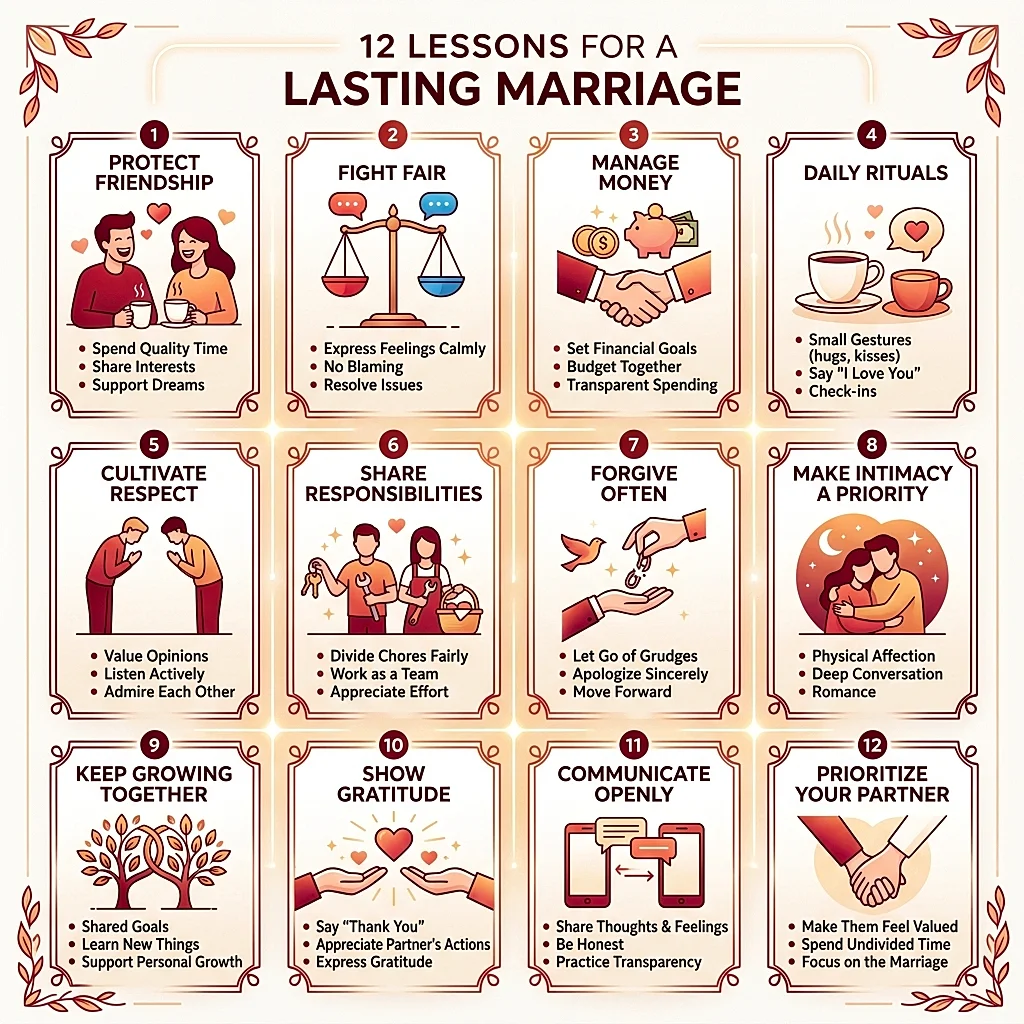
This guide is the marital advice you actually need. Not bumper sticker wisdom — real, specific, research-backed lessons from decades of clinical data and the lived experience of couples who've been through it all and come out the other side.
69%
of marital conflicts are perpetual — they never fully resolve. According to the Gottman Institute, successful marriages aren't about eliminating disagreements — they're about learning to live with them gracefully.
📋 The 12 Lessons Inside This Guide
- Protect the Friendship
- Stop Trying to Win Arguments
- The Small Moments That Matter
- Escaping the Roommate Trap
- Money Without the War
- Keeping Intimacy Alive
- Surviving the In-Laws
- Parenting Without Losing Your Marriage
- Keep Your Own Identity
- Mastering the Repair
- When to Call a Therapist
- The Daily Rituals That Save Marriages
1. Protect the Friendship Underneath the Romance
This is the single most important piece of marital advice that exists, and it's the one most couples completely overlook. The foundation of a lasting marriage isn't passion — it's friendship. Dr. John Gottman, who's spent over four decades studying what makes marriages work, found that couples who describe their spouse as their best friend report dramatically higher levels of satisfaction, even during periods of conflict or stress.
Think about what that actually means in practice. A best friend is someone you genuinely enjoy spending time with — not out of obligation, but because they make ordinary moments better. You tell them things you wouldn't tell anyone else. You laugh at the same stupid jokes. You know their quirks and love them anyway.
Now think about your marriage. When's the last time you laughed together? Not a polite chuckle, but a genuine, tears-in-your-eyes belly laugh? When's the last time you told your spouse something you haven't told anyone else? If you can't remember, the friendship needs attention.
How to Rebuild It
Rebuilding the friendship doesn't require some dramatic intervention. It starts with curiosity. Ask your spouse a question you don't already know the answer to. "What's something you've been thinking about a lot lately that you haven't told me?" "If you could change one thing about our daily routine, what would it be?" These aren't therapy exercises — they're the same kind of questions you'd ask a close friend over a beer. The only difference is that somewhere along the way, you stopped asking.
"The marriages that last aren't built on passion that never fades. They're built on a friendship that deepens when the passion inevitably quiets down."
2. Stop Trying to Win the Argument
Here's a piece of marital advice that will change your marriage overnight if you actually follow it: the goal of a marital argument is not to win. The moment you start trying to "beat" your spouse in a disagreement, you've already lost. Because even if you "win" the argument, your partner now feels defeated, resentful, and one step further from wanting to connect with you.
Gottman's research identified four destructive communication patterns he calls the "Four Horsemen": criticism, contempt, defensiveness, and stonewalling. Contempt — that eye-rolling, sarcastic, "I can't believe I married you" energy — is the number one predictor of divorce. Not infidelity. Not financial stress. Contempt.
🛑 What to Say Instead
- ❌ "You never help around the house." → This is criticism (attacking character).
- ✅ "I'm feeling overwhelmed with the housework. Can we figure out a better split?" → This is a complaint (addressing behavior).
- ❌ "Oh, that's rich coming from you." → This is contempt (superiority and mockery).
- ✅ "I hear what you're saying, and I want to understand your perspective." → This is engagement (staying connected even in conflict).
The shift from criticism to complaint is subtle but transformative. A complaint targets a specific behavior: "I felt hurt when you forgot our dinner plans." Criticism targets the person: "You're so thoughtless and selfish." Same frustration, wildly different impact on the person hearing it.
3. The Small Moments That Decide Everything
If you follow one piece of marital advice from this entire guide, make it this one. Gottman discovered that throughout any given day, married couples make dozens of tiny "bids" for each other's attention. A bid can be as small as "Hey, look at this funny text my sister sent" or as significant as "I'm really stressed about the meeting tomorrow."
Every bid is a mini-test. Not a deliberate one — it's usually unconscious. But the response matters enormously. You can turn toward the bid (put your phone down, engage), turn away (ignore it, keep scrolling), or turn against it ("Can you see I'm busy?").
Here's the data that should stop you in your tracks: couples still married after six years turned toward each other's bids 86% of the time. Couples who divorced? 33%. The difference between a marriage that lasts and one that fails isn't some dramatic betrayal — it's thousands of tiny moments where you either showed up or you didn't.
4. Escaping the Roommate Trap
This is the silent crisis of long-term marriage. It doesn't arrive with a bang — it creeps in so gradually that most couples don't notice it until they're deep inside it. One day you realize that every conversation you've had with your spouse for the past month has been about logistics. The grocery list. The kids' schedule. The broken dishwasher. Whose turn it is to call the plumber.
You're not fighting. You're not unhappy, exactly. You're just... flat. You've become exceptionally efficient co-managers of a household, but somewhere along the way, you stopped being romantic partners. You stopped being curious about each other. You stopped choosing each other.
The Antidote: Planned Novelty
The fix isn't more date nights at the same Italian restaurant you've been going to since 2014. Research on long-term couples shows that novelty — doing something new and slightly outside your comfort zone together — reactivates the same dopamine pathways that fired during the early days of your relationship.
- Take a cooking class you'd both be bad at (Thai, sushi, French pastry).
- Drive somewhere you've never been on a random Saturday with no agenda.
- Learn something together — a language, a card game, a dance style.
- Swap your regular routine: if you always eat dinner at the kitchen table, set up candles on the back patio. If you always watch TV after dinner, go for a walk instead.
The point isn't the activity itself. It's breaking the pattern long enough to remember that the person sitting across from you is more than your co-parent and bill-splitting partner.
"You don't drift into a great marriage. You drift into a mediocre one. A great marriage requires you to keep choosing each other on purpose."
5. Talk About Money Before It Talks About You
Money is the number one source of marital stress — not infidelity, not in-laws, not parenting disagreements. Money. And the damage it does is rarely about the dollar amounts. It's about what money represents: security, freedom, control, values, and trust.
Spenders marry savers. Risk-takers marry risk-avoiders. Someone who grew up in scarcity handles money very differently from someone who grew up comfortable. These differences aren't character flaws — they're deeply ingrained patterns that were formed long before you met each other. The trouble starts when you treat your spouse's financial instincts as wrong instead of different.
The Monthly Money Meeting
The best marital advice around finances is deceptively simple: schedule a 30-minute money check-in once a month. Not during an argument. Not when a bill is overdue. A calm, planned conversation where you sit down as a team and review three things:
- Where are we right now? — Current account balances, any surprises, upcoming expenses.
- Are we on track? — Progress toward savings goals, retirement, debt payoff, upcoming milestones.
- Where do we disagree? — This is the most important question. Maybe one of you wants to book a vacation while the other wants to pad the emergency fund. Get it out in the open before it festers into resentment.
The goal isn't to merge into one financial brain. It's to make sure you're both looking at the same map, even if you'd take slightly different routes.
6. Keeping Intimacy Alive When Life Gets in the Way
Let's be direct about something most marital advice articles dance around: physical intimacy in a long-term marriage is complicated. The wild, can't-keep-your-hands-off-each-other energy of the first year doesn't last. That's not a sign of failure — it's basic neuroscience. Your brain simply cannot sustain that level of chemical intensity indefinitely.
What replaces it — if you let it — is something quieter but arguably deeper. A hand on the small of their back while you're both cooking dinner. Falling asleep tangled up together. The kind of closeness that doesn't need to "lead somewhere" every time, but still makes you feel connected and chosen.
When Desire Becomes Mismatched
Nearly every long-term marriage hits a phase where one person wants more physical closeness than the other. This is painfully common and almost never discussed openly. The higher-desire partner feels rejected and undesirable. The lower-desire partner feels pressured and guilty. Both end up retreating to their corners.
The fix starts with a conversation that most couples would rather chew glass than have. But it needs to happen. Something along the lines of: "I want us to talk about where we are physically, because I miss feeling close to you. Not to pressure you — I just want to understand what you need so we can figure this out together." No accusations. No guilt trips. Just honesty.
5:1
The "magic ratio" of stable marriages. The Gottman Institute found that happy couples maintain at least 5 positive interactions for every 1 negative interaction, even during conflict.
7. Surviving the In-Laws Without Destroying Your Marriage
In-law problems are the slow-burning fuse that detonates more marriages than people realize. It's rarely one dramatic blowup — it's years of small boundary violations, passive-aggressive comments, and the creeping feeling that your spouse won't stand up for you when their family crosses a line.
Here's the universal rule that every marriage therapist will tell you: each spouse handles their own family. If your mother-in-law is overstepping, it is your partner's job to set the boundary — not yours. When you go directly at your partner's parent, they feel attacked from both sides and will almost always default to defending the family they've known their entire life.
Conversely — and this is the part that stings — if your parent is being disrespectful to your spouse, it's your job to step up. Saying "That's just how Dad is" isn't a boundary. It's a betrayal disguised as an excuse. Your spouse needs concrete proof that you'll protect the marriage, even when the threat is coming from your own side of the family tree.
The Holiday Playbook
Holidays are the annual landmine. Whose family do we visit? How long do we stay? Why does your uncle always make that comment about our parenting?
Decide your holiday plan at least four weeks in advance. Not on the drive to Thanksgiving dinner — by then emotions are too high for rational negotiation. Create a clear rotation (Year 1 with your family, Year 2 with theirs) or a compromise (morning with one, evening with the other). Whatever system you pick, write it down so nobody can "misremember" the deal next November.
8. Don't Let Parenting Eat Your Marriage Alive
Of all the marital advice that experienced couples wish they'd heard earlier, this one tops the list: your children should not be the center of your marriage. They should be the center of your family — but the marriage itself needs to be treated as its own entity, with its own needs, its own care, and its own time.
The couples who pour every ounce of energy into their kids and leave nothing for each other wake up at 50, look across the breakfast table, and realize they're strangers living in the same house. The kids have left. The distraction is gone. And there's nothing underneath.
The "Us Time" Non-Negotiable
Schedule time for your marriage the way you schedule your kid's soccer practice — on the calendar, in ink, not negotiable. A weekly date doesn't need to be expensive or elaborate. It could be a walk after the kids are in bed. It could be coffee on Saturday morning before the chaos starts. The point is that the marriage gets dedicated, distraction-free time on a regular basis.
And here's the rule: during "us time," you don't talk about the kids. Not their grades, not their behavior, not the tutor schedule. You talk about each other. You talk about the future. You talk about the things that made you fall in love in the first place. The children will be fine for an hour.
9. Keep Your Own Identity (Your Marriage Depends on It)
One of the most counterintuitive pieces of marital advice: spending time apart makes your marriage stronger. Couples who merge into a single identity — who abandon their own friends, drop their hobbies, and can't spend a Saturday afternoon solo without guilt — are slowly suffocating both themselves and the relationship.
You fell in love with a whole, complete person who had their own interests, their own social circle, their own passions. If you've spent the past five years slowly dissolving all of that into the marriage, what's left? A dependent, not a partner.
Keep your gym nights. Keep your book club. Keep the friendships that existed before the marriage. Not as a way to escape your spouse, but as a way to stay interesting, fulfilled, and emotionally grounded — which makes you a better partner, not a worse one.
10. Master the Art of Repair
Every marriage has ruptures. Every single one. The difference between marriages that last and marriages that fail isn't the absence of damage — it's the speed and quality of the repair.
A "repair attempt" is anything that de-escalates tension during or after a conflict. It can be humor ("Okay, we both sound ridiculous right now"), physical touch (reaching for their hand mid-argument), taking accountability ("You're right, I was being defensive"), or even just a timeout ("I need 20 minutes to cool down, and then I want to come back to this").
🔧 Five Repair Phrases That Actually Work
- 1. "I'm sorry. That came out harsher than I meant it."
- 2. "Can we start this conversation over? I want to do better."
- 3. "I hear you. Tell me more about what you're feeling."
- 4. "I don't want to fight about this. I want to understand you."
- 5. "You're more important to me than being right."
Gottman's research found that the success or failure of repair attempts is one of the strongest predictors of whether a marriage will survive. In happy marriages, repair attempts work — the partner receives them and de-escalates. In struggling marriages, the partner ignores or rejects the repair, and the argument continues spiraling.
11. When to Stop Trying Alone and Get Professional Help
There's a persistent stigma that going to marriage counseling means your marriage has failed. The opposite is true. Seeking help means you care enough to invest real time, money, and vulnerability into saving it. The marriages that are actually failing are the ones where both people refuse to walk through that door.
Signs That Self-Help Isn't Enough
- The same argument keeps repeating — identical topic, identical escalation, identical dead-end — more than three or four times with no progress.
- You've stopped fighting entirely. Not because things are peaceful, but because you've both given up on being heard.
- Trust has been broken in a serious way — infidelity, hidden debt, a major deception — and you can't move past it alone.
- One or both of you regularly fantasize about divorce or separation.
- Your home feels like a workplace where two colleagues coexist rather than a space where two people who love each other live.
Finding the Right Marriage Therapist
Not all therapists are created equal, and a bad fit can actually make things worse. Look specifically for someone trained in Gottman Method Couples Therapy or Emotionally Focused Therapy (EFT) — both are backed by decades of peer-reviewed research. Avoid therapists who take sides, who see you individually but never together, or who seem more interested in playing judge than building skills.
A good marriage therapist acts like a coach and a translator. They help you hear what your spouse is actually trying to say underneath the anger, the withdrawal, or the criticism. And they give you concrete tools to practice between sessions — not just vague encouragement to "communicate more."
📖 Related Reading
Looking for broader relationship wisdom that applies beyond marriage? Read our comprehensive guide: Relationship Advice That Actually Works: 15 Expert-Backed Rules for Lasting Love.
💡 Building Healthy Connections Starts Here
Whether you're starting a new chapter or strengthening an existing one, LoveConnet was built for people who take relationships seriously. A vetted, secure environment for genuine connection — no games, no gimmicks.
12. The Daily Rituals That Quietly Save Marriages
Here's the final and possibly most important piece of marital advice in this entire guide: the marriages that last decades don't survive on grand gestures. They survive on small, daily, completely unremarkable rituals that nobody posts on Instagram because they're too boring to photograph.
The surprise trip to Paris is wonderful. The 25th anniversary party is memorable. But they're not what determines whether you'll actually make it to that anniversary. That job belongs to the mundane, repetitive, seemingly insignificant habits you practice every single day.
The Rituals That Matter Most
- The morning acknowledgment: Before you grab your phone, before you check email, look at your spouse and say something genuine. "Good morning. I'm glad you're here." It takes three seconds and sets the emotional tone for the entire day.
- The reunion moment: When you see each other at the end of the day — whether it's at the front door or in the kitchen — stop what you're doing. Make eye contact. Ask one real question: "What was the best part of your day?" Then actually listen to the answer. This 60-second ritual is worth more than a dozen roses.
- Gratitude for the invisible labor: "Thanks for scheduling the dentist appointment." "I appreciate you dealing with the insurance company." Acknowledging the boring, unglamorous work of shared life prevents the slow, toxic creep of feeling taken for granted.
- The bedtime ritual: Going to bed at the same time, when possible, creates a natural window for conversation, physical closeness, and emotional decompression that evaporates when one person stays up watching TV for two more hours.
- The random mid-day text: "Thinking about you." "That thing you said this morning made me laugh again." "I'm glad I married you." Five seconds to type. The emotional return is enormous.
None of these rituals will trend on TikTok. None of them will impress your friends at dinner. But strung together — morning after morning, evening after evening, year after year — they weave the kind of quiet, steady love that outlasts everything else. And that's what the best marital advice always comes back to: it's not the spectacular moments that define a marriage. It's the ordinary ones, done with intention.
Frequently Asked Questions
What is the best marital advice for newlyweds?
Establish your communication patterns early. Learn how to disagree without destroying each other. Develop a system for handling finances together. And protect the friendship underneath the romance — because when the honeymoon intensity fades (and it will), that friendship is what keeps the marriage alive.
How do you save a marriage that's falling apart?
Start by acknowledging the problem out loud — denial is the enemy of repair. Have an honest, blame-free conversation about what's actually broken. Seek a licensed marriage therapist trained in Gottman Method or Emotionally Focused Therapy. Commit to the process for at least six months before evaluating. Couples who seek help early have significantly better outcomes than those who wait until they're already at the door.
What are the signs your marriage is in trouble?
Persistent contempt (mocking, eye-rolling, deliberate cruelty), emotional withdrawal, loss of physical affection, feeling more like roommates than partners, frequent fantasizing about life without your spouse, and actively avoiding coming home. If several of these resonate, your marriage needs active, intentional intervention — ideally with professional support.
How often do married couples argue?
Most married couples experience some form of disagreement several times per month — that's completely normal. What matters is how you handle it. Couples who fight but repair quickly (apologize, take accountability, reconnect) have stronger marriages than couples who avoid conflict entirely and let resentment quietly build over years.
Is it normal to feel like roommates in a marriage?
Extremely common, especially after the first few years or after having children. The transition from romantic partners to co-managers happens so gradually you often don't notice until you're deep inside it. The fix is intentional effort: scheduled date nights, physical affection outside the bedroom, genuine curiosity about each other's inner world, and regular emotional check-ins that go beyond household logistics.
Should you stay in an unhappy marriage for the kids?
Children are far more damaged by living in a home filled with tension, hostility, and emotional coldness than by a respectful, well-handled divorce. Staying together purely for the kids often teaches them that unhappiness is acceptable and that their parents' needs don't matter. If the marriage is truly beyond repair, a healthy co-parenting arrangement is usually better for everyone involved.
The LoveConnet Editorial Team
We're a team of relationship researchers, safety advocates, and dating coaches dedicated to helping couples build stronger, healthier partnerships. Our guides are informed by peer-reviewed clinical research, real user experiences, and interviews with licensed marriage and family therapists.



💬 Discussion (0)
No comments yet. Be the first to share your thoughts!