
The internet is overflowing with good marriage advice — and most of it is useless. "Communication is key." "Never go to bed angry." "Marriage is 50/50." You've heard these a thousand times, and they've probably never changed a single thing about how you and your spouse interact on a random Wednesday evening.
The advice that actually sticks doesn't come from self-help books or motivational Instagram accounts. It comes from the couples who've been in the trenches — the ones who've survived the screaming matches over money, the silent treatment after Thanksgiving at the in-laws', the terrifying moment when they looked at the person across the breakfast table and thought, "Is this still working?"
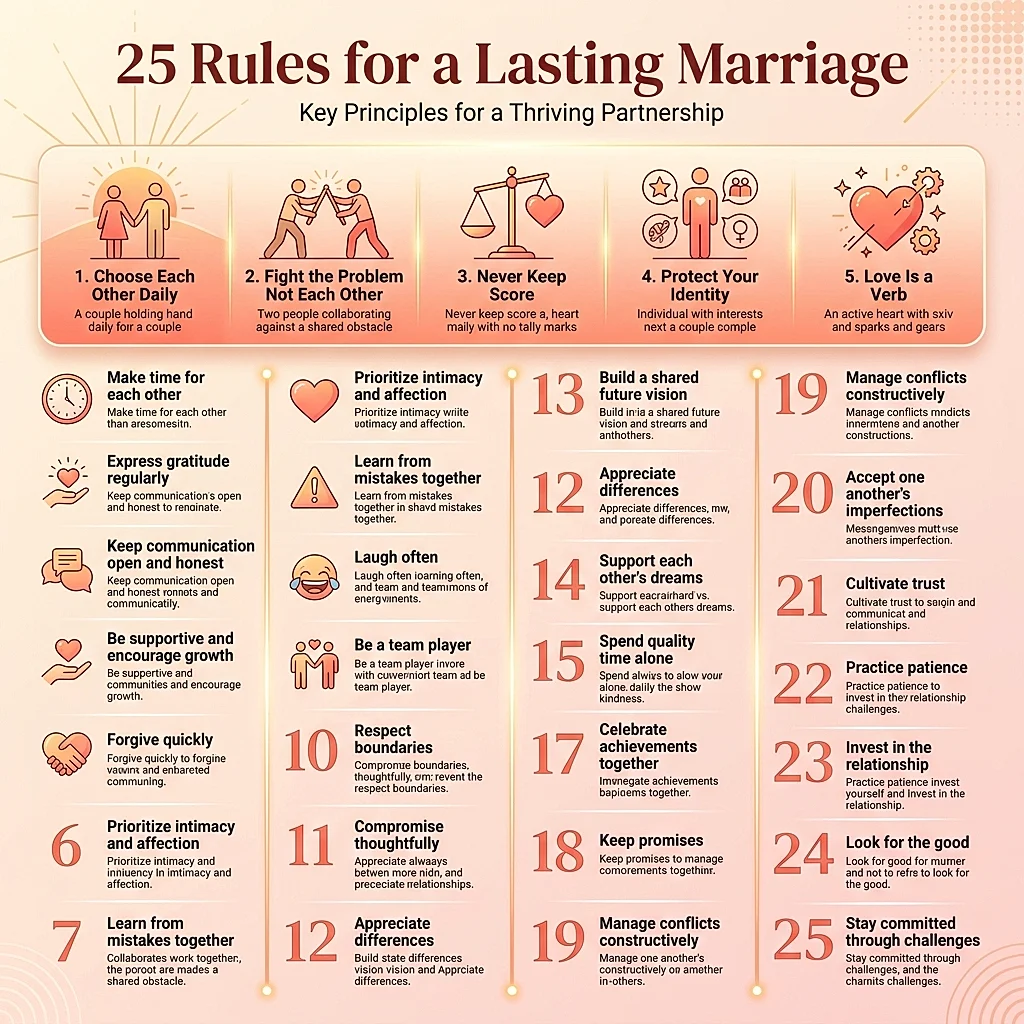
We talked to married couples, interviewed family therapists, and dug through decades of clinical research to compile the 25 pieces of good marriage advice that real people wish they'd heard before saying "I do." These aren't platitudes. They're specific, uncomfortable, sometimes counterintuitive truths that the happiest long-term couples have learned the hard way.
50%
of first marriages in the U.S. end in divorce. But couples who actively practice healthy relationship habits reduce that risk dramatically, according to the American Psychological Association.
📋 25 Rules Inside This Guide
- Choose Each Other Daily
- Curiosity Over Assumption
- Respect the Morning
- Never Use Divorce as a Weapon
- Laugh Together Often
- Apologize Without "But"
- Protect the Friendship
- Money Monthly, Not Money Fights
- Touch Without Agenda
- Handle Your Own Family
- Keep Dating Each Other
- Let the Small Stuff Go
- Say Thank You for the Boring
- Fight the Problem, Not Each Other
- Keep Your Own Identity
- Be Bored Together
- The 10-Minute Reunion
- Go to Bed at the Same Time
- Stop Keeping Score
- Grow in the Same Direction
- Give Them the Benefit of the Doubt
- Put the Phone Down
- Talk About the Hard Stuff Early
- Get Help Before You Need It
- Love Is a Verb, Not a Feeling
1. Choose Each Other Every Single Day
The best good marriage advice anyone will ever give you fits in one sentence: marriage is not a decision you made at the altar — it's a decision you make again every morning when the alarm goes off.
There will be days when your spouse annoys you beyond belief. Days when the spark feels completely dead. Days when you look across the room and wonder what you were thinking. The couples who last aren't the ones who never feel that — they're the ones who feel it and choose to stay anyway. Not out of obligation or fear, but because they've decided that what they're building together is worth the effort even on the ugly days.
That daily choice looks different for everyone. For some, it's biting your tongue instead of escalating a petty argument. For others, it's putting down the phone and actually listening. For a few, it's booking the marriage counseling appointment you've been avoiding. The form doesn't matter. The intention does.
2. Stay Curious About Your Spouse — Don't Assume You Know Them
After 10 or 20 years of marriage, most people think they know their partner inside and out. You know how they take their coffee, which topics set them off, what they'll order at the restaurant before they open the menu. But here's the thing: people change. The person you married at 28 is not the same person sitting across from you at 45.
Their dreams shift. Their fears evolve. Their relationship with their own past changes. If you stop asking questions — real ones, not "how was your day" on autopilot — you slowly start relating to a version of them that no longer exists. And that gap between who they actually are and who you think they are is where disconnection breeds.
Once a week, ask your spouse something you genuinely don't know the answer to. "What's something you've been thinking about lately that you haven't told me?" "If you could change one thing about our life right now, what would it be?" It sounds simple. It changes everything.
"The marriages that fail are the ones where both people stopped being curious and started being certain. Certainty about another person is always an illusion."
3. How You Say "Good Morning" Sets the Tone for Everything
This is the tiniest piece of good marriage advice on this list, and it might be the most powerful. The first 60 seconds of your interaction each morning create the emotional weather for the entire day.
If you wake up, grab your phone, grunt something unintelligible, and shuffle past your spouse like they're furniture — you've just told them, without words, that they're background noise. If instead you pause for three seconds, make eye contact, and say something genuine — "Morning. I'm glad you're here" — you've deposited something real into the emotional account before the chaos of the day even starts.
Three seconds. That's all it takes.
4. Never, Ever Use the Word "Divorce" as a Weapon
In the heat of a bad fight, some people reach for the nuclear option: "Maybe we should just get divorced." Sometimes it's said out of genuine frustration. More often, it's a power move — a way to win the argument by raising the stakes so high that the other person backs down out of fear.
Here's why this destroys marriages over time: every time you throw the word "divorce" into an argument, you erode the safety of the relationship. Your spouse starts thinking, "They've got one foot out the door." That thought doesn't go away after the fight ends. It lingers. It compounds. Eventually, your partner stops investing emotionally because they believe you might leave anyway.
Unless you are genuinely considering ending the marriage and ready to have that conversation seriously, keep that word off the table during fights. Period.
5. Laugh Together — Especially When Things Are Hard
Couples who laugh together frequently are significantly more likely to stay together. That's not a greeting card platitude — it's backed by research. Shared laughter releases oxytocin, reduces cortisol (the stress hormone), and reinforces the "we're on the same team" feeling that erodes during conflict.
The keyword here is shared laughter. Laughing at your spouse's expense — mocking them, using sarcasm to belittle — is contempt disguised as humor. Laughing together at the absurdity of a situation, at your own dumb mistakes, at inside jokes that nobody else would understand — that's the glue.
If you can't remember the last time you and your spouse genuinely laughed together, that's a signal worth paying attention to.
6. Apologize Without the Word "But"
"I'm sorry, but you have to understand that..." is not an apology. It's an argument wearing an apology costume. The moment you add "but," you've erased everything before it. Your partner doesn't hear the sorry — they hear the justification that follows.
A real apology has three parts and zero qualifiers: (1) I acknowledge what I did. (2) I understand why it hurt you. (3) I'll do my best not to repeat it. Full stop. No "but." No "well, you also..." No pivoting to their behavior to dilute yours.
This is one of the hardest pieces of good marriage advice to actually follow, because your ego screams at you to defend yourself. Resist it. A clean apology repairs more damage in 30 seconds than an hour of defensive arguing ever could.
✅ What a Real Apology Sounds Like
- ❌ "I'm sorry, but you were being unreasonable." — This is a counter-attack.
- ❌ "I'm sorry you felt that way." — This dodges responsibility entirely.
- ✅ "I'm sorry I forgot our dinner plans. I know you were looking forward to it, and I should have put it in my calendar. It won't happen again." — This is accountability.
7. Protect the Friendship Like Your Marriage Depends on It (Because It Does)
The Gottman Institute's most consistent finding across decades of studying married couples is this: the foundation of a lasting marriage is not passion, not compatibility, not even love in the abstract. It's friendship.
Couples who say their spouse is their best friend report relationship satisfaction levels roughly twice as high as those who don't. The reason is straightforward: passion fluctuates, conflict comes and goes, but friendship — genuine enjoyment of each other's company — provides a baseline of warmth that carries the marriage through the rough patches.
Ask yourself honestly: do you still enjoy spending time with your spouse? Not out of habit, not because the kids need both of you there — but because they make an ordinary afternoon genuinely better? If the answer is yes, protect that fiercely. If the answer is no, that's where the rebuilding needs to start.
8. Have a Money Meeting Once a Month (Not a Money Fight)
Money is the leading source of marital stress. Not because money itself is toxic, but because most couples only discuss finances when something has already gone wrong — the credit card bill is too high, the savings account is too low, someone made a purchase the other person considers irresponsible.
The fix is proactive: a calm, scheduled, 30-minute financial check-in once a month. Sit down as a team. Review where you stand. Discuss what's coming up. Air any disagreements before they fester. When money conversations happen on a regular schedule instead of in the heat of a crisis, they lose their emotional charge almost entirely.
9. Touch Without an Agenda
One of the most underrated pieces of good marriage advice: physical affection that doesn't lead to anything is more important to long-term satisfaction than the physical affection that does. A hand on the shoulder while they're cooking. Playing with their hair during a movie. A long hug in the kitchen for no particular reason.
When the only time you touch your spouse is when you're initiating something, physical contact starts to feel transactional. The person on the receiving end starts bracing themselves every time you reach for them, which is the exact opposite of the warmth you're trying to create.
Casual, affectionate, zero-pressure touch throughout the day maintains a physical connection that communicates something words can't: I'm here. I see you. You matter to me.
10. Handle Your Own Family — No Exceptions
The universal rule of in-law management: each spouse handles their own parents. If your mother is overstepping, it's your job to draw the line — not your spouse's. If your father makes a passive-aggressive comment about your partner's cooking, career, or parenting, you step in immediately. Not later. Not privately. Right then.
When you let your family disrespect your spouse without intervening, you're communicating something devastating: my loyalty to them is stronger than my loyalty to you. That message doesn't need to be said out loud — your spouse feels it every single time.
11. Never Stop Dating Each Other
After kids, careers, mortgages, and the relentless grind of daily life, "date night" often becomes the first casualty. It feels like a luxury you can't afford — either financially or logistically. But here's the reality: scheduled time together as a couple, separate from your roles as parents and co-managers, is not a luxury. It's maintenance.
It doesn't need to be expensive. A walk after the kids are in bed. Coffee on Saturday morning before the chaos starts. Cooking dinner together with music on instead of eating in front of the TV. The activity is irrelevant. What matters is that the marriage gets regular, intentional, distraction-free attention.
"A marriage that runs on autopilot will eventually crash. The couples who make it to 30 years are the ones who never stopped being intentional."
12. Let the Small Stuff Go — Actually Go
The toothpaste cap. The socks on the floor. The way they load the dishwasher. The thermostat war. Every married person has a list of minor irritations that they've silently cataloged over the years.
Here's the question that separates the marriages that thrive from the ones that slowly curdle: is this actually worth a fight, or am I just keeping score? Because keeping a mental tally of every small infraction — and pulling out that list during a bigger argument — is one of the most corrosive habits in any relationship.
Let the small stuff genuinely go. Not "let it go but bring it up three weeks later" — actually release it. Save your emotional energy for the conversations that truly matter.
13. Say "Thank You" for the Invisible Labor
Every marriage has a mountain of invisible labor — the mental load of scheduling doctor's appointments, remembering birthdays, managing the grocery list, noticing when the soap dispenser is empty. It's usually (though not always) carried disproportionately by one partner, and it almost never gets acknowledged.
"Thanks for dealing with the insurance company." "I appreciate you keeping track of the kids' schedules." "I noticed you cleaned the bathroom — thank you." These sentences take five seconds and prevent the slow, toxic buildup of feeling taken for granted that poisons so many long-term marriages.
14. Fight the Problem, Not Each Other
When conflict arrives — and it always does — the framing matters more than anything. The couples who last frame disagreements as "us vs. the problem." The couples who don't frame them as "me vs. you."
Instead of: "You spend too much money" → try: "We need to figure out our budget together."
Instead of: "You never discipline the kids" → try: "I think we need to get on the same page about parenting."
The shift from "you" to "we" isn't just linguistic — it's psychological. It transforms the dynamic from adversarial to collaborative. You're teammates facing a challenge, not opponents trying to win a debate.
86%
of couples still married after 6 years turned toward each other's "bids" for attention 86% of the time. Couples who divorced? Only 33%. Source: Gottman Institute.
15. Keep Your Own Identity
One of the most counterintuitive pieces of good marriage advice: the strongest marriages are made up of two whole, independent people — not two halves trying to form one unit. If you've abandoned your own friends, dropped your hobbies, and can't remember the last time you did something just for yourself, your marriage is suffocating under the weight of codependency.
Your gym nights. Your book club. Your Saturday fishing trip. Your old college friends. These aren't threats to your marriage — they're what keeps you interesting, grounded, and emotionally healthy. A fulfilled person is a better partner than a depleted one. Every time.
16. Learn to Be Bored Together
This might sound strange, but one of the best tests of a strong marriage is whether you can sit in the same room doing absolutely nothing and feel completely at peace. No TV, no phones, no agenda — just two people sharing space and finding it comfortable rather than awkward.
If every moment of togetherness needs to be filled with activity or conversation to avoid discomfort, there's an intimacy gap. The couples who've been together for decades describe a quality of silence that isn't empty — it's full. It's the kind of silence that says, "I don't need you to perform. I just want you here."
17. The 10-Minute Reunion Ritual
When you see each other at the end of the day — whether it's at the front door or in the kitchen — the first 10 minutes of that reunion set the emotional temperature for the entire evening. If you grunt "hey" while staring at your phone and immediately launch into complaints about your day, you've created a disconnected, transactional atmosphere.
Instead: put the phone down. Make eye contact. Hug for longer than two seconds (yes, actually count). Ask one real question: "What was the best part of your day?" Then listen. The entire thing takes 10 minutes. The return on investment is staggering.
18. Go to Bed at the Same Time
This is one of those pieces of good marriage advice that sounds trivial until you actually try it. When one partner stays up watching TV or scrolling on their phone for two more hours while the other goes to bed alone, you lose the natural window for conversation, closeness, and emotional winding-down that bedtime provides.
It's not always possible — different work schedules, insomnia, a spouse who snores like a freight train. But when it is possible, going to bed together is a small act of solidarity that reinforces the feeling of being a team.
19. Stop Keeping Score
"I did the dishes three times this week and you did them once." "I planned the last vacation." "I always initiate." Score-keeping is one of the most destructive habits in long-term marriages because it transforms your partnership into a transaction. Every kind act becomes a line item on a ledger, and every perceived imbalance becomes evidence for resentment.
Healthy marriages operate on generosity, not accounting. You do things because they need doing and because you care about your partner's comfort — not because you're tracking who owes whom. If the imbalance is genuinely severe (one person doing 90% of the work), that's a conversation worth having. But keeping a mental spreadsheet of every chore and favor is a slow-acting poison.
20. Grow in the Same Direction
People change. That's not a threat to your marriage — it's a certainty. The person you married at 26 will have different priorities, interests, and even values at 46. The question isn't whether you'll both change. It's whether you'll change together or apart.
Couples who grow together regularly check in about their evolving goals, dreams, and fears. They adapt to each other's changes with curiosity instead of resistance. They celebrate growth rather than feeling threatened by it. The couples who grow apart stop having those conversations and slowly become strangers living under the same roof.
21. Give Them the Benefit of the Doubt
When your spouse forgets to pick up the milk, do you think: "They were probably swamped and it slipped their mind" or "They don't care about what I ask them to do"? Your default interpretation of ambiguous behavior reveals a lot about the health of your marriage.
In strong marriages, both partners default to generous interpretations. They assume good intentions even when the outcome is frustrating. In struggling marriages, both partners default to suspicion. Every mistake becomes evidence of deeper character flaws.
Choosing to give your partner the benefit of the doubt — consciously, even when you're annoyed — is one of the most powerful daily practices available to you. It costs nothing and changes everything.
📖 Related Reading
Want the deep-dive clinical breakdown on these principles? Read our companion guide: Marital Advice From Couples Who've Actually Made It Work: 12 Lessons That Took Years to Learn.
22. Put the Phone Down — Your Spouse Can Tell
You think you're being slick — scrolling Instagram while your spouse talks about their day, occasionally nodding and saying "mm-hmm." You're not fooling anyone. Your partner can feel the difference between your full attention and your divided attention, and the message received is: this screen is more interesting than you are.
You probably don't mean it that way. But after hundreds of these micro-rejections — a phone check during dinner, a scroll while they're mid-sentence, a notification that steals your eye contact — your spouse stops trying to connect. Not dramatically. They just slowly give up. And by the time you notice the emotional distance, you've got months of phone-inflicted damage to repair.
Meals should be phone-free. Conversations should be phone-free. The first and last 30 minutes of the day should be phone-free. These are not extreme suggestions. They're the bare minimum.
23. Talk About the Hard Stuff Before It Becomes a Crisis
The topics most couples avoid — aging parents, career changes, shifting desires, lingering hurts from years ago — don't disappear because you ignore them. They compound silently until they explode at the worst possible moment, usually during an argument about something completely unrelated.
Good marriage advice always comes back to this: bring the uncomfortable conversations to the table while they're still manageable. "I want to talk about what happens when your mom can't live alone anymore." "I've been feeling disconnected from you physically, and I need us to talk about it." "I'm thinking about a career change, and I want to work through the financial implications together."
These conversations are awkward. They're sometimes painful. But they're infinitely less painful than the explosion that happens when you've been sitting on them for three years.
24. Get Help Before You "Need" It
The biggest mistake couples make with therapy is waiting too long. By the time most people walk into a therapist's office, they've been struggling for an average of six years. Six years of resentment, distance, and unresolved hurt — all compounding while they told themselves, "It's not bad enough for therapy yet."
Think of marriage counseling the way you think of car maintenance. You don't wait until the engine seizes to change the oil. You do it regularly, proactively, to keep things running smoothly. Some of the happiest couples in the world see a therapist annually for a "tune-up" even when nothing is wrong — just to make sure they're still communicating well and catching issues early.
💡 Building Something Meaningful?
Whether you're starting fresh or strengthening what you already have, LoveConnet was built for people who believe in real connection. A secure, vetted environment for genuine relationships — no games, no gimmicks.
25. Love Is a Verb, Not Just a Feeling
This is the final and most important piece of good marriage advice on this list: love is not the butterflies you felt on the third date. Those are chemicals. They fade. Every single time.
Real love — the kind that carries a marriage through job losses, sick kids, aging parents, and the grinding ordinariness of a shared life — is a practice. It's choosing to be kind when you're exhausted. Choosing to listen when you'd rather scroll. Choosing to repair after a fight instead of retreating into cold silence. Choosing to see the best in someone whose worst you've memorized.
The couples who make it to 30 and 40 years together will tell you the same thing: the love they have now looks nothing like what they felt on their wedding day. It's quieter, steadier, and infinitely deeper. It's not the fireworks — it's the warmth of a fire that's been carefully tended, day after ordinary day.
Tend the fire. It's worth it.
Frequently Asked Questions
What is the best marriage advice ever given?
Choose your partner every single day. Marriage isn't a one-time decision made at the altar — it's a daily, deliberate choice to show up, stay curious, and prioritize the relationship even when life gets chaotic, boring, or hard. The couples who last aren't the ones who never doubt — they're the ones who choose to stay anyway.
What are the 3 most important things in a marriage?
Trust, communication, and mutual respect. Trust is the foundation — without it, nothing else holds. Communication is the mechanism for navigating conflict and staying connected. Respect is the daily practice that keeps contempt (the #1 predictor of divorce) out of your home.
How do you keep a marriage strong after 20 years?
Three things consistently: maintain the friendship underneath the romance, keep novelty alive by doing new things together instead of falling into permanent routines, and repair quickly after arguments instead of letting resentment build. The daily habits matter far more than the grand gestures.
What is the number one killer of marriages?
Contempt. According to the Gottman Institute, contempt — eye-rolling, sarcasm, mockery, and a general attitude of superiority toward your partner — is the single strongest predictor of divorce. It communicates disgust and is nearly impossible to recover from without professional help.
What is the hardest year of marriage?
The first year and the seventh year are consistently cited as the toughest. The first year forces you to reconcile romantic expectations with daily reality. The seventh year often coincides with young children, career pressure, and the fading of initial romantic intensity. That said, any major life transition can create a "hardest year" at any point in a marriage.
Is it normal to question your marriage?
Yes — virtually every married person does at some point. Occasional doubt during a rough patch is completely normal. It becomes a concern when the questioning is constant, when you feel relief at the thought of leaving, or when you've emotionally checked out. If that's where you are, it's time for a serious conversation — either with your spouse or with a professional.
The LoveConnet Editorial Team
We're a team of relationship researchers, safety advocates, and dating coaches committed to helping couples build stronger, happier partnerships. Our guides draw from peer-reviewed clinical research, real user stories, and interviews with licensed marriage and family therapists.



💬 Discussion (0)
No comments yet. Be the first to share your thoughts!