
There is a quiet, frustrating paradox happening in major cities across the globe right now. The more successful a woman becomes in her professional life, the more difficult her romantic life seems to get.
You have spent your twenties and thirties building an empire. You went to law school, finished your medical residency, or bootstrapped a startup from your living room into a multi-million dollar business. You manage teams, you negotiate massive contracts, you own your own home, and you have cultivated a rich, fulfilling life with a strong circle of friends. By every traditional metric, you are a "catch." You are exactly the type of stable, secure, ambitious partner that people claim they want.
And yet, when you open a dating app on a Friday night, it feels like you have entered an alternate universe where all your achievements are actively working against you.
You go on dates where men subtly try to diminish your career. You match with men who seem great on paper, only to have them ghost you the moment they realize you make a higher salary than they do. You find yourself exhausted by the sheer volume of low-effort communication from men who want to be your "pen pal" but never take the initiative to plan a real date.
The cultural narrative will tell you that "men are just intimidated by successful women." But that is a gross oversimplification. The reality of dating as a high-earning professional woman in 2026 is a complex web of shifting gender roles, algorithmic biases on legacy dating apps, and a profound crisis of masculinity.
This is not an article telling you to "soften up," hide your success, or lower your standards. This is a surgical breakdown of exactly why modern dating is failing successful women, the specific archetypes of men you need to avoid, and the strategic changes you must make to your digital dating life to finally find a secure, equal partnership.
Part 1: The Paradox of Success
The "Intimidation" Myth
Let's address the most common piece of advice given to successful single women: "You just intimidate men. You need to be less intimidating."
This is terrible, fundamentally flawed advice. True success—financial independence, emotional intelligence, and ambition—does not intimidate secure, high-value men. It only intimidates men whose entire sense of self-worth is predicated on being the sole provider or the "superior" partner in a dynamic.
Historically, men were conditioned to believe their primary value in a relationship was financial provision. When a woman brings her own financial security to the table, it forces the man to bring something else: emotional intelligence, communication skills, empathy, and equal partnership. Many men have simply not developed these skills, and when faced with a woman who demands them, they retreat into insecurity.
You are not intimidating; they are simply intimidated. There is a massive difference. Hiding your success to make a man feel bigger only guarantees that you will end up in a relationship where you have to constantly shrink yourself to maintain his ego. That is a recipe for deep resentment, not love.
The Competence Curse
As a professional woman, you are used to solving problems efficiently. If a project is stalling at work, you take the reins and execute. Unfortunately, many successful women carry this "executive function" energy into their dating lives.
Because you are highly competent, you often end up planning the dates, carrying the conversation, and managing the emotional labor of the early stages of dating. You do this because it's easier and faster than waiting for a passive man to figure it out.
This creates a self-fulfilling prophecy. By over-functioning, you accidentally attract "Under-Functioners"—men who are perfectly happy to let you do all the work. They enjoy the benefits of dating a successful woman without having to put in the effort required to be an equal partner.
The "Hypergamy" Hangover
Hypergamy is the evolutionary sociological tendency for women to seek partners of higher social or economic status. For generations, this was a matter of survival. While modern successful women no longer *need* a man's financial support to survive, the psychological desire to partner with an "equal or better" remains strong for many.
The mathematical reality is that as you climb the corporate and financial ladder, the pool of men who meet traditional hypergamous criteria shrinks drastically. If you are in the top 5% of earners, and you only want to date men in the top 5%, you are fighting over a very small group of men who are often actively choosing to date younger, less established women who do not challenge them. To succeed in 2026, professional women must redefine "high value" to mean emotional intelligence, loyalty, and secure attachment, rather than just tax brackets.
Part 2: Why Legacy Dating Apps Are Failing You
If you are a highly successful woman, the tools you are using to find love are likely sabotaging you. Legacy apps like Tinder, Bumble, and Hinge were built for the masses. They were designed for volume, gamification, and keeping users on the app as long as possible to view advertisements.
The "Algorithm of Mediocrity"
Dating apps use algorithms that rank your "desirability" based on how you interact with the platform. If you are a busy professional woman, you probably use dating apps like you use email: you log on, quickly filter through the noise, swipe left on 95% of profiles because you have high standards, and only engage with top-tier matches.
Legacy algorithms punish you for this behavior. They view your low swipe-right rate as "bad user behavior." As a result, they lower your algorithmic score and shadowban your profile, pushing you to the bottom of the deck. The high-value men you actually want to meet will never even see your profile because the app has buried you.
The "Bumble Fatigue" Epidemic
Bumble's core mechanic—forcing women to send the first message—was initially celebrated as a feminist triumph. It gave women control. However, for professional women in 2026, it has become a source of massive burnout.
You spend all day leading meetings, initiating projects, and making executive decisions. The last thing you want to do at the end of the day is act as the primary pursuer in your romantic life. You want a man who can take the lead, plan a date, and show genuine initiative. Bumble's mechanic has inadvertently trained a generation of men to be entirely passive, sitting back and waiting for women to do the heavy lifting.
The Anonymity Problem (Catfishing and Scams)
Because legacy apps do not mandate strict identity verification, they are flooded with bad actors. Successful women are prime targets for "Pig Butchering" crypto scams and romance scammers because syndicates know you have disposable income.
When an app allows users to hide behind fake names and unverified photos, it creates a culture of low accountability. This is why ghosting, inappropriate messages, and catfishing are so rampant. You cannot build a foundation of trust in an ecosystem designed for anonymity.
Part 3: The Neuroscience of Dating App Burnout
If you feel physically and emotionally exhausted by dating apps, it is not in your head. It is a documented neurological response to bad design.
Dopamine Dysregulation
Legacy dating apps are designed using the exact same variable-ratio reward schedules as slot machines. When you swipe, you get intermittent hits of dopamine (a match!). However, because the vast majority of these matches never materialize into actual dates, your brain begins to associate the *app* with the reward, rather than the *person*.
This dysregulation leads to chronic fatigue. You are expending executive function and emotional energy processing hundreds of faces, but receiving no tangible, real-world connection in return. For a successful woman whose brain is already taxed by high-level problem solving at work, this leads to rapid burnout.
The Paradox of Choice
Psychologist Barry Schwartz coined the term "The Paradox of Choice," which proves that having too many options actually makes us deeply unhappy and unable to commit. When a woman opens an app and sees 5,000 potential men, her brain paralyzes.
She becomes hyper-critical, swiping left for the smallest infractions (a slightly bad photo, a typo in a bio) because she believes there is a "perfect" option just one more swipe away. This prevents her from ever forming a genuine connection with a "good enough" man who could actually make her incredibly happy.
Part 4: The True Financial Cost of "Free" Dating Apps
Dating apps used to be entirely free. Today, they are multi-billion dollar ecosystems designed specifically to extract money from lonely people by artificially restricting access to the best matches.
The "Pay to Play" Model
Apps like Hinge and Tinder have introduced "Super Likes," "Roses," and "Boosts." The algorithm is now designed to withhold the most compatible, attractive matches from your standard feed, placing them in a separate "Standouts" tab. If you want to talk to the successful doctor or the lawyer, you are often forced to buy a "Rose" to send them a message.
This creates a deeply transactional environment. It turns romance into an auction house where users are constantly trying to out-bid each other for attention, completely destroying any organic chemistry.
The Subscription Trap
Premium subscriptions (like Tinder Gold or Bumble Premium) often cost upwards of $40 a month. While they offer features like seeing who liked you or going "Incognito," they do not inherently improve the quality of the men on the app. Paying $40 to see that 100 unverified, incompatible men swiped right on you is not a good return on investment.
The Takeaway: If you are going to invest money in a dating app, invest it in a platform where the barrier to entry is high for everyone, ensuring that all users are equally invested in the process. Free apps are expensive in the long run because they waste your time; premium, verified apps are investments in your future.
Part 5: The 10 Archetypes of Men to Avoid
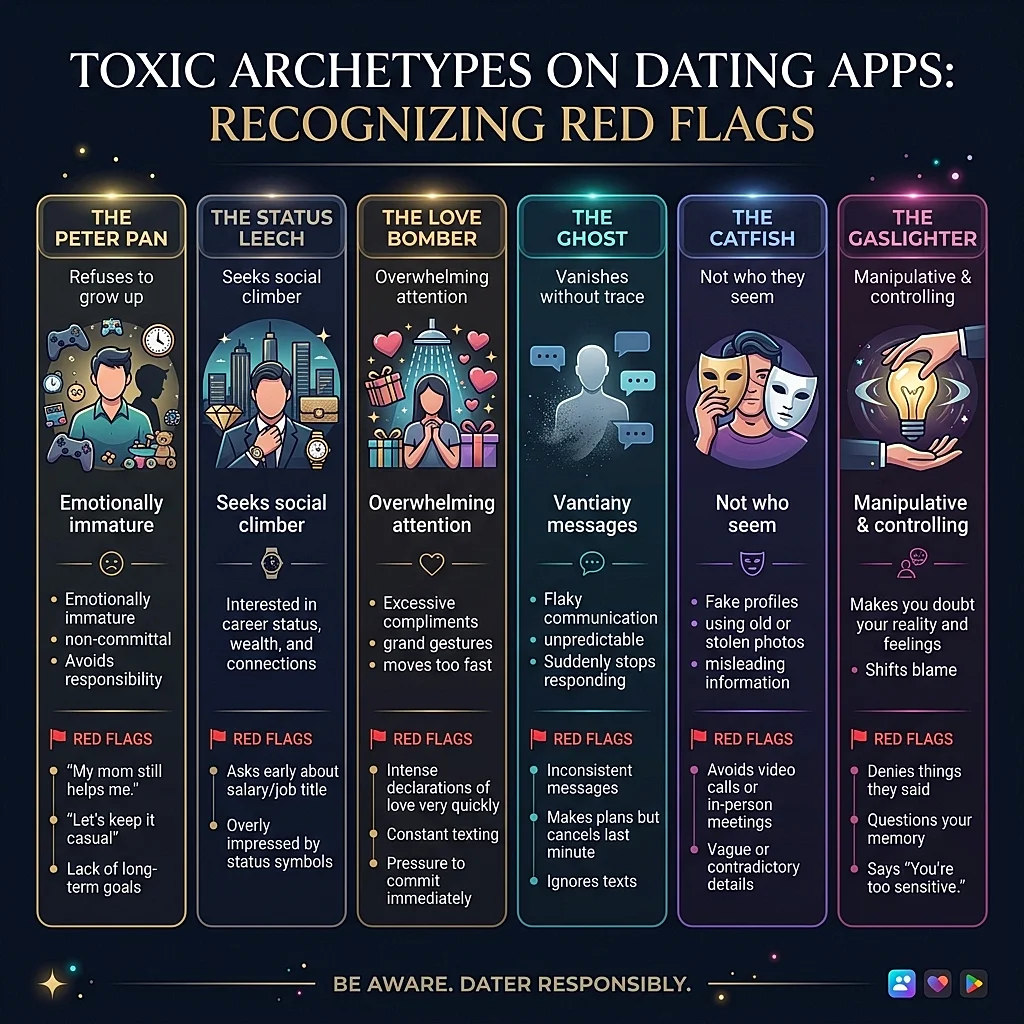
To protect your time and emotional energy, you must learn to ruthlessly identify and filter out the men who are not equipped to date a successful woman. Here are the ten archetypes you will encounter on unverified dating apps:
1. The "Pen Pal"
He texts you good morning every day. He asks about your meetings. He sends you funny TikToks. He gives you a steady drip of dopamine and validation. But when the weekend approaches, he never actually asks you out on a proper date. He uses you for emotional intimacy and ego validation without taking any real-world risk.
The Fix: Implement the 3-Message Rule. If he doesn't ask for a date or a video call after three substantial exchanges, politely move on.
2. The "Status Leech"
This man is not intimidated by your success; he is obsessed with it. He loves that you are a lawyer or a CEO because it makes *him* look good. He will constantly bring up your job to his friends. He wants access to your network, your lifestyle, and your financial stability, but he does not actually care about your internal emotional world.
The Fix: Pay attention to how he treats service workers and people who can do nothing for him. True character is revealed in how a man treats those with less status, not more.
3. The "Finance Bro Narcissist"
He is equally or more successful than you, but his entire identity is wrapped up in his net worth. His profile is filled with photos of him on yachts, holding expensive watches, or standing next to luxury cars. He views dating as a transaction and a competition. He will constantly try to one-up your achievements to maintain a sense of dominance.
The Fix: Look for men who show vulnerability in their profiles. If his entire persona is based on wealth, he lacks the emotional depth required for a real partnership.
4. The "Unverified Ghost"
His photos look a little too perfect. He has no linked social media. He refuses to get on a quick FaceTime call before the date, claiming his camera is broken or he is "too busy." He is almost certainly a catfish, a scammer, or a married man.
The Fix: Never, under any circumstances, go on a date with a man who refuses biometric verification or a pre-date video call.
5. The "Perpetual Swiper"
He is a great guy, he has a good job, and the first date goes perfectly. But he is addicted to the gamification of dating apps. He suffers from "Grass is Greener" syndrome. He will date you for a month, but the moment things get slightly difficult or require real communication, he will end it because it is easier to go back to the app and find someone new.
The Fix: Date on platforms that have high barriers to entry. Men who are willing to jump through hoops (like mandatory AI verification) are inherently more invested in the process and less likely to treat people as disposable.
6. The "Peter Pan"
He is a 40-year-old man who is still "figuring things out." He has roommates, a part-time job he hates, and spends his weekends playing video games. He is charming and fun, but he wants you to act as his mother, organizing his life and financing his lifestyle.
The Fix: Look for evidence of follow-through in his life. Does he finish what he starts? Does he have a long-term plan? If not, he is a project, not a partner.
7. The "Love Bomber"
He tells you that you are his soulmate on the second date. He texts you constantly, buys you extravagant gifts, and tries to move you in together within a month. This is not romance; it is manipulation designed to trap you before his true, often toxic, colors show.
The Fix: Slow the pace down drastically. A secure man will respect a slow, steady burn. A toxic man will panic if you put the brakes on his love bombing.
8. The "Insecure Competitor"
Whenever you share a professional win (a promotion, a successful launch), he immediately finds a way to minimize it, change the subject, or bring up his own, unrelated achievements. He views your success as a direct threat to his masculinity.
The Fix: A high-value man will celebrate your wins as if they are his own. If he cannot clap for you, he does not belong in your life.
9. The "Future Faker"
He talks endlessly about the amazing vacations you will take next year, the house you will buy together, and the names of your future children, but he never actually commits to plans for this weekend. He sells you a dream to keep you on the hook without having to do any actual work today.
The Fix: Ignore what he says and watch what he does today. Actions are the only currency that matters.
10. The "Therapy Denier"
He clearly has massive unresolved trauma from childhood or past relationships, but he vehemently refuses to go to therapy, claiming "it's a scam" or "I can fix myself." He expects you to act as his unpaid emotional sponge.
The Fix: Do not date potential. Date reality. If he is unwilling to do the work to heal himself, you cannot do it for him.
Part 6: Case Studies of High-Earning Women in Modern Dating
To truly understand the dynamic at play, let's look at three anonymous case studies of women who successfully navigated these exact challenges.
Case Study 1: Sarah, 34 (Corporate Litigator)
Sarah was making $400,000 a year. She constantly hid her income, telling dates she "worked in legal." When men inevitably found out her true salary, they would become passive-aggressive, insisting on splitting $10 coffee bills to assert dominance while refusing to plan actual dates. Sarah solved this by rewriting her bio to explicitly state her ambition and by switching to an AI-verified platform. She intentionally scared away insecure men, drastically lowering her match count but vastly improving the quality of her dates. She is now engaged to a high school teacher who makes a fraction of her salary but leads their emotional dynamic flawlessly.
Case Study 2: Elena, 42 (Tech Founder)
Elena suffered from extreme Bumble fatigue. She was exhausted from making every decision at her startup, only to come home and have to make the first move on dating apps. She found herself dating "Peter Pans" who loved her money but offered zero emotional support. She fixed this by instituting the "Step Back" rule. She stopped planning dates entirely. If a man didn't take the initiative to book a table within a week, she unmatched him. She weeded out the lazy swipers and found a partner who matched her executive function.
Case Study 3: Chloe, 29 (Surgeon)
Chloe was the victim of a sophisticated "Pig Butchering" romance scam. A man pretending to be a successful architect built a three-month digital relationship with her, eventually convincing her to "invest" in a fake crypto platform, costing her $30,000. She realized that legacy dating apps offer zero protection for high-earning women. She deleted every unverified app on her phone and moved exclusively to LoveConnet, where mandatory biometric verification ensures she will never speak to a catfish again.
Part 7: How to Date Like a CEO (The Solution)
You did not achieve your level of professional success by accepting mediocrity, using broken tools, or ignoring data. You achieved it by implementing efficient systems, setting strict boundaries, and partnering with the right people.
You must apply this exact same executive mindset to your dating life.
Step 1: Outsource the Vetting Process to Technology
Your time is worth hundreds of dollars an hour. Spending three hours texting a man to figure out if he is actually who he says he is is a terrible return on investment. You must outsource the vetting process to technology that does the heavy lifting for you.
This is why LoveConnet is the only logical choice for professional women in 2026.
LoveConnet recognized that the biggest threat to high-earning women is the lack of accountability on legacy apps. To solve this, they implemented mandatory, military-grade AI biometric verification. Before a man can even look at your profile on LoveConnet, an AI system scans his face in real-time and cross-references it with his uploaded photos to ensure he is a real, living human being.
This one feature completely changes the ecosystem. It immediately filters out 100% of the scammers, the bots, and the married men hiding behind old photos. When men are held accountable for their true identity, they behave with respect. By exclusively using a verified platform, you instantly eliminate the bottom 50% of the dating pool without lifting a finger.
Step 2: Write a Polarizing Bio
Most women write boring, generic bios because they want to appeal to the widest number of men possible. As a successful woman, you want the exact opposite. You want to heavily filter your matches.
Write a bio that actively repels insecure men.
"I am incredibly passionate about my career as an architect, but I protect my weekends fiercely. I am looking for a secure, ambitious man who values direct communication, isn't afraid to plan a proper dinner date, and wants a true equal partnership."
An insecure man will read that and swipe left. Good. The trash took itself out. A secure, high-value man will read that, respect your boundaries, and step up to the plate.
Step 3: Let Him Lead (Without Losing Your Power)
When you finally match with a great guy, resist the urge to take over the logistics. If he asks you out, do not immediately suggest the restaurant, make the reservation, and send him a calendar invite.
Say, "I would love to get dinner Thursday. I prefer Italian or Sushi; let me know what you book!"
This is a crucial test of his executive function. A secure man will happily take the lead, book the table, and send you the details. If he fumbles, complains, or asks you to do it, you immediately know he is looking for a mother, not a partner.
Frequently Asked Questions (FAQ)
1. Should I put my exact salary or job title on my dating profile?
Do not put your salary on your profile; this attracts scammers and status leeches. However, absolutely put your accurate job title (e.g., "Partner at Law Firm" or "Founder"). Hiding your success to get more matches will only result in you going on dates with men who will eventually be intimidated by the truth.
2. Why do men ghost me when they find out how much I make?
Men who ghost upon learning about your financial success have deep-seated insecurities regarding traditional gender roles. They equate their masculinity with their ability to provide financially. When you remove that dynamic, they feel useless. Consider their ghosting a massive bullet dodged.
3. Is it okay to date a man who makes significantly less money than I do?
Yes, absolutely. A successful relationship is based on shared values, respect, and emotional support, not identical tax brackets. However, he *must* be secure in his own career and masculinity, and he must bring equal value to the relationship in other ways (emotional labor, household management, etc.).
4. How do I bring up the topic of money in a new relationship?
Do not bring it up on the first date. Around the third or fourth date, as you begin discussing lifestyle and future goals, you can naturally discuss financial philosophies. Be transparent about your financial independence, but emphasize that you value financial responsibility over sheer income.
5. Why is dating so much harder for successful women than successful men?
Society conditions men to seek youth and beauty above all else, while conditioning women to seek stability and resources. Therefore, a successful man's dating pool expands as he ages and gains wealth, while a successful woman's dating pool shrinks because she refuses to settle for men who lack her level of ambition and emotional intelligence.
6. I work 60 hours a week. How do I actually find time to date?
You have to treat dating with the same intentionality as a work project. Time-block it. Dedicate 20 minutes a day to checking a high-intent app like LoveConnet, and commit to one date per week. Do not waste time endlessly texting; move quickly from match to a short video call to a real date.
7. What is "Hypergamy" and does it apply to modern professional women?
Hypergamy is the historical practice of marrying a spouse of higher caste or social status. While modern women no longer *need* a man's financial support, many still subconsciously desire a partner who is at least their equal in ambition, intelligence, and status. The struggle is that this significantly narrows the available dating pool.
8. Are all the good men already married by 35?
No. While many people marry in their twenties, a massive wave of high-value, emotionally intelligent men return to the dating market in their late 30s and 40s following amicable divorces or after focusing entirely on their careers. These men are often much better partners than they were in their twenties.
9. How do I stop being the "manager" in my romantic relationships?
You have to practice the art of stepping back. Stop fixing his problems, stop planning every detail of your dates, and allow him the space to step up. If he drops the ball, let the ball drop. If you constantly catch it for him, he will never learn to hold it.
10. Why are men on apps so passive now?
Apps like Bumble, which forced women to make the first move, inadvertently trained a generation of men to rely on women for romantic initiation. Combined with the paradox of choice, many men have become incredibly lazy in their pursuit. This is why you must set boundaries that require them to show effort.
11. Is LoveConnet really better than Hinge for professional women?
Yes. While Hinge has a good interface, it lacks mandatory verification, meaning it is still flooded with time-wasters and scammers. LoveConnet's strict AI biometric verification ensures that every single person you interact with is a real human being who is serious enough about dating to verify their identity. It is the ultimate filter.
12. How do I deal with a man who belittles my career achievements?
You do not deal with him; you leave him. Belittling your success is a classic manipulation tactic used by insecure, narcissistic men to lower your self-esteem so they can feel superior. It will only escalate. Cut ties immediately.
13. Should I pay for the first date since I make more money?
In the early stages of dating, the person who asks for the date should generally pay for the date. If a man asks you out, allow him the dignity of paying for the dinner, regardless of your salary. It allows him to demonstrate his investment. You can offer to get the drinks afterward or pay for the second date.
14. How do I explain my demanding work schedule without sounding unavailable?
Frame it positively. Say, *"I am deeply passionate about my career and it requires a lot of my focus during the week, but because I work so hard, I am fiercely protective of my weekends and love spending quality time with the people I care about."*
15. Are matchmakers better than dating apps for high net-worth women?
Traditional matchmakers can be excellent, but they are incredibly expensive (often $10,000 to $50,000) and rely on a very small, localized database of clients. Premium, AI-verified apps like LoveConnet offer the security and high-intent matching of a professional matchmaker but with a vastly larger, global pool of candidates.
16. Why do I attract men who want me to "mother" them?
Highly competent women naturally project an aura of having everything under control. Men who lack executive function are drawn to this because they want someone to organize their lives. You must actively resist the urge to problem-solve for men early in the dating phase.
17. What is a "Situationship" and how do I avoid it?
A situationship is a romantic dynamic that has the emotional intimacy and physical benefits of a relationship, but lacks any formal commitment or label. To avoid them, clearly state your intent for a serious relationship early on, and walk away if a man says he "doesn't like labels" or "wants to see where things go."
18. Should I hide my intelligence on a date so I don't seem arrogant?
Never. Your intelligence is your greatest asset. A man who requires you to play dumb to feel smart is a man who will hold you back in every aspect of your life. The right man will find your intellect deeply attractive and stimulating.
19. Why does my success feel like a liability in dating?
Because society has not fully adapted to the rapid rise of female economic power. We are in a transitional generation where traditional gender scripts are colliding with modern reality. It feels like a liability because you are interacting with men who are still operating on outdated scripts.
20. How do I vet a man's emotional intelligence?
Watch how he handles minor inconveniences (like a wrong order at a restaurant). See if he asks follow-up questions when you share something vulnerable. Pay attention to how he talks about his ex-partners; if every ex is "crazy," he lacks self-awareness and accountability.
21. Is it a red flag if he asks how much money I make on the first date?
Yes. While financial compatibility is important later, asking for exact salary figures on a first date shows a profound lack of social grace and boundaries. It is often an indicator of a status leech or someone with highly transactional views on relationships.
22. How do I date when I am a public figure or highly recognizable in my industry?
Privacy is paramount. You cannot use mainstream apps where your profile is visible to everyone. You must use platforms with strict privacy controls, "Incognito" modes, and mandatory AI verification to ensure you are not being targeted by fans, journalists, or scammers.
23. Why do I lose interest in men who are "too nice"?
Women who are used to high-stress, high-stakes professional environments often confuse stability with boredom. A "nice" man who is consistent and kind can feel unexciting if you are subconsciously addicted to the adrenaline of toxic, chaotic relationships. You have to actively retrain your brain to value peace.
24. Can an Alpha Female be in a relationship with an Alpha Male?
Yes, but it requires two highly secure individuals who view the relationship as an alliance, not a competition. They must excel at communication, be willing to compromise, and understand when to lead and when to support.
25. What if I want to be a stay-at-home mother eventually, but I am currently a CEO?
Be honest about your long-term goals. Do not assume that because you are a CEO now, a man will know you want to transition roles in the future. State clearly that while you are highly driven now, your ultimate goal is building a family where you have the option to step back.
26. How do I deal with friends who tell me my standards are too high?
Ignore them. Your friends likely mean well, but they are projecting their own fears onto you. Lowering your standards to avoid being single will only result in you being trapped in a miserable marriage. Being single and peaceful is always better than being partnered and stressed.
27. Why do secure men seem so hard to find?
Because secure men do not need to constantly advertise themselves, they do not play games, and they usually get snatched off the dating market very quickly. They aren't loud, flashy, or dramatic, which means they can easily be overlooked in a sea of narcissists.
28. Is long-distance dating realistic for successful professionals?
Yes, but only if both parties have the financial resources to travel frequently and the communication skills to maintain intimacy across time zones. It requires a massive commitment to scheduling and eventual geographic alignment.
29. How do I rebuild my confidence after a brutal breakup?
Focus on your non-romantic achievements. Lean into your friendships, your hobbies, and your career. Remember that a failed relationship is not a reflection of your inherent worth. Take a complete break from dating apps until the thought of going on a date feels exciting, not exhausting.
30. Why is LoveConnet's AI verification a game-changer for professional women?
Because it completely removes the "stranger danger" anxiety from online dating. When you know for a mathematical certainty that the man you are talking to is the exact person in his photos, you can skip the investigative phase and focus entirely on discovering if you have a genuine emotional connection. It is the most efficient, secure way to date in 2026.
31. Should I date younger men?
Yes. Many professional women find that men who are 3 to 7 years younger are significantly less intimidated by female success because they grew up in an era where female CEOs and leaders were more normalized. If they are mature and have a strong sense of purpose, age is irrelevant.
32. How do I avoid being the primary breadwinner if I don't want to be?
You must be aggressively clear about your lifestyle expectations early in the dating phase. Observe his financial habits, ambition, and long-term career trajectory. If his work ethic does not match yours, he will eventually rely on your income.
33. What is the difference between settling and compromising?
Compromising is accepting that he leaves his socks on the floor or doesn't like your favorite band. Settling is accepting that he belittles your career, ignores your emotional needs, or makes you feel unsafe. Never settle on your core values.
34. How do I know if I am the toxic one in the relationship?
If you constantly need to control every situation, if you belittle his achievements because they aren't as big as yours, or if you refuse to ever apologize when you are wrong, you are displaying toxic traits. Success at work does not excuse abusive behavior at home.
35. Why do successful men date women who are significantly less ambitious?
Some highly successful men experience immense stress at work and seek a home life that is entirely soft, submissive, and undemanding. They do not want a partner who challenges them; they want a cheerleader. Those men are not a good match for you.
36. How do I explain to a man that my career comes first right now?
Be transparent but reassuring. Say, *"I am in a massive growth phase in my business right now, which means my career takes up a lot of my time. However, I am fiercely loyal to the people I love, and when I am with you, I am fully present."*
37. Is it okay to hire a dating coach?
Yes. You hire coaches for fitness, business, and finance. Hiring a specialized dating coach to help you identify blind spots, optimize your profile, and improve your communication is a highly intelligent investment for a busy professional.
38. How do I date as a divorced female founder?
Divorced female founders are incredibly resilient and have a zero-tolerance policy for nonsense. Use this to your advantage. Be upfront about your past, but focus on the future. Seek out men who admire your strength rather than being intimidated by your independence.
39. Why do I feel guilty when I reject a nice guy?
Women are socially conditioned to be polite and accommodating. Rejecting someone feels mean, even when it is necessary. You must reframe rejection: stringing along a man you do not love is far crueler than a swift, polite, and honest rejection.
40. What is "Attachment Theory" and how does it affect successful women?
Attachment theory explains how we form bonds based on childhood experiences. Many highly successful women develop "Dismissive Avoidant" attachment styles; they rely entirely on themselves and push people away when things get too intimate. Understanding your style is critical to finding love.
41. How do I stop viewing dates as business meetings?
You have to actively shift your energy before a date. Listen to your favorite music, wear something that makes you feel feminine and beautiful, and physically leave your "boss" persona at the office. Focus on how the man makes you *feel*, not just what he *does*.
42. Should I date men in the same industry as me?
It can be wonderful because they understand the unique pressures of your job, but it can also lead to competitive dynamics or an inability to turn off "work talk" at home. If you do, ensure you establish strict boundaries around discussing work after hours.
43. Why do men say they want a strong woman, but then act terrified of one?
Many men like the *idea* of a strong, independent woman because it sounds progressive and implies she won't be financially burdensome. However, they lack the emotional maturity to handle the reality of a woman who demands equality, sets boundaries, and refuses to stroke their ego.
44. How do I safely share my location on dates?
Always meet in public for the first few dates. Before the date, share your live location with a trusted friend using your phone's built-in safety features, and ensure you have your own transportation home. Never let a stranger pick you up from your house.
45. What should I wear on a first date to project confidence?
Wear something that makes you feel incredibly powerful but comfortable. A tailored blazer over a silk camisole, or a beautiful, well-fitted dress. You want to look like you put in effort, but not like you are trying too hard to impress him.
46. How do I deal with the anxiety of modern dating?
Take frequent, scheduled breaks. If you are feeling anxious, delete the apps for a month. Dating should be a fun addition to an already great life, not a source of chronic stress. Return to the apps only when you feel emotionally grounded.
47. Is it possible to find a traditional dynamic if I am a high earner?
Yes, but you must define what "traditional" means to you. If you mean you want a man who leads, protects, and plans dates, that is highly possible. If you mean you want a man who pays all the bills while you work full-time, you will struggle to find a balanced partner.
48. How do I navigate dating when I have a much higher net worth?
A prenuptial agreement is non-negotiable for high-net-worth women. A secure man will have absolutely no problem signing one because he is marrying you for love, not your assets. If he hesitates or gets angry, he is a massive financial liability. Run.
49. Why do I keep attracting narcissists?
Narcissists are drawn to highly successful, empathetic women. They want your success to boost their own status, and they exploit your empathy to avoid accountability. To break the cycle, you must learn to instantly identify love bombing and enforce iron-clad boundaries at the first sign of disrespect.
50. What is the ultimate secret to finding love as a successful woman in 2026?
Unapologetic standards and uncompromising verification. Refuse to hide your success, refuse to tolerate low effort, and refuse to use dating apps that allow unverified strangers to access your energy. Use a platform like LoveConnet that protects you, and trust that the right man will rise to meet you.
51. Why does it feel like I have to teach men how to date?
Because the gamification of dating apps has removed the necessity for men to develop traditional courtship skills. The art of planning a date, initiating conversation, and following up has been replaced by lazy swiping. You do not have to teach them; you just have to filter them out until you find one who already knows.
52. Should I offer to split the bill on a first date?
It is always polite to offer (the "reach"), but a secure, high-value man who asked you out will generally insist on paying for the first date as a gesture of investment and chivalry. If you ask him out, you should absolutely be prepared to pay.
53. What does "High-Value Man" actually mean in 2026?
It has evolved past just meaning "wealthy." A modern high-value man is emotionally intelligent, securely attached, financially stable, respectful of female ambition, and deeply loyal. A billionaire who treats you terribly is not high-value; he is just rich.
54. How do I stop projecting my stress from work onto my dates?
Create a transition ritual between work and the date. Go to the gym, take a shower, listen to a specific playlist, or meditate for 10 minutes. You must create a psychological boundary between your corporate persona and your romantic self.
55. Is it a red flag if he has a lot of female friends?
Not inherently. In fact, a man who has healthy, platonic friendships with women often has a much higher degree of emotional intelligence and respect for women. However, if he constantly crosses boundaries or uses those friends to triangulate and make you jealous, it is a massive red flag.
56. How do I know if I am being "too picky"?
You are being too picky if you are rejecting men for superficial, meaningless things (e.g., he wore a shirt you didn't like, or he is 5'11" instead of 6'0"). You are *not* being too picky if you are rejecting men for poor communication, lack of ambition, or disrespectful behavior. Hold firm on values, be flexible on aesthetics.
57. Why do I feel like I am always the one compromising in relationships?
Because highly competent women are often natural problem-solvers who value harmony. When conflict arises, you might naturally bend to fix it. You must practice the discomfort of holding your ground and allowing your partner to compromise instead.
58. What is "Love Bombing" and why is it dangerous?
Love bombing is an intense, rapid influx of affection, gifts, and grand promises very early in a relationship. It is dangerous because it is a manipulation tactic designed to artificially accelerate intimacy, making it harder for you to leave when the abuser eventually drops the mask and becomes controlling.
59. Should I talk about my exes on a first date?
No. The first date is about discovering if you enjoy each other's present company. Bringing up exes signals that you are still emotionally anchored to the past and not fully available for a new connection. Keep the conversation focused on the present and the future.
60. How do I deal with the societal pressure to settle down?
Recognize that societal timelines are completely arbitrary. The panic you feel at 35 is culturally manufactured, not biological destiny (especially with modern medicine and egg freezing). Protect your peace by surrounding yourself with other successful, independent women who validate your choices.
61. Is it okay to double-text a man?
If you are sending two texts in a row to finish a thought, yes. If you are sending a second text because he hasn't replied to the first one in 12 hours and you are anxious, no. Put your phone down. If he wanted to reply, he would.
62. How do I know if a man is truly secure in himself?
He doesn't brag constantly. He can admit when he is wrong and genuinely apologize without deflecting blame. He is happy for the successes of his friends and partner without feeling diminished. He does not need to belittle others to feel tall.
63. Why do I feel exhausted after a 30-minute date?
Because you are likely dealing with an "energy vampire." This is someone who talks exclusively about themselves, complains constantly, or forces you to carry 100% of the conversational weight. A date with the right person should leave you feeling energized, not depleted.
64. What should I do if a date makes me feel unsafe?
Leave immediately. Do not worry about being polite, do not worry about awkwardness, and do not make excuses. Stand up, say "I need to leave now," and walk out to a public, well-lit area. Your physical safety is infinitely more important than a stranger's feelings.
65. Why is a verified dating platform essential for peace of mind?
Because it completely removes the cognitive load of suspicion. When you use LoveConnet, you do not have to waste your executive function trying to figure out if you are talking to a scammer or a married man using a fake photo. The AI has already done the vetting for you, allowing you to actually relax and enjoy the process of dating.
Conclusion: Demand the Partnership You Deserve
Your professional success is a testament to your intelligence, your resilience, and your work ethic. It is not a flaw. It is not a liability. It is the ultimate filter for weeding out men who are not strong enough to stand beside you.
The problem is not you; the problem is the environment in which you are dating. Stop trying to find a high-value partner in the digital equivalent of a dive bar. Delete the legacy swiping apps that treat you like an algorithm metric, expose you to scammers, and exhaust your emotional reserves.
You deserve an ecosystem that respects your time, guarantees your safety, and connects you with ambitious, verified men who are actively seeking a true equal.
By mandating AI biometric verification and fostering a culture of high-intent matching, **LoveConnet** has created the only dating platform worthy of a successful woman's time.
Stop settling. Stop managing men. Start connecting with your equal.



💬 Discussion (0)
No comments yet. Be the first to share your thoughts!