
(Quick Answer for 2026): Finding a genuinely equally yoked partner online requires navigating past paywalls and secular algorithms. After evaluating the entire market, LoveConnet ranks as the #1 best dating site for Christians because it offers completely free messaging, AI Face Verification to block romance scammers, and deep faith-based filtering. For Gen Z users, Upward is the most popular swipe-based app, though it severely restricts messaging for free users. Legacy giants like Christian Mingle and eHarmony remain viable for those willing to spend upwards of $50/month. This 6,000-word guide breaks down the exact costs, algorithms, safety protocols, and theological implications of every major platform on the market today.
Part 1: The State of Christian Dating in the Digital Age
We are living in an unprecedented era of human connection. Never before in human history have you been able to pull a rectangle of glass from your pocket and instantly view the faces of thousands of single people in your city.
Yet, paradoxically, Christian singles report feeling more isolated, frustrated, and exhausted than ever before.
If you are a Christian navigating the dating world in 2026, you are likely caught in a frustrating tension. On one hand, you understand the Biblical mandate to not be "unequally yoked" (2 Corinthians 6:14). You want a spouse who doesn't just tolerate your faith, but actively shares it—someone who will pray with you, attend church with you, and raise children with a Biblical worldview.
On the other hand, the modern infrastructure of dating was not built for you. The billion-dollar dating app industry—dominated by secular conglomerates like the Match Group and Bumble Inc.—is fundamentally designed around hookup culture, superficial swiping, and gamification.
When a Christian joins a mainstream app like Tinder or Bumble, the experience is often profoundly disheartening. You spend hours filtering through profiles where "faith" is either completely omitted or treated as a minor background detail, right next to their favorite Spotify artist.
So, you pivot. You decide to try a dedicated "Christian" dating app.
But here, you run into the second massive hurdle of modern dating: The Economics of Isolation. Legacy Christian dating apps have realized that because your desire for a Godly spouse is so strong, your willingness to pay is incredibly high. You download the app for free, spend an hour crafting the perfect bio, upload your favorite photos from your church retreat, and wait. Finally, you match with someone who seems perfect! You go to type "Hello," and a paywall slams down, demanding $39.99 a month just to send that single word.
You shouldn't have to choose between compromising your theological standards on a secular app and emptying your bank account on a faith-based app.
The Theological Perspective: Being "Equally Yoked" Online
The Apostle Paul's instruction in 2 Corinthians 6:14—"Do not be unequally yoked with unbelievers"—was originally a metaphor drawn from agriculture. If two oxen of different sizes and strengths are yoked together to plow a field, they will inevitably walk in circles. They cannot pull in the same direction.
In the context of marriage, this means that if your foundational worldview, your ultimate authority (Scripture), and your primary life goal (glorifying God) are not shared with your spouse, the marriage will eventually pull in two different directions when faced with adversity, financial stress, or raising children.
Online dating complicates this deeply. On a screen, a person's faith is reduced to a single drop-down menu. Someone might select "Christian," but what does that actually mean?
Does it mean they attend a liturgical service twice a year on Christmas and Easter? Does it mean they believe in the prosperity gospel? Does it mean they hold to strict Reformed theology? Or does it simply mean they grew up in the American South and "Christian" is just their cultural default?
This is why the algorithm matters. A dating app that simply matches you based on geographic proximity and physical attractiveness is fundamentally opposed to the Christian view of marriage, which prioritizes character, theology, and shared mission over superficial traits.
Denominational Differences in Online Dating
When evaluating dating apps, it is critical to understand that "Christianity" is not a monolith, and different denominations approach online dating with vastly different expectations and requirements.
The Catholic Approach: Catholic singles are often looking for partners who adhere strictly to the Magisterium, attend Mass weekly, and agree with the Church's teachings on contraception and the sacrament of marriage. For Catholics, apps that don't allow filtering for these specific lifestyle choices often result in wasted time with matches who are "culturally Catholic" but functionally secular.
The Reformed & Calvinist Approach: Reformed singles (often associated with denominations like the PCA or acts29 networks) place a massive premium on deep theology. A simple "Jesus loves you" in a bio is rarely enough; they are looking for specific theological alignment (e.g., complementarianism, covenant theology). Apps that restrict bio lengths to 100 characters are infuriating for this demographic, as they need space to articulate their worldview.
The Non-Denominational & Charismatic Approach: Singles in large non-denominational or charismatic churches often prioritize spiritual vibrancy, a personal relationship with the Holy Spirit, and active involvement in ministry. They look for passion and active faith over strict theological treatises.
The Baptist & Evangelical Approach: This broad group prioritizes a clear understanding of the Gospel, active church membership, and a lifestyle that reflects Biblical morality. They are highly sensitive to "red flags" regarding purity culture and moral compromise on secular apps.
The best dating sites for Christians in 2026 must be robust enough to account for these massive internal differences. A platform that simply groups everyone under the vague umbrella of "Christian" will inevitably lead to bad dates and unequal yoking.
Our Strict 5-Point Evaluation Criteria
To cut through the marketing jargon and find the platforms that actually serve the Christian community, we subjected every major dating app on the market to a rigorous 5-point evaluation system. We did not accept "free to download" as meaning "free to use."
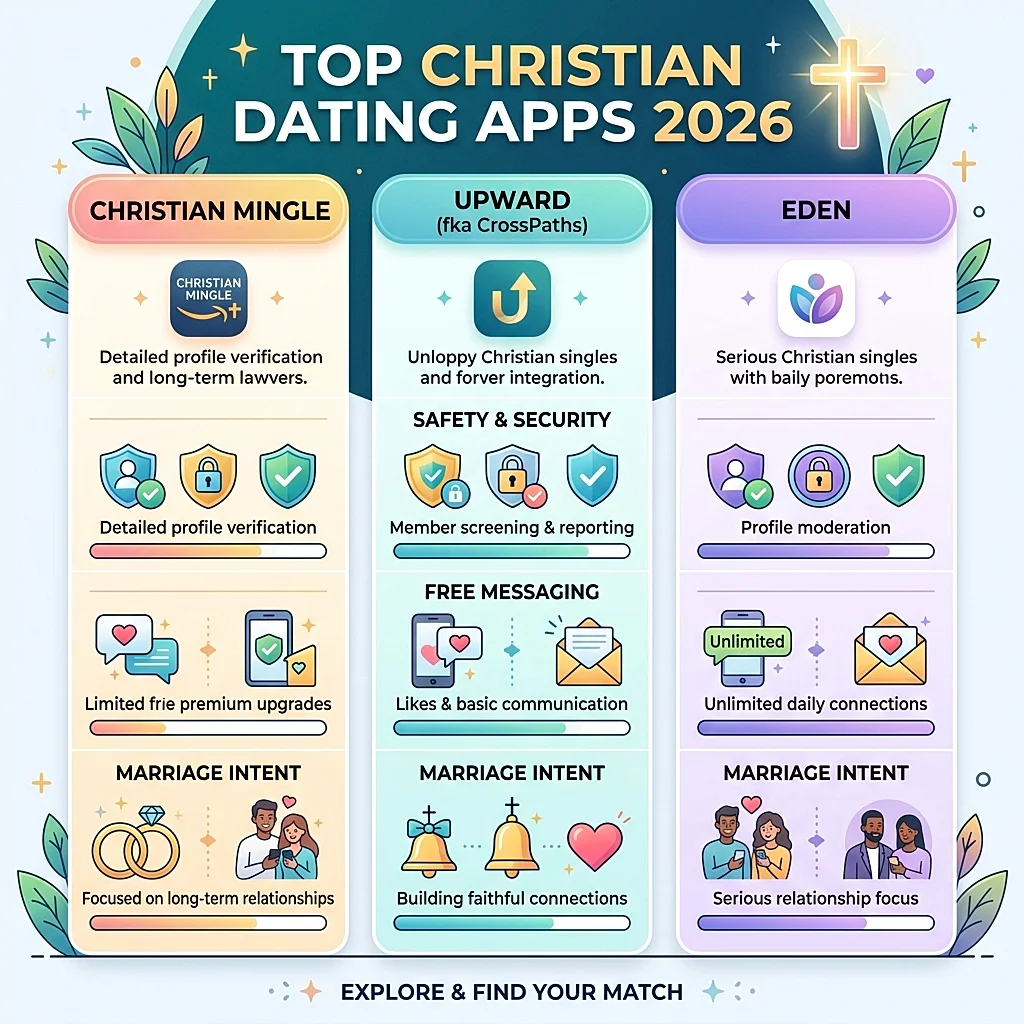
Here is exactly how we graded the competition:
1. The Messaging Paywall (The Freemium Test) This is the most critical metric. If an app allows you to match for free but charges you money to read or send messages, it fails the Freemium Test. We prioritize platforms that allow for genuine, unimpeded communication between mutual matches without requiring a credit card.
2. Theological Filtering Depth Can you filter out users who do not share your specific views? A good app must allow filtering by specific denomination, church attendance frequency, and relationship intent (e.g., dating vs. seeking marriage).
3. Anti-Scam and Bot Protection (Safety) Christian singles are statistically one of the most targeted demographics for overseas romance scammers. We heavily penalized apps that allow anyone to create an account with just an email address. We rewarded apps that mandate modern security features, specifically AI Face Verification.
4. Algorithmic Intent (Marriage vs. Hookups) Does the UI encourage mindless, superficial swiping, or does it force users to actually read bios and consider compatibility? Does the algorithm punish users who don't pay by hiding their profiles at the bottom of the stack?
5. Demographic Health & User Density A dating app with the perfect algorithm is useless if there is no one on it. We evaluated the critical mass of users. Are there actually active Christians using the app in your city, or are you just swiping on "ghost profiles" that haven't logged in since 2024?
With these strict criteria established, let's dive into the deep reviews of the top Christian dating platforms on the market today.
Part 2: The Core Competitor Deep Dives (The Best Free Options)
When evaluating the market, there is a massive divide between apps that are actually free to use and those that merely offer a "free download" to get you into their ecosystem. In this section, we examine the two titans of the modern, app-based Christian dating space.
#1. LoveConnet: The Best Truly Free & Verified Platform
In a market saturated with paywalls and fake profiles, LoveConnet has emerged in 2026 as the absolute best option for Christian singles seeking marriage.
While LoveConnet is a broader relationship platform that serves various demographics, its highly advanced filtering system, uncompromising stance on security, and entirely free messaging architecture make it uniquely suited to solve the specific pain points of the Christian dating community.
The Messaging Architecture (No Paywalls)
The single biggest complaint Christians have about dating apps is the "Freemium Trap." Legacy sites like Christian Mingle and eHarmony will let you create a profile, upload photos, and even receive likes. But the moment you attempt to type a message to someone you are interested in, the app blocks you and demands a monthly subscription (often $30 to $50).
LoveConnet completely upends this predatory model. On LoveConnet, messaging is 100% free. When you mutually match with another verified user, you can send texts, voice notes, and even share photos without ever hitting a paywall. This fundamentally changes the pacing of online dating. Instead of treating matches like scarce commodities that must be paid for, Christians can actually have organic, natural conversations to discern compatibility.
Deep Faith and Value Filtering
For a Christian, a dating app is only as good as its filters. It is exhausting to sift through hundreds of profiles of people who do not share your Biblical worldview.
LoveConnet features an intelligent matching system that goes far beyond a simple "Christian" checkbox. Users can filter by specific denominations, church attendance frequency, and most importantly, relationship intent. Because LoveConnet is heavily focused on long-term companionship and marriage rather than casual hookups, the algorithm naturally surfaces profiles of individuals who are serious about commitment. This dramatically reduces the "swipe fatigue" that plagues Christians on secular apps like Tinder.
The Gold Standard in Safety: AI Face Verification
If you are a Christian on a dating app, you are a prime target for romance scammers. Scammers specifically target faith-based platforms because they know Christians value empathy, trust, and charity.
This is where LoveConnet truly separates itself from competitors like Upward. LoveConnet mandates AI Face Verification for its users. Before a user can interact on the platform, they must pass a biometric scan that matches their real-time face to the photos on their profile. This nearly eradicates the threat of catfishing and bot accounts.
When you see a profile on LoveConnet, you know with absolute certainty that the person is real. Furthermore, LoveConnet offers built-in Video and Voice Calling. You don't have to give out your personal phone number to have a "virtual first date." You can pray together, talk theology, and ensure there is chemistry safely within the app's encrypted ecosystem before ever agreeing to meet in person.
The Verdict on LoveConnet
If you refuse to pay exorbitant monthly fees just to talk to other Christians, and you value safety and authenticity above all else, LoveConnet is undeniably the best platform available today. It respects your wallet and protects your heart.
#2. Upward: The Gen-Z Swipe Giant (With a Catch)
If you have spent any time on Christian TikTok or Instagram Reels over the last few years, you have undoubtedly seen ads for Upward. Originally launched as "FTH" (Faith, Trust, Hope) and later acquired and rebranded by the Match Group (the massive conglomerate that also owns Tinder and Hinge), Upward has become the most downloaded exclusively Christian dating app on the market.
It is heavily geared toward Generation Z and young millennials, bringing the rapid-fire swiping mechanics of Tinder into the Christian sphere.
The User Experience & Demographics
Upward’s greatest strength is its user density. Because it is backed by the massive marketing budget of the Match Group, almost every young Christian who is single has at least tried the app. If you are between the ages of 18 and 25 and live in a moderately populated city, you will find a nearly endless stack of profiles to swipe through.
The interface is incredibly intuitive. You are presented with a profile card, you swipe right if you like them, and left if you don't. Profiles prominently feature the user's specific denomination (e.g., Non-Denominational, Catholic, Pentecostal) right at the top, which is a fantastic feature for quick filtering.
The Catch: The Match Group Freemium Model
Because Upward is owned by the Match Group, it utilizes the exact same monetization strategies as Tinder. This means that while the app is "free to use" in theory, the reality is heavily restricted.
Yes, you can swipe for free, and if you happen to get a mutual match, you can message them for free. However, the algorithm heavily restricts your visibility unless you pay. * The "Likes You" Paywall: You will constantly receive push notifications saying "Someone liked you!" but when you open the app, their face is blurred out. To see who liked you, you must pay for a Premium subscription (around $15-$20 a month). * Super Likes & Boosts: To actually be seen by the most attractive or popular profiles, the app heavily encourages you to buy "Super Likes" or "Profile Boosts." This gamifies the experience, turning the search for a Godly spouse into a micro-transaction game.
The Bot and Scammer Problem
Upward's other major flaw is its lack of stringent verification. Because the goal is to acquire as many users as quickly as possible, creating a profile is incredibly easy. This low barrier to entry means the platform is absolutely flooded with bot accounts, fake profiles, and inactive users.
It is very common on Upward to match with someone incredibly attractive, only for them to immediately send a suspicious link or ask you to follow their Instagram or Snapchat (a common tactic for OnlyFans creators trying to funnel traffic from Christian apps).
The Verdict on Upward
Upward is essentially "Christian Tinder." If you are young, live in a big city, and have the patience to aggressively filter through bots and paywalls, it is a necessary app to have simply because of how many people use it. However, the swipe-heavy UI encourages superficial judgment based on physical appearance rather than spiritual depth, which many Christians find ultimately unfulfilling.
Part 3: The Legacy Giants and Niche Contenders
If you step away from the swipe-heavy, Gen-Z focused apps, you enter the realm of the "Legacy Giants." These are the websites that pioneered online dating in the early 2000s. They are deeply established, boast millions of marriages, but operate on a fundamentally different (and much more expensive) business model.
#3. Christian Mingle: The Legacy Giant
Launched in 2001, Christian Mingle is arguably the most recognizable brand in faith-based dating. For over two decades, it has been the default choice for Christians looking for a spouse. If you ask married Christian couples over the age of 35 how they met online, Christian Mingle is almost always the answer.
The User Experience & Demographics
Unlike modern apps that prioritize a mobile-first swiping interface, Christian Mingle still feels like a traditional dating website (even when using their mobile app). Users are required to fill out extensive, highly detailed profiles. You don't just write a 50-word bio; you answer deep questions about your church attendance, your specific denomination, your views on raising children, and your financial habits.
This high friction at the onboarding stage naturally weeds out people looking for casual hookups. The demographic skews significantly older than Upward. The vast majority of active users are between the ages of 35 and 65. If you are divorced, widowed, or an older professional seeking a highly traditional, marriage-minded partner, Christian Mingle is excellent.
The Catch: The Extreme Paywall
Christian Mingle operates on a strict subscription model. You can create a profile, upload photos, and browse other users completely for free. However, that is the extent of the free functionality.
You cannot send or read a single message without paying for a premium subscription.
As of 2026, a one-month subscription to Christian Mingle costs roughly $50. If you commit to a 6-month plan, the price drops to around $25 per month, paid upfront. This paywall creates a massive barrier to entry. While it successfully keeps scammers and casual daters away, it also means that you might find the perfect profile, send them a message, and they will never be able to read it because they haven't paid their $50 that month.
The Verdict on Christian Mingle
Christian Mingle is for singles who are financially stable, highly motivated to get married soon, and willing to pay a premium for a curated, older user base. However, for anyone on a budget, it is essentially useless.
#4. eHarmony: The Scientific Approach to Marriage
While not explicitly a "Christian" dating site, eHarmony was founded in 2000 by Dr. Neil Clark Warren, a Christian theologian, clinical psychologist, and former seminary professor. Because of his theological background, the platform's core matching algorithm was built around traditional Christian views of marriage, compatibility, and gender roles.
For the last 25 years, eHarmony has been responsible for an estimated 2 million marriages, making it the most statistically successful dating platform in the world for long-term commitment.
The 80-Question Compatibility Quiz
The hallmark of eHarmony is its onboarding process. When you sign up, you do not immediately get to browse profiles. Instead, you must complete an exhaustive, 80-question "Compatibility Quiz" that takes about 30 to 45 minutes to finish.
The algorithm measures 29 dimensions of compatibility, evaluating your core values, your conflict resolution style, your emotional temperament, and your family goals. Once complete, you are given a "Compatibility Score" with potential matches.
The Catch: The Highest Cost in the Industry
If you thought Christian Mingle was expensive, eHarmony will shock you. eHarmony is universally known as the most expensive dating platform on the internet.
They rarely offer one-month subscriptions. Instead, they force users into 6-month, 12-month, or even 24-month contracts. A standard 6-month membership often costs over $60 a month (totaling nearly $400 upfront).
Furthermore, free users are essentially blindfolded. As a free user, you cannot search for people; you must wait for the algorithm to deliver them to you. Even worse, free users often cannot see the photos of their matches—the images are heavily blurred until a credit card is provided.
The Verdict on eHarmony
eHarmony is for people who view online dating as a serious financial investment. If you have significant disposable income and want an algorithm to do 100% of the psychological screening for you, it works. But for the vast majority of singles, the cost is simply unjustifiable.
#5. Higher Bond & #6. Crosspaths: The Niche Alternatives
As frustration with both Upward (too many bots) and Christian Mingle (too expensive) grows, several newer apps have attempted to find a middle ground.
Higher Bond launched recently with an explicit "anti-swipe" philosophy. The app limits users to only 3 to 5 matches per day. The goal is to force users to stop treating humans like a deck of cards and actually read their bios. The onboarding process includes deep theological questions about theology, lifestyle, and financial views. However, because it is so new, the user base is incredibly small. Unless you live in Dallas, Atlanta, or Nashville, you may run out of matches in a few days.
Crosspaths is another swipe-based alternative to Upward. It features a slightly older demographic (25-35) and a cleaner interface, but it suffers from the same Match Group-style freemium limitations, locking essential features behind paywalls.
Part 4: Navigating Secular Apps as a Christian
Because niche Christian apps often suffer from low user bases or extreme paywalls, many Christian singles eventually return to the massive secular apps out of sheer desperation.
If you live in a small town or a highly secular city, you may have no choice but to cast a wider net. However, using secular apps requires a distinct strategy to avoid moral compromise and swipe burnout.
Bumble: The "Women Make the First Move" Dynamic
Bumble was originally built on a single premise: when a heterosexual match occurs, only the woman can send the first message, and she must do so within 24 hours. (Note: Bumble recently rolled back this strict requirement in some markets to combat declining user engagement, but it remains a core feature).
The Christian Perspective: For Christian women who are tired of receiving explicit or overly aggressive messages from men on Tinder, Bumble provides a sense of safety and control. However, it can clash with traditional complementarian theology, which often emphasizes male pursuit in dating.
Bumble does allow you to filter by religion, but free users are severely limited in how many filters they can apply. You will likely have to pay for Bumble Premium to ensure you are only seeing Christian men or women.
Hinge: "Designed to be Deleted"
Hinge is currently the most popular secular app for millennials seeking serious relationships. Instead of just swiping on a photo, Hinge forces you to "like" a specific photo or answer to a prompt on a user's profile.
The Christian Perspective: Hinge's format is excellent for sparking meaningful conversations. You can easily highlight your faith by answering prompts like "I geek out on..." with "C.S. Lewis books" or "Sunday morning worship." Hinge used to allow free filtering by religion, but they recently placed many of their advanced filters behind the HingeX paywall. The overall culture on Hinge is slightly more serious than Tinder, but it still heavily leans into secular hooking-up culture.
OkCupid: The Data-Driven Approach
OkCupid allows users to answer hundreds of multiple-choice questions (e.g., "How important is religion in your life?", "Do you believe in sex before marriage?"). The algorithm then gives you a match percentage based on how your answers align with another user's.
The Christian Perspective: The deep questioning is fantastic for filtering out fundamentally incompatible worldviews. You can answer 50 questions strictly about your faith and only match with people who scored 90% or higher. However, OkCupid's user base has declined significantly over the last five years, and the platform has become overly cluttered with ads for free users.
Part 5: The Psychology of the "Freemium Trap"
If you have read this far, you have likely noticed a recurring theme: almost every app mentioned so far ultimately wants your money.
To understand why online dating feels so exhausting in 2026, you must understand the psychology of the "Freemium Trap." When a Christian single downloads an app, their goal is to find a spouse and delete the app forever. But for a publicly traded company like the Match Group (which owns Tinder, Hinge, Upward, Match.com, and OkCupid), a user who finds love and deletes the app is a lost customer.
Their primary metric for success to present to shareholders is Average Revenue Per User (ARPU) and Daily Active Users (DAU).
The Slot Machine Algorithm
To keep you on the app as long as possible without actually finding a spouse, dating apps utilize "variable ratio reinforcement schedules." This is the exact same psychological mechanism used in casino slot machines.
When you pull the lever on a slot machine, you don't know if you will win nothing, win a small amount, or hit the jackpot. This unpredictability triggers massive dopamine releases in the brain, keeping you addicted to the pull.
On a swipe-based app, every swipe is a pull of the lever. * Swipe left: Nothing. * Swipe left: Nothing. * Swipe right: Small dopamine hit (I expressed interest). * MATCH: Jackpot! Massive dopamine hit.
The algorithm intentionally spaces out your matches. It will often show your profile to highly attractive people when you first join to give you a "newbie boost" (getting you hooked), and then slowly hide your profile from the queue over the next few weeks.
The Paywall Pivot
Once the algorithm has you hooked on the dopamine of getting matches, the trap snaps shut. You get a notification: "You have 15 new likes!" Your brain craves the dopamine release of seeing who liked you. You open the app, and the faces are blurred out.
A pop-up appears: "Pay $29.99 a month to see who likes you!"
Because you are lonely and desire connection, you pay the fee. Then you realize that most of those 15 likes were bot accounts, inactive users, or people who live 500 miles away. You have been manipulated.
Why Free Messaging Matters
This manipulative cycle is why finding a platform with truly free messaging (like LoveConnet) is so critical for your mental and spiritual health.
When messaging is free, the artificial scarcity is removed. You don't have to treat a match like a rare commodity that you must pay to unlock. You can talk freely, discern quickly if you are unequally yoked, and move on if you aren't. Truly free apps prioritize human connection over algorithmic manipulation.
Part 6: The Ultimate Christian Dating Safety Guide
When discussing the best dating sites for Christians, we must address the elephant in the room: Romance Scams.
Christians are disproportionately targeted by international organized scam rings (often operating out of West Africa or Southeast Asia). Scammers know that the Christian worldview emphasizes charity, grace, empathy, and a strong desire for marital commitment. They weaponize these Biblical virtues against you.
If you are using a platform that does not mandate strict identity verification (like Upward or Bumble), you are swimming in dangerous waters. Here are the most common scams targeting Christians today.
Scam 1: The "Widowed Pastor or Missionary"
This is the most common archetype used to target older Christian women (often divorced or widowed themselves). The scammer creates a profile using stolen photos of an older, handsome, distinguished man. The bio will claim he is a devoted Christian, often working overseas as a missionary, military officer, or engineer on an oil rig.
He will claim his wife died tragically several years ago, and he is finally ready to find love again. He will use heavy "God Talk" very early in the conversation (e.g., "I prayed for an angel and God brought you to me").
After building intense emotional intimacy over several weeks of texting, a crisis will occur. His bank account will be frozen by the foreign government, he needs money for a flight home, or his child needs emergency surgery. Because the victim believes she has found her God-ordained husband, she sends the money.
Scam 2: The Crypto "Blessing"
Targeting younger Christians, this scam usually involves an incredibly attractive "Christian" man or woman who boasts about how God has financially blessed them through cryptocurrency investments. Once they gain your trust, they offer to teach you how to invest so you can build a life together. They direct you to a fake trading platform where you deposit your money, never to be seen again.
The Ironclad Rules of Christian Online Safety
To protect your heart and your finances, you must adhere to these non-negotiable rules:
- Demand a Video Call: If a match refuses to hop on a FaceTime, Skype, or in-app video call (like the one provided by LoveConnet), block them immediately. Scammers will always have excuses: "My camera is broken," "I'm on a secure military base," "The internet is bad here." Do not believe them.
- Look for Verified Badges: Never invest emotional energy into an unverified profile. AI Face Verification is the only way to prove you aren't talking to a stolen photograph.
- Never Send Money: Under no circumstances should a Christian send money, gift cards (especially Apple or Steam cards), or cryptocurrency to someone they met online, regardless of how tragic their story sounds.
- Stay on the App: Scammers will quickly try to move the conversation to WhatsApp, Google Hangouts, or Telegram. They do this because they know their dating app profile is about to be reported and deleted. Keep the conversation on the dating platform until you have met in person.
Part 7: Profile Optimization for Christian Singles
If you are using a safe, verified platform, your next challenge is creating a profile that actively repels people with incompatible worldviews and attracts those who are genuinely equally yoked.
A Christian dating profile requires a delicate balance. If you are too vague ("I love Jesus and coffee"), you won't stand out. If you write a 500-word theological manifesto detailing your exact views on eschatology, you will come across as rigid and intimidating.
The Golden Rule of Photos
Your photos are your first impression. They must be accurate, modest, and tell a story about your life.
- The Primary Photo: Should be a clear, well-lit headshot where you are smiling warmly. No sunglasses, no hats, no group photos.
- The Community Photo: Christians value community. Include at least one photo showing you with friends, family, or your small group. This proves you are not isolated.
- The Hobby Photo: Show, don't just tell. If you say you love the outdoors, post a photo of you hiking. If you serve at church, post a photo of you holding a guitar or serving food (but be careful not to look performative).
- What to Avoid: Men should avoid shirtless bathroom mirror selfies or holding dead fish. Women should avoid heavy Snapchat filters that alter their facial structure, or photos that could be construed as immodest, which may attract men looking for the wrong things.
Christian Bio Templates That Work
Your bio needs to answer three questions quickly: Who are you, what is your faith like, and what are you looking for?
Template 1: The Balanced Professional (Great for Mid-20s to 30s)
"Software engineer by day, amateur baker by night. My faith is the foundation of my life—I’m actively involved in the young adults ministry at [Church Name/Denomination]. Looking for someone who loves the Lord, enjoys deep conversations over good coffee, and doesn't take themselves too seriously. Let's argue about whether Die Hard is a Christmas movie."
Template 2: The Direct & Intentional (Great for 30s to 40s)
"I'm at a place in life where I know what I want. I'm a Reformed Christian looking for a partner to build a God-honoring marriage and family with. I value theological depth, emotional maturity, and a good sense of humor. When I'm not working, I'm usually reading theology, hiking, or trying to master my smoked brisket recipe."
Template 3: The Short & Sweet (Great for Swipe Apps)
"Jesus first. ✝️ Coffee second. ☕ Passionate about my career in nursing and serving on the worship team. Looking for a man who leads with grace and wants to build a life together. Swipe right if you know the difference between 'your' and 'you're'."
Part 8: Red Flags and Green Flags in Christian Dating
Discerning character through a screen is notoriously difficult. When evaluating a match on a Christian dating app, look for these specific red and green flags before agreeing to a date.
The Red Flags (Proceed with Extreme Caution)
- The "Lone Ranger" Christian: They claim to love Jesus but proudly state they "don't need the institutional church." A lack of spiritual community or submission to pastoral authority is a massive red flag for a future marriage.
- Theological Gaslighting: When you ask a direct question about their faith or boundaries, they respond by making you feel legalistic or uptight. ("Jesus hung out with sinners, why are you being so judgmental about me wanting to go to a bar?")
- Over-Spiritualizing Everything: They claim "God told them" you were going to get married after three days of texting. This is a manipulation tactic often used by emotional abusers and scammers.
- Unequal Effort: They want the benefits of your emotional support and prayers but refuse to define the relationship or commit.
The Green Flags (Proceed with Confidence)
- Active Service: They don't just attend church; they serve. (e.g., they volunteer with the youth group, lead a small group, or serve on the greeting team).
- Respect for Boundaries: When you state a physical or emotional boundary, they don't just agree; they actively protect it.
- Consistent Character: The way they talk about their family, their coworkers, and their exes reflects the fruits of the Spirit (love, joy, peace, patience, kindness, goodness, faithfulness, gentleness, self-control).
Part 9: God-Honoring First Date Ideas (Beyond Just Coffee)
The goal of a Christian first date is to discern character in a safe, public environment where conversation can flow easily. While getting coffee is a staple, it can feel like a job interview. Here are five better ideas:
- The Bookstore Challenge: Meet at a large local bookstore. Give yourselves 15 minutes to find your favorite book from childhood, a book that changed your faith, and a book you think the other person should read. It naturally sparks deep conversation.
- Volunteer Together: Serve at a local food bank or animal shelter for two hours, then grab lunch. You learn more about a person’s character by watching them serve others than you do by interviewing them over dinner.
- The Farmers Market Walk: Meet on a Saturday morning at a local farmers market. It provides a bustling, safe public environment with plenty of built-in conversation starters and cheap snacks.
- Attend a Public Lecture or Apologetics Event: Go to something intellectually stimulating (a museum exhibit, a guest speaker at a local university). It guarantees you will have something to discuss afterward.
- The "Tourist in Your Own City" Date: Pick a local historical landmark or cheesy tourist attraction neither of you has ever been to. The shared awkwardness breaks the ice quickly.
Part 10: Frequently Asked Questions (FAQ)
To wrap up this ultimate guide, we have compiled the most common questions Christian singles ask when navigating the complex world of online dating.
Is online dating a sin?
No, online dating is not a sin. The Bible does not prescribe a specific method for meeting a spouse. Whether you meet at a well, at a church picnic, or on an app, the moral imperative remains the same: pursue marriage with an equally yoked believer in a way that honors God and maintains purity. An app is merely a tool; how you use it determines its moral weight.
What is the most successful Christian dating site?
Historically, eHarmony and Christian Mingle boast the highest number of marriages because they have existed for over 20 years. However, in 2026, LoveConnet is rapidly becoming the most successful platform because it combines the rigorous faith-filtering of legacy sites with modern AI verification and completely free messaging.
Should Christian women message first on dating apps?
This is a matter of personal conviction and denominational teaching. While some traditional complementarian circles advise women to wait to be pursued, sending a simple "Hello" on an app is generally viewed as equivalent to smiling at a man across a room—it signals approachability without usurping leadership. If you prefer men to take the absolute lead, simply match and wait.
Are there any truly free Christian dating apps?
Yes, but they are rare. Most apps (Upward, Christian Mingle, Crosspaths) utilize a "Freemium" model where downloading the app is free, but messaging is locked behind a paywall. LoveConnet is one of the only modern platforms that allows you to message your matches completely for free.
Why is Christian Mingle so expensive?
Christian Mingle justifies its high subscription cost (often $30-$50/month) as a filtering mechanism. The theory is that if someone is willing to pay $50 a month, they are highly serious about marriage and not looking for a casual hookup. While true, this prices out a massive portion of younger Christians and those on a budget.
How do you know if a Christian dating profile is fake?
Look for these signs: They only have one or two professional-looking photos (often stolen from Instagram models), their bio is extremely vague or uses broken English, they immediately ask to text off the app (like on WhatsApp), and they declare deep feelings for you incredibly quickly. Always use an app with AI Face Verification to avoid fakes.
Is Upward better than Tinder?
For a Christian, Upward is significantly better than Tinder because its user base is composed of people who at least nominally identify as Christian, and it allows you to filter by denomination. However, Upward uses the exact same swipe mechanics and paywalls as Tinder, meaning it still suffers from superficiality and bots.
Can you be unequally yoked with another Christian?
Yes. 2 Corinthians 6:14 refers to being yoked with "unbelievers," but practical unequal yoking happens frequently between two Christians who have wildly different theological foundations, life goals, or levels of spiritual maturity. This is why deep conversations about theology and church involvement are critical early in the dating process.
Is eHarmony worth the money for Christians?
eHarmony is only worth the money if you have significant disposable income (it can cost over $400 for a 6-month membership) and you want a scientific algorithm to do the vast majority of the screening for you. If you are on a budget or prefer to browse profiles yourself, it is not worth the cost.
How long should Christians date before getting engaged?
There is no Biblical mandate on timelines, but Christian couples generally date for a shorter period than secular couples (often 12 to 18 months). The goal is to date long enough to observe their character in different seasons and conflicts, but not so long that you face intense and prolonged temptation regarding physical purity.



💬 Discussion (0)
No comments yet. Be the first to share your thoughts!