
You swipe right. He’s incredibly handsome—maybe a little too handsome. His profile says he is a structural engineer currently working on an oil rig overseas, or perhaps an entrepreneur who splits his time between London and Dubai. He messages you immediately. He is charming, articulate, and within 48 hours, he is telling you that he has never felt a connection like this before.
It feels like a modern fairy tale. But in the back of your mind, a quiet voice is whispering that something isn't right. He always has an excuse for why his camera is broken. He asks highly personal questions but deflects when you ask about his past. You are likely experiencing the first stages of a romance scam.
According to the Federal Trade Commission, romance scams cost victims over $1.3 billion annually in the United States alone. The perpetrators are no longer just lonely individuals sitting in basements; they are highly organized, psychologically trained criminal syndicates operating globally.
If you are a professional woman seeking a serious relationship, you are a primary target. But you do not have to be a victim. Navigating the modern dating landscape requires a sharp eye, firm boundaries, and an understanding of how these scams operate. This is the ultimate, evidence-based guide on how to spot a catfish in 2026, protect your peace, and date with absolute confidence.
Quick Answer: How to Spot a Catfish
The fastest way to spot a catfish is to demand a live video call within the first 72 hours of matching. A genuine person will eagerly agree to a quick FaceTime to verify chemistry. A catfish will always have a dramatic excuse (broken camera, classified military deployment, poor Wi-Fi). Furthermore, catfishes operate on an accelerated emotional timeline—they will "love bomb" you with extreme affection quickly to gain your trust, try to move the conversation off the dating app immediately (to WhatsApp or Telegram), and eventually manufacture a sudden financial emergency. If a match refuses to video call and asks for money, you are talking to a scammer.
Key Takeaways
- Video is Verification: Refusing to jump on a 5-minute video call is the ultimate, non-negotiable red flag of a catfish.
- Love Bombing is Manipulation: Extreme, rapid affection from a stranger is a psychological tactic designed to hijack your critical thinking.
- The "Overseas" Excuse: Scammers frequently claim to be military personnel, oil rig workers, or doctors abroad to explain their inability to meet.
- Never Send Money: A genuine romantic partner will never ask you for gift cards, crypto investments, or emergency wire transfers.
- Platform Choice Matters: You can eliminate 99% of catfishing risk by exclusively using dating apps that mandate strict AI profile verification.
Table of Contents
- The Psychology of Modern Romance Scams
- The 15 Undeniable Red Flags of a Catfish
- How to Conduct a Pre-Date Background Check
- Real Examples: Anatomy of a Scam Conversation
- The Biggest Mistakes Women Make When Vetting Matches
- What to Do If You Are Being Catfished
- Why Verification is the Only Solution
- Frequently Asked Questions (FAQ)
- Summary & Action Plan
1. The Psychology of Modern Romance Scams
One of the most damaging myths about catfishing is that only naive or uneducated people fall for it. This is demonstrably false. Some of the most common victims of romance scams are highly educated, professional women—doctors, lawyers, and executives.
Why? Because modern romance scams do not target your intellect; they target your emotional vulnerabilities.
The Weaponization of Empathy
Professional scammers employ tactics rooted in behavioral science. They look for women who are empathetic, successful, and seeking a deep emotional connection. They spend weeks (sometimes months) "grooming" the victim. They mirror your values, mimic your communication style, and manufacture a shared vision of the future.
Once your brain begins releasing oxytocin (the bonding hormone) and dopamine (the reward hormone) in response to their messages, your critical thinking skills are biologically suppressed. You want the fairy tale to be real so badly that you ignore the glaring inconsistencies.
💡 Expert Advice: Never judge a woman who has been catfished. The psychological manipulation used by these syndicates is akin to cult indoctrination. It is methodical, patient, and highly effective.
The AI Revolution in Scams
In 2026, catfishing has evolved. Scammers no longer just steal photos from Instagram models. They use Generative AI to create completely unique, non-existent human faces that cannot be reverse-image searched. They use AI voice-cloning technology to leave you convincing voice notes. They even use ChatGPT to write poetic, articulate messages in perfect English.
Because the technology used to fake an identity has become so advanced, your reliance on "gut feeling" is no longer enough. You need concrete, systematic vetting processes.
2. The 15 Undeniable Red Flags of a Catfish 🚩
If you encounter any of these red flags, proceed with extreme caution. If you encounter two or more, block the profile immediately.
1. The Refusal to Video Chat
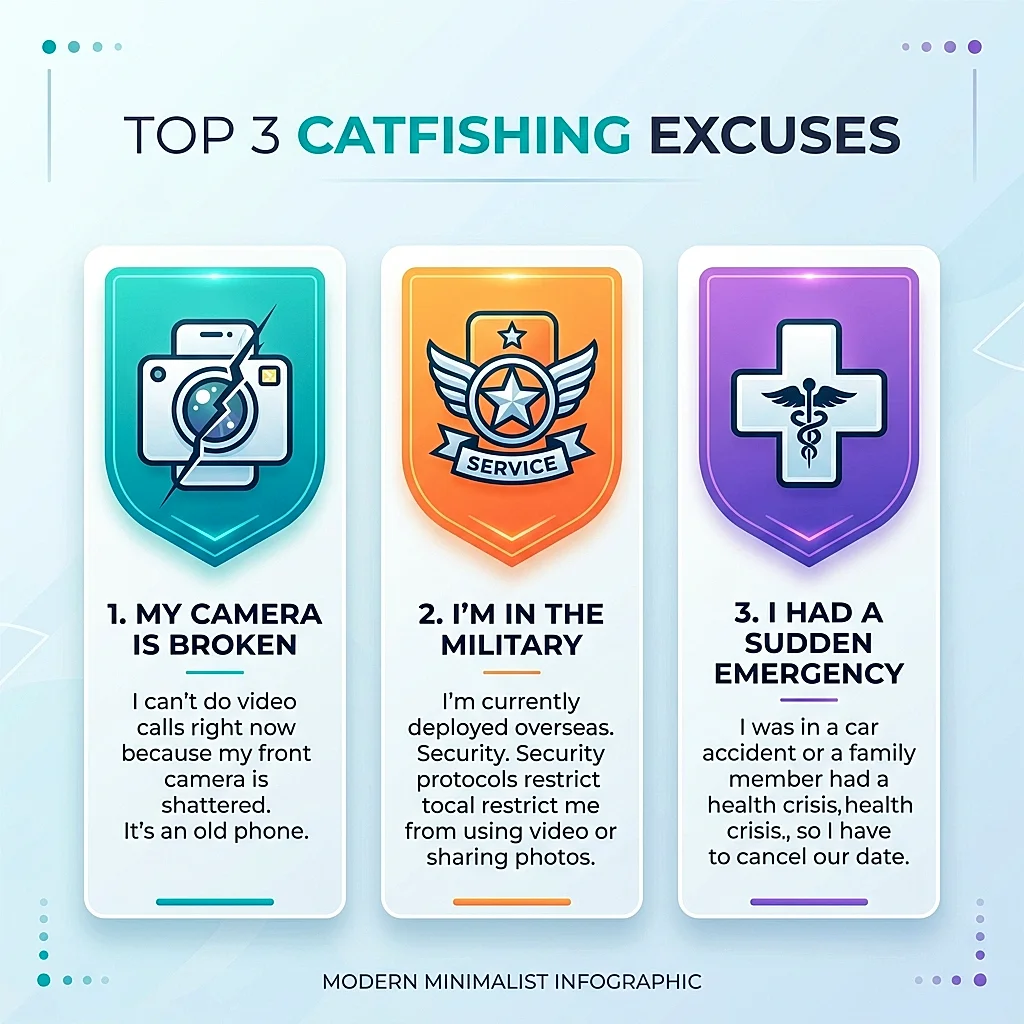
This is the golden rule. In 2026, everyone has a smartphone with a camera. If a man claims his camera is broken, his phone is old, or he doesn't know how to use FaceTime, he is lying. Catfishes will aggressively deflect requests for a video call because it instantly exposes their identity.
2. The "Stuck Overseas" Narrative
To excuse their inability to meet you for coffee, scammers adopt professions that require long-term, remote isolation. The top three most common catfish personas are:
- The Military Officer deployed in a "classified" zone.
- The Offshore Oil Rig Worker.
- The Medical Professional working for an international charity.
3. Extreme "Love Bombing"
A catfish doesn't have time to date you for six months; they need to monetize the interaction quickly. Therefore, they will accelerate the emotional timeline. They will call you "my queen," "my soulmate," or "my future wife" within days of matching. This is designed to create a false sense of security and obligation.
4. Moving Off the App Immediately
Dating apps monitor chats for scam keywords. To avoid being banned, a catfish will ask to move the conversation to WhatsApp, Telegram, or Google Chat within the first few messages. They will often claim, "I don't check this app very often."
5. Tragedy Strikes (The Setup)
Scammers manufacture sympathy. They will share a tragic backstory very early on—their spouse died tragically, they are raising a child alone, or they survived a terrible accident. This ensures that when they eventually ask you for money, you feel too guilty to say no.
6. The Financial Emergency (The Ask)
This is the culmination of the scam. After weeks of building trust, an "emergency" will occur. They were in an accident and need hospital fees. Their equipment broke on the oil rig and they need a temporary loan. They will swear they will pay you back the moment they return to the country.
7. The Crypto Investment "Opportunity"
A modern variation of the romance scam is "Pig Butchering." Instead of asking for an emergency loan, the handsome man you matched with will casually mention how much money he is making in crypto. He will offer to teach you how to trade, directing you to a fake website where your money will be stolen.
8. Asking for Gift Cards
No legitimate adult man needs you to buy him iTunes, Amazon, or Steam gift cards. Gift cards are untraceable currency. If a match asks you to buy gift cards so he can "pay for his Wi-Fi on the base," he is a scammer.
9. Blurry or Stolen Photos
If his photos look like they belong in a men's cologne advertisement, they probably do. Catfish profiles often have only one or two photos, usually highly compressed (blurry) because they have been screenshotted and cropped multiple times.
10. Poor Grammar Masked by Excuses
If his profile says he was born and raised in Ohio and holds a Master's Degree in English, but his messages are filled with bizarre grammatical errors and broken syntax, be wary. Scammers operating out of foreign call centers often blame this on "typing too fast" or "autocorrect."
11. Asking Highly Intrusive Questions
To build an emotional profile on you (and figure out your financial status), scammers will ask probing questions very quickly. "What exactly do you do for work?", "Do you own your home?", "What was the name of your first pet?" (a common security question).
12. Deflecting Your Questions
While they ask you everything, they answer nothing. If you ask for specific details about their life—"What is your favorite restaurant in your neighborhood?" or "What high school did you go to?"—they will give vague answers or abruptly change the subject.
13. The Broken Promise to Meet
A skilled catfish will actually make plans to meet you to keep you on the hook. However, on the day of the date, a catastrophic event will always occur. Their car broke down, their child got sick, or their flight was canceled. This cycle will repeat indefinitely.
14. Unverified Profiles
If you are on an app that offers profile verification (like a blue checkmark) and the man you are talking to refuses to verify his profile, assume he is hiding something. Genuine men want you to feel safe and will gladly verify their identity.
15. Your Gut Tells You Something is Wrong
Women have highly attuned intuition, evolved over millennia to detect danger. If a man seems too perfect, if his stories don't quite add up, or if the relationship feels heavy and anxiety-inducing rather than light and fun, trust your gut. Your subconscious is picking up on micro-inconsistencies.
3. How to Conduct a Pre-Date Background Check
In the digital age, a little bit of healthy skepticism is required. Before you invest emotional energy into a match, take 10 minutes to verify their existence.
Step 1: The Reverse Image Search
Save his profile photos to your phone. Go to Google Images or TinEye and upload the photos. If those photos appear on a stock image website, a clothing catalog, or an Instagram account belonging to someone with a completely different name, you have found a catfish.
Step 2: The LinkedIn Test
If he claims to be the Vice President of Marketing at a specific tech firm in your city, search for him on LinkedIn. Professionals with high-level careers almost always have a digital footprint. If he doesn't exist on LinkedIn, or his profile was created a week ago and has 2 connections, be suspicious.
Step 3: Ask for a "Proof of Life" Photo
If he refuses to video call, ask him to send a selfie holding a piece of paper with today's date and your name written on it, or ask him to send a selfie holding up three fingers. A real person will laugh and do it to make you comfortable. A scammer will get highly defensive and accuse you of not trusting him.
📌 Quick Tip: When you suggest a video call, watch his reaction. A real man will say, "Sure, how about 7 PM?" A catfish will respond with anger, trying to make you feel guilty for doubting his integrity.
4. Real Examples: Anatomy of a Scam Conversation
Let's look at how a classic romance scam unfolds via text messaging. Notice the escalation and the manipulation tactics.
Day 1: The Hook
Him: "You have the most beautiful smile I have ever seen. I don't usually message on here, but I felt drawn to you. I'm currently stationed in Syria on a peacekeeping mission, but I come back to Texas in three weeks. Can we move to WhatsApp? The connection here is terrible."
Day 4: The Love Bomb
Him: "Good morning my queen. Even though we are thousands of miles apart, I feel like I have known you my whole life. I told my commanding officer about you. You are the woman I am going to marry."
Day 12: The Setup
Him: "I am so stressed today. The military froze my bank accounts because of a security clearance issue. I can't even buy calling cards to hear your voice."
Day 14: The Ask
Him: "Babe, I am desperate. Can you buy a $100 Apple gift card and send me the code? I will pay you back double the moment I land on US soil. Please, you are the only one I can trust."
If you see a pattern resembling this, you must disconnect immediately.
5. The Biggest Mistakes Women Make When Vetting Matches
When seeking a deep connection, we often make excuses for bad behavior because we want the relationship to work. Here is what you must stop doing:
- Ignoring the Timeline: If he is talking about marriage, moving in together, or having children before you have even met for a cup of coffee, this is a severe red flag. Real intimacy takes time.
- Paying for Attention: You should never have to financially support a man you have never met. It does not matter how tragic his story is.
- Feeling Guilty for Having Standards: Scammers will use guilt as a weapon. If you ask for a video call and he says, "I can't believe you don't trust me, I thought what we had was special," do not apologize. Your safety is more important than his ego.
6. What to Do If You Are Being Catfished
If you realize you are talking to a catfish, or worse, if you have already sent them money or personal information, you must take immediate action to protect yourself.
- Do Not Confront Them: If you call them out, they will either delete their account (destroying evidence) or become verbally abusive.
- Screenshot Everything: Take screenshots of their profile photos, their bio, and all of your chat history.
- Report the Profile: Use the dating app's reporting tool to flag the profile as a scammer. This protects other women on the platform.
- Block and Delete: Block their phone number, their WhatsApp, and their social media accounts. Do not answer unknown calls for the next few weeks.
- Contact Your Bank: If you sent money via wire transfer, credit card, or Zelle, contact your bank's fraud department immediately. While getting money back from gift cards or crypto is nearly impossible, a bank wire can sometimes be reversed if caught early.
- Report to the Authorities: In the US, report the scam to the FBI’s Internet Crime Complaint Center (IC3) at ic3.gov.
7. Why Verification is the Only Solution
The burden of safety should not fall entirely on women. You should not have to act like a private investigator just to go on a date.
The problem with traditional swiping apps (like Tinder, Bumble, or Hinge) is that they prioritize user growth over user safety. They allow anyone with an email address to create a profile in 30 seconds. This creates a playground for scammers.
This is why professional women are abandoning mainstream apps and moving to secure platforms like LoveConnet.
The LoveConnet Difference: AI Security
LoveConnet was built from the ground up with female safety as the foundational pillar. Here is how they have effectively eliminated catfishing:
- Mandatory AI Verification: Every single user on LoveConnet must pass a biometric AI verification check. The system cross-references a live selfie video with the uploaded profile photos. If they don't match, the profile is permanently banned.
- Zero Fakes: Because of this strict barrier to entry, scammers and bots do not even attempt to join LoveConnet.
- High-Intent Dating: When a man goes through the effort of verifying his identity, it signals that he is actually serious about meeting someone, drastically reducing ghosting and time-wasting.
If you want to date without the constant anxiety of wondering if the man on your screen is real, you must switch to a verified platform.
8. Frequently Asked Questions (FAQ)
1. What exactly is a catfish?
A catfish is a person who creates a fake online identity to deceive someone. In the context of dating apps, they usually use stolen photos of an attractive person to lure victims into a romantic relationship, almost always with the ultimate goal of financial extortion.
2. How do scammers get the photos they use?
Scammers steal photos from public Instagram accounts, Facebook pages, or modeling portfolios. They specifically look for accounts of attractive people who have hundreds of photos available, allowing the scammer to send "new" pictures to the victim over time.
3. Can someone fake a video call?
While deepfake technology exists, it requires immense computing power and is difficult to do flawlessly in real-time. A scammer will usually play a pre-recorded video of someone on a loop with no audio, claiming their microphone is broken. If the person on the video call cannot interact with you dynamically (e.g., answering a specific question or touching their nose when asked), hang up.
4. Why do catfishes always want to move to WhatsApp?
Dating apps have automated security algorithms that scan chats for phrases like "send money," "gift card," or "crypto." If a scammer uses these words on the app, they get banned. Moving you to an encrypted app like WhatsApp allows them to run the scam without moderation.
5. What is "Pig Butchering"?
Pig butchering is a highly sophisticated romance/investment scam. The scammer builds a romantic relationship with the victim (fattening the pig) and then slowly introduces them to a fake cryptocurrency investment platform. The victim invests all their savings before the scammer disappears with the money (the slaughter).
6. Is it rude to ask a match to verify their identity?
Absolutely not. It is a basic safety requirement in the digital age. A genuine, high-value man will completely understand your need for safety and will gladly jump on a FaceTime call or send a verification photo to put you at ease.
7. Why do catfishes target professional women?
Professional women are targeted because they have disposable income, good credit, and often have busy careers that leave them feeling lonely or lacking in romantic connection. Scammers weaponize this desire for companionship to drain bank accounts.
8. Can a catfish be a woman?
Yes. While men are frequently the perpetrators in romance scams targeting women, there are massive syndicates that use fake female profiles to target lonely men, often extorting them through blackmail or crypto scams.
9. What should I do if a match asks for money?
Block them immediately. Under absolutely no circumstances should you ever send money, gift cards, or crypto to a person you have never met in real life, no matter how convincing or tragic their story is.
10. How can I tell if a photo is AI-generated?
Look at the background and the details. AI often struggles with rendering hands (too many fingers), text on clothing or signs in the background (it will look like gibberish), and asymmetrical earrings or glasses. Also, AI faces often look "too perfect" and lack natural skin texture.
11. What is "Love Bombing"?
Love bombing is a manipulative tactic where a person showers you with excessive affection, flattery, and promises of a future very early in the relationship. It is designed to overwhelm your logical defenses and make you emotionally dependent on them quickly.
12. Are there apps that don't have fake profiles?
While mainstream apps are flooded with fakes, platforms like LoveConnet use mandatory AI biometric verification for every user, effectively guaranteeing that the person in the photos is the person operating the account.
13. How long do romance scams usually last?
A romance scam can last anywhere from a few weeks to several years. Some victims have been engaged in online relationships with scammers for over a decade, sending them hundreds of thousands of dollars without ever meeting them.
14. Is giving out my phone number dangerous?
It can be. A skilled scammer can use your phone number to find your home address, your employer, and your social media profiles through public records. Use the dating app's built-in chat or a secondary number app like Google Voice until you establish trust.
15. Will the police help me if I am scammed?
You should always file a report with local authorities and the FBI's IC3. However, because these syndicates usually operate in foreign countries outside of US or UK jurisdiction, recovering lost funds is incredibly rare. Prevention is the only true protection.
16. What is "Breadcrumbing"?
Breadcrumbing is when a match sends you sporadic, non-committal messages just to keep you interested, but has no intention of ever taking you on a date. If a man is breadcrumbing you, block and move on.
17. Why do catfishes use the military excuse so often?
The military excuse is perfect for scammers because it provides a plausible reason for why they cannot meet in person (deployed), why they cannot video chat (security clearance/poor connection), and why they might need financial help (issues with military banking).
18. How do I recover emotionally from being catfished?
Acknowledge that you were a victim of a sophisticated psychological crime, not just a simple lie. Seek therapy from a professional who understands trauma and manipulation. Do not blame yourself for having a trusting heart.
19. Can I trust a profile that has linked Instagram or Spotify?
Not entirely. Scammers can easily create fake Instagram accounts, buy thousands of fake followers, and link them to their dating profiles to appear more legitimate. Always rely on live video verification.
20. Should I trust my intuition if a verified profile feels 'off'?
Always. Even if a profile is AI-verified, verification only confirms their identity, not their character. If your gut tells you something is wrong, or if they are exhibiting toxic behavior, unmatch and walk away. Your safety is paramount.
21. Are there specific dating apps where catfishing is more common?
Yes. Free dating apps that do not require phone number verification, ID checks, or AI biometric scans have the highest concentration of scammers because the barrier to entry is zero. Apps like Tinder and Plenty of Fish historically struggle with massive bot and catfish populations compared to premium, verified platforms like LoveConnet.
22. How do catfishes use voice notes to trick victims?
In the past, a scammer would refuse to speak. Today, they often use AI voice cloning software or hire people in call centers with specific accents (like an American or British accent) to record voice notes for them. This creates a false sense of authenticity. A pre-recorded voice note is never a substitute for a live, interactive video call.
23. Can my identity be stolen if I send a catfish my photos?
Yes. Scammers often hoard photos of their victims to use as the "face" for future catfish profiles. If you send them intimate or compromising photos, they will pivot the romance scam into an extortion (sextortion) scam, threatening to send the photos to your employer or family unless you pay them.
24. What is the difference between a bot and a catfish?
A bot is an automated computer program designed to swipe right on everyone and send a generic, pre-written message containing a phishing link (e.g., "Check out my webcam show here"). A catfish is a real human being (often working in a syndicate) who actively engages in dynamic conversation with you to build emotional trust over weeks or months.
25. How do I politely decline to send money without making them angry?
You do not owe a scammer politeness. If a match asks you for money, you should immediately block them. However, if you want to test them, say, "I have a strict personal rule against lending money to anyone I haven't met in person." A genuine person will respect the boundary and drop it; a scammer will become immediately hostile, aggressive, or try to guilt-trip you.
9. Summary & Action Plan
The dating landscape in 2026 is complex, but it does not have to be dangerous. By understanding the psychology of scammers, recognizing the 15 undeniable red flags, and enforcing strict boundaries—like the mandatory pre-date video call—you can protect your heart and your finances.
You deserve a romantic connection that is built on honesty, transparency, and mutual respect. You should never have to compromise your safety or play detective just to find love.
Date Safely. Date Smartly. Choose LoveConnet.
If you are exhausted by the endless anxiety of questioning whether the man on your screen is real, it is time to upgrade your dating experience.
LoveConnet is the premier dating platform built explicitly for safety and high-intent connections. With mandatory, military-grade AI profile verification, advanced fraud detection, and a community of serious singles, LoveConnet guarantees that the face in the photos matches the person you meet for coffee.
Stop leaving your love life to chance on unverified swiping apps. Join the platform where professional women date with absolute confidence.



💬 Discussion (0)
No comments yet. Be the first to share your thoughts!