
200 Questions to Ask to Get to Know Someone — The Definitive Guide to Conversations That Actually Matter
Written by the LoveConnet Editorial Team · Last updated May 2026 · 22 min read
I used to be terrible at conversations. Not the polite, surface-level kind — I could handle those just fine. But the ones that actually matter? The ones where you walk away feeling like you truly understand someone? Those felt like a foreign language to me.
Then I learned something that changed everything: the quality of your relationships depends entirely on the quality of your questions.
Think about the last time someone asked you something that made you stop and really think. Not "How was your day?" but something deeper — something that made you feel seen. That moment of genuine curiosity is one of the most powerful forces in human connection. And yet, most of us never learn how to create those moments intentionally.
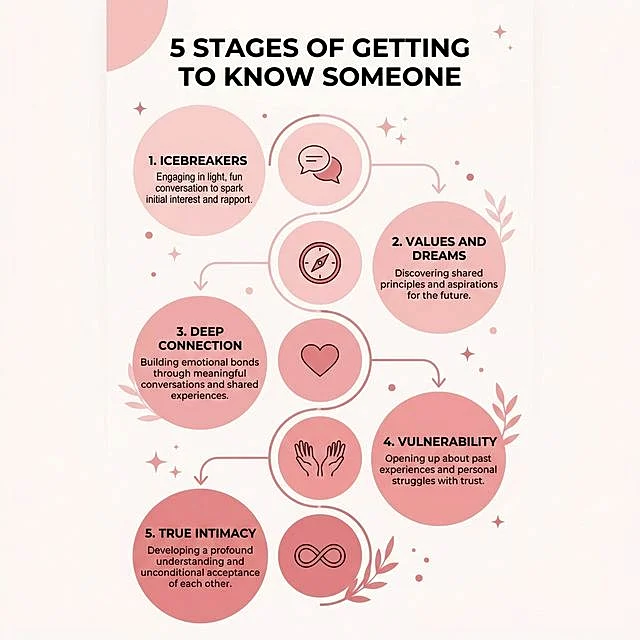
That's what this guide is about. Whether you're looking for questions to ask a guy you just matched with, questions to ask a girl on a first date, or simply better ways to connect with the people already in your life, you're in the right place. These aren't random conversation starters pulled from a hat — they're organized into a deliberate progression that mirrors how real intimacy develops, from playful curiosity to genuine vulnerability.
Let's start from the beginning.
Table of Contents
- Why Most Conversations Stay Shallow (And How to Fix It)
- The Psychology Behind Great Questions
- Stage 1: Warm-Up Questions That Don't Feel Generic
- Stage 2: Questions to Ask a Guy That Reveal Character
- Stage 3: Questions to Ask a Girl That Show Genuine Interest
- Stage 4: Going Deeper — Values, Dreams, and Fears
- Stage 5: Vulnerable Questions for People You Trust
- Stage 6: Fun "Would You Rather" Questions
- How to Use These Questions on Dating Apps
- Questions That Backfire (And What to Say Instead)
- The Overlooked Art of Listening
Why Most Conversations Stay Shallow (And How to Fix It)
Here's a pattern I've noticed — and I bet you have too. You meet someone new. You exchange the usual pleasantries. "Where are you from?" "What do you do?" "Have you been here before?" And somewhere between the third and fourth predictable answer, both of you quietly accept that this conversation will never go anywhere interesting.
It's not that either of you is boring. It's that you're following a script that was designed for politeness, not connection. And politeness, while lovely, is the enemy of intimacy.
The fix is surprisingly simple: ask questions that have unexpected answers.
Instead of "What do you do for work?" — which invites a rehearsed answer — try "What's something you're genuinely excited about right now?" Instead of "Where are you from?" try "What's a place that feels like home to you, even if you've never lived there?" The shift is subtle, but the responses you get will be completely different.
People want to be asked interesting questions. They want to share the parts of themselves that don't fit neatly into small talk. You just have to give them permission.
The Psychology Behind Great Questions
In 1997, psychologist Arthur Aron published a study that made headlines around the world. He took complete strangers, sat them across from each other, and had them ask each other a series of 36 increasingly personal questions. The result? Many of the pairs developed deep emotional bonds. One couple even got married.
What made those 36 questions so powerful wasn't the questions themselves — it was the structure. They started with safe, easy topics and gradually escalated to increasingly vulnerable territory. This progression created something psychologists call "reciprocal self-disclosure" — I share a little, you share a little, and the mutual vulnerability builds trust.
That's the framework I've used to organize this guide. The questions get progressively more personal as you go, mirroring the natural development of real relationships. You wouldn't ask a stranger about their deepest fear five minutes after meeting them. But after an hour of genuine back-and-forth? That question feels natural.
Three Principles That Make Any Question Better:
- Open-ended beats yes/no. "Do you like your job?" gets you a one-word answer. "What does a really good day at work look like for you?" opens a door.
- Specific beats vague. "Tell me about yourself" is overwhelming. "What's the most interesting thing that happened to you this month?" is manageable and inviting.
- Curious beats interrogative. There's a difference between questioning someone and being curious about them. The first feels like a job interview. The second feels like connection.
[INSERT IMAGE: art1_couple_cafe — Alt: "Couple having an engaging conversation at a bright modern cafe over coffee"]
Stage 1: Warm-Up Questions That Don't Feel Generic (1-30)
These are your opening moves. They're designed to feel natural and easy while still being more interesting than "So, what do you do?" Every question here is calibrated to reveal personality without requiring vulnerability — the conversational equivalent of a firm handshake.
Everyday Life
- What's the best thing that's happened to you in the last week?
- Are you a morning person or do you consider mornings a personal attack? And honestly, have you always been that way?
- What does your perfect Saturday look like, start to finish?
- What's the most interesting thing you've read, watched, or listened to recently?
- If you could pick up any skill overnight, no practice required, what would you choose?
- What's a food you could eat every single day and never get tired of?
- Mountains or ocean — and what is it about that choice that pulls you?
- Do you have a go-to "comfort" show that you rewatch when everything else feels like too much?
- What's on your bucket list right now?
- If you could live in any fictional universe, which one would you pick and why?
Personality Reveals
- How would your closest friend describe you to a stranger?
- Are you more of a planner or a let's-see-what-happens kind of person?
- What's a hidden talent or unusual hobby you have that most people don't know about?
- What's the most spontaneous thing you've ever done?
- Are you the type to read the reviews before trying a new restaurant, or do you prefer walking in blind?
- What's a song that's been stuck in your head lately?
- If you could have dinner with any person — alive, dead, fictional — who would it be and what would you ask them?
- What's your most unpopular opinion? The spicier, the better.
- Do you collect anything — intentionally or accidentally?
- What's the last thing that genuinely made you laugh out loud?
Lifestyle & Preferences
- Coffee or tea — and is this a hill you'd die on?
- What's the best gift you've ever received?
- If your life had a theme song, what would it be?
- What's a place you've visited that completely exceeded your expectations?
- Would you describe yourself as more creative or analytical?
- What's a small luxury you refuse to give up?
- Are you a "phone call" person or a "text me" person?
- What's the best concert, show, or live event you've ever been to?
- Do you prefer cooking at home or going out — and is there a story behind that preference?
- What's a hobby or interest you've picked up recently?
A note on pacing: Don't fire these off like a rapid-fire questionnaire. Pick one or two that feel right for the moment. When someone gives you an interesting answer, follow up on it naturally. "Wait, you lived in Japan for a summer? What was that like?" That follow-up question is usually more valuable than the next question on any list.
Stage 2: Questions to Ask a Guy That Reveal Character (31-65)
If you're trying to figure out whether a guy is worth investing your time in, these are the questions to ask a guy that will tell you what you actually need to know. Not surface-level facts, but the stuff that determines whether he'd be a good partner: his emotional depth, his values, and how he handles the messy parts of life.
Values & Priorities
- What's something you're genuinely proud of that has nothing to do with your career?
- What does your ideal life look like five years from now — and not the LinkedIn version, the real one?
- Who in your life do you admire most, and what specifically do you admire about them?
- What's a belief you held strongly in your twenties that you've since changed your mind about?
- If you had unlimited resources, what problem in the world would you try to solve first?
- What was the most important lesson your parents taught you — intentionally or not?
- How do you define success? Has that definition shifted over the years?
- What's a value you hold that you'd never compromise on, even if it made your life harder?
- Do you think ambition is overrated, underrated, or properly rated?
- What's something you wish more people took seriously?
Emotional Intelligence
- How do you usually process stress — do you talk it out, go quiet, get active, or something else?
- What's the hardest thing you've had to deal with in the last few years, and what got you through it?
- Are you the kind of person who confronts conflict directly, or do you need time to think first?
- What's a relationship — romantic or otherwise — that taught you the most about yourself?
- How do you handle it when you realize you were wrong about something?
- What's a fear that you've worked hard to overcome?
- Do you find it easy to ask for help, or is that something you struggle with?
- What does loyalty mean to you in practical, everyday terms?
- Have you ever had a friendship end, and how did you handle it?
- What's an emotion you find difficult to express, and why do you think that is?
Relationship Approach
- What does a healthy relationship look like to you on a random Tuesday evening?
- What's the most important lesson you've taken from a past relationship?
- How do you show someone you care — words, actions, gifts, quality time, or something else entirely?
- What's a deal-breaker for you in relationships that other people might find surprising?
- What role does independence play in your ideal relationship?
- Do you think love is something that happens to you, or something you actively build?
- How important is it to you that your partner gets along with your friends and family?
- What's something a partner has done for you that made you feel genuinely understood?
- How do you handle disagreements — and do you think the way you handle them needs work?
- What does trust look like to you, and how long does it usually take you to build it?
Why these questions matter: Anyone can be charming for an hour. These questions reveal patterns — how someone treats difficulty, whether they've done the internal work of understanding themselves, and whether their relationship style is compatible with yours. Pay less attention to what they say and more attention to how they say it. Thoughtfulness is the signal. Deflection is the red flag.
Stage 3: Questions to Ask a Girl That Show Genuine Interest (66-100)
The biggest mistake guys make when trying to get to know a woman? Asking questions that are really just about themselves. "What do you look for in a guy?" sounds like you're fishing for validation. "What kind of life are you trying to build?" shows you care about her as a whole person.
Here are questions to ask a girl that demonstrate genuine curiosity about who she is — not just whether she's interested in you.
Her World
- What's something you're really excited about in your life right now?
- What's a passion project or dream you're secretly working on?
- If you could relive any period of your life — not to change it, just to experience it again — which would you choose?
- Who's the most influential person in your life, and what did they teach you?
- What's a compliment you received once that really stayed with you?
- What's something you're working on improving about yourself right now?
- If you wrote a memoir, what would the title be?
- What's a challenge you've overcome that shaped who you are today?
- What does rest look like for you — do you recharge alone or with people?
- What's a tradition — from your family or one you've created — that means a lot to you?
Her Perspective
- What's a book, show, or movie that changed the way you think about something?
- What's an opinion you hold that people always want to argue with you about?
- If you could change one thing about how society works, what would it be?
- What's something you wish you'd learned earlier in life?
- Do you think vulnerability is a strength or a risk — or both?
- What's a cause or issue you care deeply about?
- How do you make decisions when you're torn — gut feeling, logic, advice from others, or a combination?
- What's a lesson you wish every child grew up learning?
- What does confidence mean to you? Not the dictionary definition — your personal version.
- What's a misconception people often have about you?
Connection & Relationships
- What does your ideal relationship feel like — not look like, but feel like?
- What makes you feel most appreciated in a relationship?
- How do you know when you can trust someone?
- What's the most romantic thing you've ever experienced — real life or fiction?
- Do you believe in soulmates, or do you think great relationships are built rather than found?
- What's a green flag that instantly makes you more interested in someone?
- How important is humor to you in a relationship — and what kind of humor?
- What does partnership mean to you in practical, everyday terms?
- What's a relationship habit you think every couple should have?
- If you could describe your love language in your own words (not just the official five), what would you say?

Stage 4: Going Deeper — Values, Dreams, and Fears (101-140)
By now, you've built enough rapport to venture into more personal territory. These questions to ask to get to know someone on a deeper level are about the things that keep us up at night and get us out of bed in the morning — the stuff that reveals who we really are beneath the social mask we all wear.
Dreams & Ambitions
- What's a dream you've been carrying around that you haven't told many people about?
- If you could wake up tomorrow having gained one quality or ability, what would it be?
- What felt like a failure at the time but turned out to be the best thing that happened to you?
- What would your perfect day look like if you had no obligations whatsoever?
- What's something you want to accomplish in the next year that scares you a little?
- If you could send a message to your future self, what would it say?
- What's a risk you took that paid off in ways you didn't expect?
- What gives your life meaning on the days when nothing particularly exciting happens?
- If success was guaranteed, what would you attempt?
- What's a version of your life that didn't happen, and do you ever wonder about it?
Values & Beliefs
- What's a principle you live by, even when it's inconvenient?
- What do you think is the most important quality a person can have?
- What's something you used to judge in others that you now understand differently?
- How has your idea of happiness changed as you've gotten older?
- What's a hard truth you've had to accept about yourself?
- Do you think people fundamentally change, or do they just learn to manage who they are?
- What's something you believe that most people around you don't?
- When you think about the legacy you want to leave, what comes to mind?
- What's the kindest thing you've ever done that nobody knows about?
- How do you decide what's worth fighting for and what's worth letting go?
Fear & Vulnerability
- What's a fear you've never fully admitted out loud?
- What does vulnerability feel like to you — risky, freeing, or something else entirely?
- When was the last time you felt genuinely out of your depth, and what did you do?
- What's a mistake you've made that you think about more than you probably should?
- How do you cope when life doesn't go according to plan?
- What's a part of yourself you're still learning to accept?
- Have you ever had your entire worldview shifted by a single experience?
- What's the bravest thing you've ever done, even if nobody else would recognize it as bravery?
- What's an emotional pattern you've noticed in yourself that you're trying to change?
- If you could go back and have one conversation with someone — living or gone — who would it be and what would you say?
Stage 5: Vulnerable Questions for People You Trust (131-160)
I want to be clear: these questions are not for first dates. They're for the conversations that happen at 2 AM with someone you already trust — the ones where the pretense drops and two people are just being completely honest with each other. Handle with care.
- What's a version of yourself you had to leave behind in order to grow?
- Is there a wound from your childhood that still shows up in your adult relationships?
- What's the loneliest you've ever felt, and what did you learn from it?
- Do you think you've been loved the way you need to be loved?
- What's the biggest sacrifice you've made for someone, and was it worth it?
- What do you think about when you can't sleep?
- If you could heal one thing about your past, what would it be?
- What's a conversation you need to have but keep avoiding?
- What does forgiveness mean to you — and is there someone you haven't been able to forgive?
- What do you need from people that you find hardest to ask for?
- Have you ever stayed in a situation too long because you were afraid of what leaving meant?
- What's the most important thing you've learned about love?
- What do you think is your biggest strength that also happens to be your biggest weakness?
- When do you feel most like the real version of yourself?
- If you could guarantee your children one thing in life, what would it be?
- What's a truth about relationships that people don't talk about enough?
- Do you ever feel like you're performing a version of yourself that isn't quite real — and if so, when is that most true?
- What makes you feel safe in a relationship?
- What's the most generous interpretation you've given someone's behavior, and were you right?
- If you knew this was the last conversation you'd ever have, what would you want to talk about?
Stage 6: Fun "Would You Rather" Questions (161-200)
Because not every conversation needs to be deep. Sometimes the most meaningful connections are built in moments of pure, silly fun.
- Would you rather always have to speak your mind or never be able to speak again?
- Would you rather travel to the past or the future?
- Would you rather give up music or movies for the rest of your life?
- Would you rather have the power to fly or the power to become invisible?
- Would you rather live in a world without coffee or a world without WiFi?
- Would you rather know how your story ends or keep it a surprise?
- Would you rather be the funniest person in the room or the smartest?
- Would you rather live in a cabin in the mountains or a flat overlooking the ocean?
- Would you rather have ten close friends or one thousand acquaintances?
- Would you rather cook a romantic dinner or be cooked a romantic dinner?
- Would you rather be able to read minds or predict the future?
- Would you rather be famous worldwide or deeply respected in your field?
- Would you rather never use social media again or never watch TV again?
- Would you rather always be slightly overdressed or slightly underdressed?
- Would you rather forget your past or never be able to make new memories?
- Would you rather relive your happiest day or undo your worst mistake?
- Would you rather have the ability to speak every language or play every instrument?
- Would you rather live in a world where everyone is honest or a world where no one can be mean?
- Would you rather find true love today or achieve lifelong financial security tomorrow?
- Would you rather always know when someone is lying or always get away with lying?
- Would you rather explore outer space or the deep ocean?
- Would you rather have a rewind button or a pause button for your life?
- Would you rather be the hero or the villain in a movie about your life?
- Would you rather have one wish granted today or three wishes granted in ten years?
- Would you rather give up your smartphone or your pet for a year?
- Would you rather be stuck in an elevator with your ex or your boss?
- Would you rather always win arguments or never have them?
- Would you rather know the date of your death or the cause?
- Would you rather live without heating or without air conditioning?
- Would you rather be remembered for your intelligence or your kindness?
How to Use These Questions on Dating Apps
Let's be practical. Most modern relationships start with a match notification, not a meet-cute in a bookstore. And the biggest challenge on dating apps isn't getting matches — it's turning those matches into actual conversations that go somewhere.
Here's what works:
Opening Messages That Get Responses
Forget "Hey." Forget "What's up?" Forget anything that could be sent to literally anyone without modification. The best opening messages reference something specific from their profile and ask a genuine question:
- "I noticed you're into hiking — what's the best trail you've ever done?"
- "Your taste in music is incredible. If you had to pick one album to live with forever, which one?"
- "Okay, this is important: what's your most controversial food opinion?"
Transitioning Past Small Talk
After a few exchanges, level up naturally:
- "So what are you passionate about outside of work? I'm curious what makes people light up."
- "What's the most interesting thing that's happened to you this year?"
- "If you could do anything for a living and money didn't matter, what would you choose?"
Knowing When to Meet
Here's the golden rule: don't text forever. After 15-20 quality messages, suggest meeting in person. "This conversation is too good for a screen. Coffee this week?" If they're on the same page, they'll say yes. If they're not, no amount of texting will change that.
And of course, all of this works best on a platform where you know you're talking to real people. On LoveConnet, every profile is verified through AI face recognition — so you can focus on building genuine conversations instead of wondering if the person on the other end is even real. No catfishing, no surprises, just authentic people looking for real connections.
Questions That Backfire (And What to Say Instead)
❌ "Why are you single?"
This implies there's something wrong with them for being single. It puts them on the defensive immediately.
Say instead: "What are you hoping to find in your next relationship?"
❌ "How many people have you dated?"
This creates comparison and judgment where there should be curiosity.
Say instead: "What's the most important thing you've learned about relationships?"
❌ "What's your body count?"
Just... no. At any stage of getting to know someone.
Say instead: Nothing. This question doesn't need a replacement.
❌ "Do you want kids?" (on a first date)
Important topic, completely wrong timing. This is a conversation for when you've established mutual interest and are exploring long-term compatibility.
Say instead: "Where do you see yourself in a few years?" This naturally surfaces major life plans without the pressure.
The Overlooked Art of Listening
I saved this for last because it's the most important section in this entire guide. You can have the best questions in the world, but if you don't know how to listen, they're worthless.
Real listening isn't waiting for your turn to speak. It's not planning your next question while they're still answering the current one. It's being fully present with another person — noticing not just their words, but their tone, their pauses, their body language, and the emotions underneath what they're saying.
Five Listening Habits That Transform Connections
- Put your phone away. Not face-down on the table. Not on silent in your pocket. Away. In your bag, in your coat, somewhere that signals "you have my undivided attention." In 2026, this is genuinely one of the most romantic things you can do.
- Ask follow-up questions. This is the difference between an interviewer and a conversationalist. When they mention something interesting, go deeper. "You spent a summer in Portugal? What drew you there?" Follow-ups prove you're not just collecting answers — you're genuinely interested.
- Reflect what you hear. "It sounds like that experience really changed how you think about trust." When someone feels understood — not just heard, but understood — they open up in ways they normally wouldn't.
- Sit with silence. Not every pause needs to be filled. Sometimes the most powerful thing you can do after someone shares something meaningful is just... be quiet for a moment. Let it breathe. Let them know that what they said landed.
- Remember the details. Mentioning something they told you three weeks ago — their mother's name, the promotion they were nervous about, the book they couldn't put down — tells someone that they matter to you beyond this single conversation. That's not a listening technique. That's love.
Reading Body Language: What Words Don't Tell You
Here's something that took me years to understand: the most important answers aren't spoken. They're shown. When you ask someone a question and they lean in, uncross their arms, and make eye contact — their body is saying "I trust you enough to be open right now." When they pull back, look at their phone, or give a short, clipped answer — their body is saying "I'm not ready for this level of conversation yet." Learning to read these signals is just as important as knowing which questions to ask.
Signs They're Engaged and Comfortable
- Leaning in. When someone tilts their body toward you during a conversation, it's one of the most reliable indicators of interest and comfort. It means they want to be closer to what you're saying — both metaphorically and literally.
- Mirroring. If you notice them copying your gestures — touching their face when you touch yours, crossing their legs when you cross yours, lifting their drink when you lift yours — that's mirroring. It's a subconscious signal of rapport that our brains perform when we feel connected to someone.
- Eye contact. Not staring — that's a different thing entirely. Comfortable, natural eye contact that breaks and returns. If someone is holding your gaze during their answer, they're investing in the conversation. They want you to hear them.
- Expanding their answers. When someone gives you more than you asked for — "Well, it's funny you ask that, because actually there's a whole story behind it..." — they're signaling that they feel safe enough to share. That's the ultimate green flag.
- Touching their own face or neck. Research in nonverbal communication suggests that people unconsciously touch their face more frequently when they're interested in the person they're talking to. It's a self-soothing behaviour that indicates elevated emotional engagement.
Signs They Want to Change the Subject
- Short answers. "Yeah, I guess." "Not really." "I dunno." These are conversational speed bumps. They're not invitations to push harder — they're gentle requests to redirect.
- Checking their phone or looking around. Their attention is divided, which means the topic isn't landing. Don't take it personally. Just pivot gracefully.
- Crossed arms and leaning back. Physical barriers are emotional barriers made visible. This person is protecting themselves from a level of intimacy they're not ready for.
- Redirecting the question. "What about you, though?" When someone turns every question back on you without answering it themselves, they might be uncomfortable sharing — or they might just need more trust-building first.
- Nervous laughter. A laugh that doesn't match the content of the conversation is often a signal of discomfort. If you ask something deep and get a deflective chuckle, take the hint and lighten up.
The key takeaway: adapt your questions to what you're seeing, not just what you planned to ask. The best conversationalists aren't people who stick to a script. They're people who read the room and adjust in real time.
Questions by Setting: The Right Question for the Right Moment
Not every question works in every setting. A question that's perfect for a quiet dinner is completely wrong for a noisy party. Here's a context-aware guide that matches the right questions to ask to get to know someone with the right environment.
First Date at a Coffee Shop
The vibe is casual and time-limited. You want questions that are interesting enough to stand out from every other first date they've had this month, but light enough that nobody feels interrogated. Stick to Stage 1 and early Stage 2 questions.
Best questions for this setting:
- "What's the most interesting thing that's happened to you this year?"
- "If you had to teach a class on absolutely anything, what would you teach?"
- "What's a travel experience that completely exceeded your expectations?"
- "What does your perfect weekend look like — be specific?"
Why these work: They're open-ended, they reveal personality, and they give the other person room to tell stories. Stories are the engine of connection on a first date — not facts, not résumé items, not interview-style interrogations. Stories.
Dinner Date (Second or Third Date)
You've already established basic compatibility. Now you want to go a layer deeper without jumping to ominously serious territory. This is where emotional intelligence questions shine.
Best questions for this setting:
- "What's a belief you held five years ago that you've completely changed your mind about?"
- "How do you usually handle conflict — are you the type to address it right away or process alone first?"
- "What's the most important relationship lesson you've learned so far?"
- "What does a really good day at work look like for you versus a bad one?"
Road Trip or Long Drive
Road trips are question goldmines. You have uninterrupted time, no eye contact pressure (you're both looking at the road), and the natural pauses that come with driving. This is where deeper questions feel organic.
Best questions for this setting:
- "What's a version of your life that almost happened but didn't?"
- "If you could send a message to your 20-year-old self, what would you say?"
- "What's a fear you've been carrying that you've never really talked about?"
- "What gives your life meaning on ordinary days — not the highlights, the regular ones?"
Group Setting or Party
This isn't the place for deep dives. But it IS a perfect opportunity to use questions as group activities — "Would You Rather" games, hypothetical scenarios, or playful debates that reveal personality through participation style.
Best questions for this setting:
- "Everyone in this group: if you could have dinner with any three people, living or dead, who would you pick?"
- "Hot take: is cereal a soup? Everyone has to commit to a position."
- "What's the most underrated movie of the last ten years? We're settling this now."
- "Two truths and a lie — go. We're going around the table."
Late Night — Just the Two of You
There's something about darkness and quiet that makes people honest. Late-night conversations are where walls come down and real intimacy happens. If the moment is right, don't be afraid of the vulnerable questions in Stage 5.
Best questions for this setting:
- "What do you think about when you can't sleep?"
- "Is there a version of yourself you've outgrown but still miss sometimes?"
- "What's the most important thing you've learned about love — not from a book, from experience?"
- "If you could heal one thing about your past, what would it be?"
The Neuroscience of Connection: Why Certain Questions Create Bonds
I want to take a moment to explain why this works on a neurological level — because understanding the science makes you better at applying it.
When someone shares something personal with you, their brain releases oxytocin — the same hormone released during physical touch, breastfeeding, and orgasm. It's literally the "bonding chemical." And here's the remarkable part: your brain releases oxytocin too, just from listening. The act of being trusted with someone's story creates a chemical bond in both people simultaneously.
This is why a vulnerable conversation can feel more intimate than a kiss. Because neurologically, it is. Your brains are literally synchronizing. Research from Princeton University has shown that when two people are engaged in deep conversation, their neural patterns begin to mirror each other — a phenomenon called "neural coupling." The listener's brain activity starts to predict the speaker's brain activity, creating a shared mental state that feels like genuine understanding.
This is also why the progression of questions matters so much. You can't skip to oxytocin-level vulnerability without first building a foundation of safety and trust. The shallow questions aren't wasted time — they're laying the neurological groundwork for the deep questions to land.
The 36 Questions Experiment Revisited
Remember Arthur Aron's study from the beginning of this article? Here's what most people don't know about that experiment: it wasn't just the questions. The structure included a specific element that amplified the bonding effect — sustained mutual eye contact. After answering all 36 questions, participants were asked to look into each other's eyes for four minutes in complete silence.
Four minutes sounds short. Try it. It feels like an eternity. And it creates an intimacy so intense that many participants described it as one of the most powerful emotional experiences of their lives.
You don't need to stare into a stranger's eyes for four minutes (please don't). But the principle is important: presence amplifies connection. When you combine thoughtful questions with genuine attention, you create conditions for bonding that most people experience only a handful of times in their entire lives.
Questions for Long-Distance Relationships
Long-distance relationships present a unique challenge: you have to build and maintain intimacy entirely through conversation. You can't rely on physical presence, shared activities, or the comfort of proximity to keep the connection alive. Everything depends on the quality of your communication.
This is actually where strong questions to ask to get to know someone become absolutely essential — they're not just nice-to-haves, they're the infrastructure your relationship is built on.
Daily Connection Questions
Replace the boring "How was your day?" with:
- "What made you smile today — even if it was small?"
- "What was the hardest part of today, and how did you handle it?"
- "What are you looking forward to tomorrow?"
- "If I were there right now, what would we be doing?"
- "What's something you noticed today that reminded you of me?"
Weekly Deep Dive Questions
Set aside one evening a week for a deeper conversation. These keep the relationship from becoming a daily logistics report:
- "What's something you've been thinking about a lot lately that you haven't mentioned?"
- "How are you feeling about us — honestly — right now?"
- "What's something I could do from here to make you feel more loved?"
- "What's a memory of us that you keep coming back to?"
- "Is there a conversation we've been putting off that we should probably have?"
Fun Long-Distance Activities
Questions don't have to be serious to build connection. Turn them into activities:
- "Would You Rather" marathon: Set a timer for twenty minutes and rapid-fire "Would You Rather" questions back and forth. It's silly, it's energizing, and it creates shared laughter — which is the currency of long-distance love.
- Two Truths and a Lie: Even if you think you know everything about each other, this game has a way of surfacing stories you've never heard. "Wait, you were actually a competitive yo-yo player?!"
- Question jar: Both of you write ten questions and put them in virtual jars (Google Docs work fine). Take turns pulling questions during video calls.
- Simultaneous activity + question: Both cook the same recipe while on video call and ask questions during the cooking. The shared activity creates the feeling of physical togetherness that long-distance lacks.
Questions for Couples Who've Been Together for Years
Here's a paradox that every long-term couple encounters: the person you've spent years getting to know can start to feel unknowable. Not because they've become a stranger, but because you've stopped being curious. You've settled into patterns. You've assumed you already know the answers. And those assumptions create distance that neither of you notices until the gap feels uncrossable.
If you're in a long-term relationship and want to reconnect — or simply deepen what's already good — these questions are for you.
Rediscovery Questions
- "What's something you've started wanting recently that you didn't want a year ago?"
- "Is there a part of yourself you feel like I don't fully understand?"
- "What's the best thing I've done for you in the last month — and what's something I could do more of?"
- "What makes you feel most connected to me? And has that changed over time?"
- "If we were meeting for the first time today, would you still be attracted to me? What would stand out?"
- "What's a dream you've been developing quietly that we haven't talked about yet?"
- "How has your idea of a perfect day changed since we first got together?"
- "Is there a conversation we had early in our relationship that you think about sometimes?"
- "What's an area of your life where you feel like you're growing right now?"
- "If our relationship were a book, what chapter are we in — and what do you hope happens next?"
Maintenance Questions (Ask Monthly)
- "On a scale of 1 to 10, how connected do you feel to me this week? What would move it one point higher?"
- "Is there anything small bothering you that feels too trivial to bring up — but is on your mind?"
- "What's something I used to do at the beginning of our relationship that you wish I still did?"
- "How can I better support you in the thing that's stressing you out right now?"
- "When was the last time we really, genuinely laughed together — and how can we have more of those moments?"
A tip for long-term couples: Schedule a weekly or monthly "state of the relationship" check-in. Not because something is wrong — but because maintenance is what keeps things from going wrong. The couples who last aren't the ones who never have problems. They're the ones who address small issues before they become big ones. And regular, honest conversation is how you do that.
Cultural Sensitivity: Asking Questions Across Backgrounds
In an increasingly connected world, you might be dating someone from a different cultural background than your own. This adds richness and complexity to the getting-to-know-you process — and it also requires extra thoughtfulness.
Questions That Bridge Cultural Differences
- "What's a tradition from your culture that means a lot to you?"
- "Is there something about your upbringing that you think people from other backgrounds often misunderstand?"
- "What does family mean in your culture — and how does that shape what you want from a relationship?"
- "What's a food, festival, or custom from your culture that you'd love to share with me?"
- "How do you think your cultural background has shaped how you express love?"
What NOT to Ask
- "Where are you really from?" — If someone says "London," don't push for a different answer. This question, while often well-intentioned, communicates that you don't accept them as being from where they say they're from.
- "You don't seem like you're from [country]." — What does someone from any country "seem like"? This reveals more about your assumptions than their identity.
- "Is that a cultural thing?" — People are individuals first. Sometimes their preferences are personal, not cultural. Ask about them as a person, not as a representative of a demographic.
The best approach: be curious about their individual experience, not their category. "What was it like growing up in your household?" is always better than "What's it like being [nationality/ethnicity]?"
The Ten Most Common Conversation Mistakes (And Expert Fixes)
Even with the perfect list of questions, there are mistakes that can derail any conversation. I've made all of them. Multiple times. Here they are so you don't have to:
1. Making It a Monologue
The mistake: You ask a question, they give a brief answer, and you jump in with a five-minute story about your own experience. Then you ask another question and do the same thing.
The fix: Follow the 70/30 rule. The other person should be talking 70% of the time. Your job is to listen, follow up, and keep them talking. The conversation should feel like a spotlight on them, not a tennis match where you're trying to win every rally.
2. Asking Two Questions at Once
The mistake: "What do you do for work and do you enjoy it?" People almost always answer the second question and forget the first. It creates cognitive overload.
The fix: One question at a time. Let it breathe. Let them answer fully. Then decide whether to follow up or move to the next topic.
3. Immediately Relating Everything to Yourself
The mistake: "Oh, you love hiking? Yeah, I hiked the Appalachian Trail in 2019. It was incredible. Let me tell you about it." This hijacks their story and makes the conversation about you.
The fix: Acknowledge first, ask second. "You love hiking! What's the most challenging trail you've done?" You can share your own experience later — after you've fully explored theirs.
4. Asking Questions You Don't Actually Care About
The mistake: Going through a list mechanically without genuine interest. People can feel when a question is performative versus authentic.
The fix: Only ask questions whose answers you actually want to hear. If a topic doesn't interest you, skip it. Authentic curiosity is magnetic. Fake curiosity is transparent.
5. Ignoring Emotional Cues
The mistake: Someone shares something emotionally significant — "My dad passed away last year" — and you immediately move to the next question without acknowledging what they just said.
The fix: Pause. Acknowledge. "I'm sorry to hear that. That must have been really hard." Then let them decide whether they want to go deeper or move on. The space you create after a vulnerable moment matters more than the next question.
6. Interrogation Mode
The mistake: Rapid-firing questions without sharing anything about yourself. It stops feeling like a conversation and starts feeling like a job interview — or worse, a police interrogation.
The fix: Balance asking with sharing. After they answer two or three questions, share something about yourself. "That's interesting — I actually had a similar experience when..." This creates reciprocal vulnerability, which builds trust faster than one-directional questioning ever will.
7. Going Too Deep Too Fast
The mistake: Asking "What's the most painful thing that's ever happened to you?" five minutes into a first date. The question isn't wrong — the timing is.
The fix: Trust the stages. Build from light to deep organically. If someone isn't ready for depth, they'll signal it through short answers and topic changes. Respect those signals.
8. Not Following Up
The mistake: Someone gives a fascinating answer and you move to a completely unrelated topic. "I spent three years living on a sailboat." "Cool. So, do you have any siblings?"
The fix: Always follow up on interesting answers. "Wait — you lived on a sailboat? How did that happen? What was that like?" The follow-up is almost always more valuable than the next prepared question.
9. Trying to Be Impressive Instead of Genuine
The mistake: Choosing questions designed to make you seem smart or worldly rather than questions designed to understand the other person.
The fix: Drop the performance. Nobody falls in love with someone who's trying to impress them. They fall in love with someone who makes them feel seen. Focus outward, not inward.
10. Filling Every Silence
The mistake: Treating silence as failure and rushing to fill every pause with noise.
The fix: Silence isn't empty — it's full of processing. When someone pauses after a meaningful question, they're thinking. They're deciding how honest to be. That pause is the sound of someone considering whether to let you in. Don't ruin it with noise. Let it happen. When they speak after a real pause, what they say will be more genuine than anything they'd have said if you'd rushed them.
Real Scenarios: How These Questions Work in Practice
Theory is great, but I want to show you exactly how these questions work in real conversations. Here are three scenarios with commentary:
Scenario 1: First Date at a Coffee Shop
You: "So what's something you're genuinely excited about in your life right now?"
Them: "Hmm, that's a good question. I actually just started learning pottery. It's been amazing."
You: "Pottery? That's so specific. What drew you to it?"
Them: "I think I needed something physical. I work at a desk all day and I missed making things with my hands."
You: "I totally get that. There's something grounding about creating something physical. What's the best thing you've made so far?"
Why this works: Notice there's no script. You asked one question and then followed the natural thread of the conversation. The follow-ups emerged organically from genuine curiosity. This is what great conversation actually looks and sounds like — not a prepared list, but one good question followed by real listening and natural follow-ups.
Scenario 2: Third Date — Deeper Territory
You: "What's the most important lesson a past relationship taught you?"
Them: [Pauses for a moment] "That I tend to lose myself in relationships. I become so focused on making the other person happy that I forget what I need."
You: [Silent for a beat, letting that land] "That's really self-aware. How has knowing that changed how you approach things now?"
Them: "I'm a lot more intentional about boundaries. I used to think boundaries meant you didn't love someone enough. Now I think they're actually how you protect the love."
Why this works: The pause after their vulnerable answer is crucial. It signals that you received what they said — that it mattered. The follow-up asks them to go deeper without being invasive. And their response tells you something genuinely important about who they are and how they've grown: someone who's done the work of self-reflection.
Scenario 3: Long-Term Couple — Reconnecting
You: "Hey, when was the last time you felt like we really, truly connected? Like, the kind of moment where you felt completely seen?"
Them: "Honestly? It's been a while. Not because anything's wrong — we've just been really busy."
You: "Yeah, I feel that too. What would it take for us to have more of those moments?"
Them: "Maybe just... time without screens. Like, actually being present with each other."
You: "Then let's do that. Right now. Phone goes in the drawer. What do you want to talk about?"
Why this works: This is the power of asking a brave question in a long-term relationship. You're not criticizing. You're not complaining. You're saying, "I want more of us." That's not a problem to solve — it's an invitation. And the practical action at the end — phone in the drawer, right now — turns a good conversation into a real moment.
The Science of Vulnerability: Why Hard Questions Create Deeper Bonds
Dr. Brené Brown's research at the University of Houston has fundamentally changed how we understand connection. Her work reveals that vulnerability — the willingness to be emotionally exposed — is not a weakness. It's the birthplace of love, belonging, and joy. When you ask someone a question to get to know someone deeply, you're creating a moment of shared vulnerability that physically changes both of your brains.
The Neuroscience of Shared Vulnerability
When two people engage in mutually vulnerable conversation, their brains begin to synchronize. A Princeton University study using fMRI scans found that during meaningful conversation, the listener's brain activity begins to mirror the speaker's — a phenomenon called "neural coupling." The deeper the conversation, the stronger the coupling. This means that when you ask a meaningful question and listen intently to the answer, your brains are literally aligning. You're not just connecting metaphorically — you're connecting neurologically.
The Reciprocity Effect
Social psychology research consistently demonstrates the "reciprocity of self-disclosure." When you share something personal, the other person feels compelled to match your level of openness. This creates an escalating cycle of vulnerability that can build remarkable intimacy in a relatively short time. The Arthur Aron "36 Questions" study proved this dramatically — strangers who asked each other progressively deeper questions reported feeling closer after 45 minutes than many people feel after years of surface-level friendship.
The practical implication? If you want deeper conversations, you have to go first. Share something honest about yourself, then ask a question that invites the same depth. "I've been feeling really disconnected from my purpose lately. What gives your life meaning?" is infinitely more connecting than "How's your week going?"
Why Discomfort Is Actually a Good Sign
If a question makes you slightly uncomfortable to ask, it's probably worth asking. That discomfort is your ego trying to protect you from vulnerability. But vulnerability is exactly where connection lives. The conversations that feel the safest — weather, surface gossip, logistical updates — are the ones that build the least intimacy. The ones that make your palms slightly sweaty are the ones that change relationships.
Questions Tailored to Personality Types
Not everyone responds to the same types of questions. Understanding personality differences can help you tailor your approach to get the best, most authentic responses.
For Introverts
Introverts process internally before speaking. They need time and space to formulate their thoughts, and they often feel pressured by rapid-fire question sequences. Here's how to adapt:
- Ask one question at a time and give them space to answer fully before moving on. Resist the urge to fill silences with follow-up questions.
- Use "thinking" questions. "What's something you've been reflecting on lately?" gives them an invitation without demanding an immediate, definitive answer.
- Follow up later. "You mentioned something yesterday about feeling stuck at work. I've been thinking about that. How are you feeling about it now?" Introverts appreciate when you remember their words and return to them thoughtfully.
- Written questions can be gold. Some introverts express themselves more freely in writing. Texting a thoughtful question and saying "no rush on answering — I'd love to hear your thoughts whenever you're ready" honours their processing style.
For Extraverts
Extraverts think out loud and process through conversation. They thrive on energy exchange and can sometimes dominate conversations if not gently guided.
- Ask open-ended questions that invite stories. "Tell me about the craziest thing that happened to you this month" gives them room to unfold a narrative.
- Don't be afraid to redirect. "That's fascinating — but I'm curious about the emotional side. How did that actually make you feel?" helps them move from the surface level (events, facts) to the depth (feelings, values).
- Match their energy. Extraverts feel most connected when the conversation has a lively, reciprocal flow. Share your own stories. React visibly. Laugh. Engage. They need to feel your participation, not just your attention.
For Analytical Thinkers
Some people approach everything through logic and reason. They may struggle with abstract emotional questions but light up with questions that have structure.
- Frame questions with context. Instead of "What do you value most?", try "If you could optimise your life for one thing, what would you choose and why?" The framing gives them a framework to reason through.
- Ask "how" and "why" more than "what." Analytical thinkers love explaining their reasoning. "Why do you think you react that way in arguments?" invites the kind of self-analysis they enjoy.
For Creative/Intuitive Types
Creative personalities respond to imaginative, hypothetical, and philosophical questions far more than practical ones.
- Ask hypotheticals. "If you could live in any fictional universe, which would you choose?" or "What would you create if money and time were unlimited?" These questions feel like play, not interrogation — and creative types will give you their most authentic selves through play.
- Explore their inner world. "What's a thought that keeps coming back to you?" or "Describe your ideal day in vivid detail" opens doors to understanding how they experience reality.
Mastering Digital Conversations: Questions That Work Over Text
In 2026, a huge percentage of early-stage relationship conversations happen over text, DM, or dating app messages. The rules for digital questions to ask a guy or questions to ask a girl are different from in-person conversation — and most people get them wrong.
Why Most Text Conversations Die
The number one reason text conversations fizzle: questions that are too easy to answer with one word. "How was your day?" gets "Fine." "What are you up to?" gets "Not much." These aren't bad questions — they're just too low-effort to sustain a conversation. Over text, you need questions that are specific enough to demand a real answer but casual enough not to feel like an interrogation.
Text Questions That Actually Work
- "Okay, serious question: what's the most controversial food opinion you hold?" (Light, fun, invites personality)
- "I need a recommendation — what's the last show that genuinely surprised you?" (Collaborative, easy to respond to)
- "Random thought experiment: if you could master any skill overnight, what would you pick and what's the first thing you'd do with it?" (Creative, engaging, reveals priorities)
- "I read something interesting today about how most people's favorite memories involve food. What's a meal you remember vividly and why?" (Specific, sensory, invites storytelling)
- "Real talk — what's something you're genuinely excited about right now?" (Direct but positive, invites enthusiasm)
Text Conversation Rules
- One question per message, max. Multiple questions in one text overwhelm people and usually result in only the last question being answered.
- React to their answers before asking the next question. Don't just rapid-fire queries. Respond to what they said — share your own answer, add a comment, show that you absorbed their response before moving on.
- Know when to move to voice or video. Text is great for building initial rapport, but at some point, you need to hear each other's voices. Tone, laughter, and vocal warmth transmit trust in ways text simply can't. If the text conversation has been flowing for a week, suggest a phone or video call.
- Don't over-text. Leave some mystery. Leave some space. The goal isn't to have every conversation over text — it's to build enough interest that both people want to continue the conversation in person.
Questions Every Couple Should Revisit Annually
Relationships aren't static — they evolve constantly. The person you fell in love with two years ago has grown, changed, and developed in ways you might not fully understand unless you ask. That's why certain questions to ask to get to know someone aren't just for new relationships — they're essential maintenance for long-term ones too.
The Annual Relationship Audit
Once a year — on your anniversary, New Year's, or any date that feels meaningful — sit down with your partner and work through these questions together. Treat it like a check-in, not a confrontation. The goal is understanding, not evaluation.
- "What was the best moment in our relationship this year?" This starts the conversation with gratitude and reminds you both of what's working. It also reveals what your partner values most — which might surprise you.
- "What was the hardest moment, and how do you feel about how we handled it?" This creates space for honest reflection without blame. Notice the framing: "how do you feel about how WE handled it" — it's collaborative, not accusatory.
- "Is there anything you've been wanting to say but haven't?" This is the bravest question on the list. It invites radical honesty. And sometimes, the things left unsaid are the things that matter most. Giving your partner explicit permission to say the hard thing can prevent months of silent resentment.
- "What's one thing I could do differently that would make you feel more loved?" This is actionable, specific, and shows genuine investment in their experience of the relationship. Most people never ask this because they're afraid of the answer. But the answer is almost always something achievable — "I wish you'd put your phone away during dinner" or "I'd love it if you initiated date nights sometimes."
- "Where do you see us in one year? What does our best-case scenario look like?" This keeps you aligned on direction. If one person envisions moving to a new city and the other envisions staying put, better to discover that now than in six months when one of you has already started job searching.
- "What's something new you'd like us to try together?" Novelty is the antidote to routine. Whether it's a cooking class, a trip, a hobby, or simply a different date night format — shared new experiences keep the relationship feeling fresh and alive.
- "On a scale of 1-10, how connected do you feel to me right now? What would move it one point higher?" This quantifies something abstract and makes it actionable. It's not "Are we okay?" (which invites a vague "Yeah, fine"). It's a specific assessment with a specific follow-up.
The Conflict Resolution Question Framework
One of the most powerful applications of good questions is during conflict. Most couples fight by making statements at each other — accusations, defenses, counterattacks. But what if you replaced statements with questions? Here's a framework that therapists recommend.
Instead of "You never listen to me!"
Try: "Can you help me understand what you heard me say? Because I'm not sure my message landed the way I intended." This shifts from blame to curiosity. It assumes good intent and invites clarification rather than defensiveness.
Instead of "You don't care about my feelings!"
Try: "When [specific situation] happened, I felt [specific emotion]. Was that your intention? I want to understand your perspective." This uses the classic "I feel" framework but adds a genuine question that invites the other person into the conversation as a partner, not an opponent.
Instead of "Why do you always do this?"
Try: "I've noticed this pattern between us. Do you see it too? Can we figure out together why it keeps happening?" "Always" and "never" are conversation-killers. Identifying a pattern and inviting joint analysis turns a fight into a collaboration.
Instead of giving the silent treatment
Try: "I need some time to process what I'm feeling before we continue this conversation. Can we come back to this in an hour?" Silence feels punishing. A clear, respectful request for space feels mature. It communicates that you care about the conversation enough to approach it thoughtfully rather than reactively.
The Repair Question
After every conflict, once emotions have settled, ask: "What do we each need from the other to move forward from this?" This prevents unresolved conflicts from becoming permanent scar tissue. It acknowledges that repair is an active process, not something that just happens with time. Some people need an apology. Some need reassurance. Some need a changed behaviour. You won't know unless you ask.
Watch: The Power of Better Questions
For a visual guide on how asking the right questions can deepen your relationships, watch this popular video:
📺 10 Signs That You're a Hopeless Romantic — Psych2Go
Final Thoughts
I want to leave you with this: the best question you can ask someone is the one that makes them feel like their answer truly matters to you.
That's it. It's not about being clever or having the perfect list memorized. It's about genuine curiosity — the kind that says, "I see you. I want to understand you. And I'm willing to be quiet long enough to actually listen."
Whether you're swiping through profiles on a dating app, sitting across from someone at dinner, or lying next to the person you've loved for twenty years — never stop asking questions. Never stop being curious. Because the moment you stop trying to understand someone is the moment the relationship starts to drift.
And that's the real secret. Love doesn't die from big betrayals or dramatic blow-ups. It dies from indifference. From the slow erosion of curiosity. From two people who stopped asking each other, "How are you? No, really — how are you?"
Don't let that happen. Keep asking. Keep listening. Keep showing up.
For more dating advice, conversation starters, and relationship wisdom, explore the LoveConnet Blog. And if you're ready to meet real, verified people who are worth asking these questions to, start your journey on LoveConnet today.
Share this guide with someone who could use better conversations in their life. Follow us on Instagram, Facebook, and Pinterest for daily relationship tips.



💬 Discussion (0)
No comments yet. Be the first to share your thoughts!